Moving to Spain as an American: 9 Honest Costs & Visa Surprises (2026)
Some links on this site are affiliate links, which means the site may earn a commission at no extra cost to you. Services are included because they fit the move abroad process, not because of the commission.
At a Glance
- Main visa options: Spain Digital Nomad Visa, Non-Lucrative Visa, or Student Visa
- DNV income requirement: ~€3,256/month (200% of Spain’s minimum wage)
- Rent (1-bedroom, city center): €600–€900 outside Madrid/Barcelona; €1,200–€1,800 in major cities
- Required before arrival: Visa, NIE (foreigner ID number), private health insurance
- Path to residency: Yes — permanent residency after 5 years, citizenship at 10 years
- Tax note: Spain taxes worldwide income for residents; special expat regime may apply
- Top cities for Americans: Valencia, Málaga, Barcelona, Madrid, Alicante
📋 What’s In This Guide
- Visa and Residency Pathways for Americans
- How to Prepare for Your Move
- Cost of Living in Spain vs the US
- Choosing Where to Live
- Healthcare and Health Insurance in Spain
- Understanding Taxes as a US Expat
- Adjusting to Spanish Life and Culture
- Working and Studying in Spain
- Your 30/60/90-Day Spain Launch Plan
- Frequently Asked Questions
Spain has become one of the top destinations for Americans looking to live abroad. If you’re thinking about moving to Spain as an American, you’re joining a growing community—over 40,000 US citizens are already registered residents. The country offers a lower cost of living, excellent healthcare, and a relaxed lifestyle that values enjoying life over constant work. Over 40,000 US citizens are already registered as residents, and that number keeps growing. 
To move to Spain from the US, you’ll need a long-term visa like the Digital Nomad Visa or Non-Lucrative Visa, a NIE (foreigner ID number), and private health insurance. The visa you choose depends on your situation, whether you plan to work remotely, retire, or study. The process takes planning and paperwork, but it’s manageable when you know the steps. Making the move means navigating everything from visa applications to finding housing, understanding Spanish taxes, and adjusting to a new culture. This guide walks you through what you need to know to relocate successfully and start your new life in Spain.
Key Takeaways
- Americans need a long-term visa to stay in Spain beyond 90 days, with options including digital nomad and retirement visas
- Spain offers a lower cost of living and better work-life balance compared to most US cities
- You’ll need to prepare for healthcare enrollment, tax obligations in both countries, and cultural adjustments when settling in
Visa and Residency Pathways for Americans
 Americans can stay in Spain for up to 90 days without a visa, but moving permanently requires obtaining long-term residency through one of several pathways. Each option has different income requirements, documentation needs, and permissions for work.
Spain Digital Nomad Visa
The Digital Nomad Visa lets you live in Spain while working remotely for companies outside the country. You need to prove monthly income of at least €2,400 (about $2,600) or have an employment contract with a non-Spanish employer. This visa allows you to stay for up to five years and bring family members with you. You can also work for Spanish clients, but no more than 20% of your income can come from Spanish sources.
The application requires proof of remote work, health insurance, and a clean criminal record. You’ll pay Spanish taxes on your worldwide income, though the first four years offer a favorable tax rate of 24% instead of the standard progressive rates. Processing typically takes 20 days once you submit your application at a Spanish consulate in the US.
Non-Lucrative Visa
The Non-Lucrative Visa works best if you have savings or passive income and don’t plan to work in Spain. You must show around €28,800 per year for one person, plus additional funds for each family member. This visa strictly prohibits any work activities in Spain. Your income needs to come from pensions, dividends, rental properties, or savings. You must also purchase private health insurance and prove you have housing arranged in Spain. The initial visa lasts one year, then you can renew for two-year periods. After five years of continuous residency, you become eligible for permanent residency. You need to spend at least six months per year in Spain to maintain this status.
Work Visas and Self-Employment Routes
Getting a traditional work visa requires a Spanish employer to sponsor you, which can be difficult since companies must prove no qualified EU candidate exists for the position. The employer handles most paperwork, but the process often takes several months. Self-employment visas offer another path if you plan to start a business or work as a freelancer serving Spanish clients. You need a detailed business plan and proof of sufficient funds to support yourself and launch your venture. Spain also offers an entrepreneur visa for innovative business projects that benefit the Spanish economy. This requires approval from ENISA (a government innovation agency) and represents a more complex application process than standard work permits.
Student Visa Requirements
Student visas allow you to study at a Spanish university or language school for the duration of your program. You need an acceptance letter from an accredited institution and proof of funds to cover tuition and living expenses (roughly €1,000 per month). This visa permits part-time work up to 30 hours per week, which helps offset living costs while you study. You must also show proof of health insurance and housing arrangements in Spain. After completing your studies, you can apply for a one-year residence permit to search for work or start a business. Many Americans use the student visa as a stepping stone to longer-term residency options.

📌 Save this guide for later! Pin it to your travel or move abroad board so you can find it when you need it.
Click the image above to save directly to Pinterest.
📌 Save this guide for later! Pin it to your travel or move abroad board so you can find it when you need it.
Hover over any image in this post to pin it directly to Pinterest.
Moving to Spain as an American: How to Prepare
 Before your relocation to Spain, you need to handle financial arrangements, prepare official documents, and understand how Spanish systems work. These steps will save you time and frustration once you arrive.
Financial Planning and Banking
You should research Spanish banks and their account requirements before leaving the US. Most banks require proof of address in Spain, which means you might need to open a Spanish bank account after you arrive rather than before. Bring enough money to cover your first few months of expenses. This includes rent deposits, which often require first month’s rent plus one or two months as security. Keep funds accessible in your US account while you set up banking in Spain.
When you’re ready to open a Spanish bank account, you’ll need your NIE, passport, proof of address, and sometimes proof of income. Some popular banks for expats include BBVA, Santander, and CaixaBank. Consider keeping your US bank account active for at least the first year to manage any remaining financial obligations back home. Notify your US bank and credit card companies about your move to avoid having your cards frozen for suspicious activity. Ask about international transaction fees and whether they have partnerships with Spanish banks.
Gathering and Translating Documents
Spain requires official translations for most important documents you bring from the US. A traductor jurado, which is a sworn translator certified by the Spanish government, must handle these translations. Regular translations won’t be accepted for legal or official purposes.
Documents you should translate include your birth certificate, marriage certificate, divorce decree if applicable, educational diplomas, and medical records. Get multiple certified copies of each document before leaving the US since you’ll need originals for the translation process. Apostille stamps verify that your US documents are legitimate for use in Spain. You can get these from the Secretary of State office in the state where each document was issued. The apostille must be on the document before the sworn translation happens.
Understanding Spanish Bureaucracy
Spanish administrative processes move slower than what most Americans expect. Offices often have limited hours, long wait times, and may require multiple visits to complete simple tasks.
The empadronamiento is your first major bureaucratic task after finding housing. This certificate proves you live at a specific address in Spain and you’ll need it for almost everything: opening bank accounts, registering for healthcare, enrolling children in school, and renewing your visa. To get your empadronamiento, visit your local town hall with your passport, lease agreement, and NIE. Some municipalities also require your landlord to sign a form or appear with you. Each city has slightly different requirements, so check with your specific ayuntamiento.
Make copies of everything. Spanish bureaucracy often requires you to submit copies rather than originals, and having extras saves you trips to copy shops. Start each administrative task early because delays are common and deadlines are strict.
Cost of Living in Spain vs the US
One of the biggest draws of moving to Spain as an American is the cost of living — Spain typically costs about 35% less than the United States, though your actual expenses will depend on which Spanish city you choose and how you spend your money. Your housing, groceries, and healthcare will likely cost less, while your income and taxes may look different than what you’re used to back home.
Housing and Utilities Costs
Rent makes up your biggest expense difference between the two countries. A one-bedroom apartment in a Spanish city center runs about $800 to $1,200 per month, while the same apartment in an American city averages $1,500 to $2,500. Smaller towns and rural areas in Spain offer even better deals, with rent sometimes dropping to $500 or less.
Buying property in Spain also tends to be more affordable. You’ll find decent apartments in mid-sized cities for $150,000 to $250,000, compared to similar properties in US metros that often start at $300,000 or higher. Madrid and Barcelona prices approach American levels, but other cities like Valencia, Seville, or Málaga give you more space for your money. Utilities including electricity, water, gas, and internet typically cost $100 to $150 monthly for an average apartment. This is comparable to or slightly less than US rates, though electricity can spike during summer months if you use air conditioning heavily.
Everyday Expenses and Transportation
Your grocery bill will drop significantly when living in Spain. Fresh produce, bread, and local products cost much less at neighborhood markets and supermarkets. A week’s worth of groceries for one person runs about $40 to $60, compared to $70 to $100 in most US cities.
Eating out remains affordable across Spain. A three-course meal at a mid-range restaurant costs $12 to $20 per person, and the menú del día (daily menu) at lunch offers multiple courses for $10 to $15. Coffee and pastries at local cafés rarely exceed $3. Public transportation beats American costs by a wide margin. Monthly metro or bus passes cost $30 to $55 in major Spanish cities. Trains connect cities efficiently at reasonable prices, and you won’t need a car in most urban areas. Gas prices run higher than in the US if you do drive, but shorter distances balance this out.
Budgeting for Your Lifestyle
Your monthly budget in Spain can range from $1,500 to $3,000 depending on your location and habits. A comfortable life in Spain for a single person typically requires $2,000 to $2,500 monthly, covering rent, food, utilities, transportation, and entertainment. Couples can manage on $3,000 to $4,000 combined.
Healthcare costs less through Spain’s public system or private insurance. Private health insurance runs $50 to $150 monthly for comprehensive coverage, much lower than American premiums. Prescription medications also cost a fraction of US prices. Your after-tax salary in Spain will likely be lower than in the US, but the reduced living expenses often compensate. Remote workers earning American salaries while living in Spain find their money stretches further. You’ll need to factor in Spanish income taxes, which range from 19% to 47% based on your earnings, plus potential US tax obligations as an American citizen abroad.
Choosing Where to Live: Spain’s Best Cities and Regions
For anyone moving to Spain as an American, the country offers everything from busy metropolitan areas to quiet coastal towns, and your choice will shape your daily experience. The cost of living, climate, and local culture vary widely between regions.
Best Cities in Spain for Americans
Madrid stands out as Spain’s capital and largest city. You’ll find strong job opportunities, a large expat community, and excellent public transportation. The cost of living is lower than major US cities, though higher than other Spanish locations.
Barcelona attracts many Americans with its Mediterranean beaches and international atmosphere. The city blends Spanish and Catalan culture. Rent prices run high, but the mild climate and creative scene draw remote workers and entrepreneurs. Valencia offers a middle ground between big city energy and relaxed coastal living. It costs about 30% less than Barcelona while still providing beaches, modern amenities, and a growing expat population. The city has improved significantly over the past decade. Seville gives you authentic Spanish culture in Andalusia’s capital. Summers get extremely hot, but winters stay mild. The slower pace of life and lower costs appeal to retirees and those seeking traditional Spanish experiences.
Regional Differences to Consider
Northern Spain (Basque Country, Galicia) brings cooler temperatures and regular rainfall. These regions feel different from stereotypical Spain, with distinct languages and cuisines. San Sebastian and Bilbao offer sophisticated city life with easier access to France.
The Mediterranean coast (Costa del Sol, Costa Blanca) delivers the beach lifestyle many Americans imagine. Towns like Alicante and Málaga have large English-speaking communities and year-round sunshine. These areas attract retirees but can feel touristy. Central Spain (Madrid, Castile) experiences hot summers and cold winters. You’ll encounter more traditional Spanish culture with fewer tourists outside Madrid. These regions offer lower housing costs and authentic local communities. The islands (Balearics, Canaries) provide permanent vacation vibes but come with isolation. Mallorca and Tenerife have established expat networks, though shipping goods and traveling to mainland Europe costs more.
Popular Neighborhoods and Expat Communities
Madrid’s Chamberí and Salamanca districts attract professionals and families. These central neighborhoods offer walkability, good schools, and Spanish-speaking environments that help with language learning. In Barcelona, Gràcia and Eixample balance local culture with expat-friendly services. Poblenou has become popular with digital nomads for its former industrial spaces turned into modern apartments near the beach. Valencia’s Ruzafa neighborhood draws younger expats with its restaurants and nightlife. Nearby beachside areas like El Cabanyal offer family-friendly living with local character. Along the Costa Blanca, towns like Jávea and Denia have concentrated American and British communities. You’ll easily find English speakers and familiar services, though this can limit cultural immersion. Alicante city proper provides better integration with Spanish locals while maintaining expat support networks.
Healthcare and Health Insurance in Spain
Spain’s healthcare system ranks among the best in Europe. When moving to Spain as an American, you’ll need to understand which system they can access based on their visa type and how to navigate medical care in a new country.
Public vs Private Healthcare
Spain’s public healthcare system provides high-quality care at little to no cost for eligible residents. The system is known for its skilled professionals and modern facilities. However, you can’t access it immediately as an American expat.
Your visa type determines your healthcare options. If you’re moving on a Non-Lucrative Visa or Digital Nomad Visa, you must have private health insurance that meets specific requirements. The insurance needs to show you won’t burden Spain’s public system financially. Once you become a legal resident and start working in Spain, you’ll contribute to Social Security through payroll taxes. This grants you access to the public system. Private insurance typically costs €50-200 per month depending on your age and coverage level. Many Americans choose to keep private insurance even after qualifying for public healthcare. Private coverage offers shorter wait times, access to English-speaking doctors, and more flexibility in choosing specialists.
Accessing Medical Care as an American
Getting medical care in Spain works differently than in the US. You’ll need to register at a local health center to get a public health card if you’re eligible. This card gives you access to doctors, specialists, and hospital services.
For private insurance, you select from a network of doctors and clinics. Most major cities have medical professionals who speak English, making the transition easier for Americans living in Spain. Doctor visits through the public system are free, while private appointments range from €50-100. Emergency care is available to everyone in Spain, regardless of insurance status. You can visit any hospital emergency room or call 112 for urgent situations. Prescriptions require a doctor’s visit first. Many medications available over-the-counter in the US require prescriptions in Spain, so plan accordingly.
Pharmacies and Medications
Spanish pharmacies are highly regulated and staffed by trained pharmacists. You’ll find them marked with a green cross throughout cities and towns. Most neighborhoods have at least one pharmacy nearby.
Pharmacists in Spain can provide medical advice for minor health issues. They often recommend treatments without needing a doctor’s visit for simple problems like colds or allergies. Medication costs are significantly lower than US prices. Public healthcare users pay a percentage of prescription costs based on income, typically 10-60%. Private insurance holders pay full price or get reimbursed depending on their plan. Not all US medications are available in Spain under the same names. Bring a list of your medications with generic names to help pharmacists find equivalents. Some pharmacies operate on rotation for 24-hour service, called “farmacia de guardia.”
Understanding Taxes as a US Expat in Spain
When moving to Spain as an American, you’ll face tax obligations in both countries since the US taxes citizens on worldwide income and Spain taxes residents on their global earnings. The good news is that tax treaties and exclusions exist to prevent you from paying twice on the same income.
Spanish Tax Residency Rules
Spain considers you a tax resident if you spend more than 183 days in the country during a calendar year. You also become a tax resident if your main economic interests are in Spain, even if you don’t meet the 183-day threshold. Tax residents pay Spanish income tax at progressive rates from 19% to 47%. Non-residents pay a flat 24% on income earned in Spain. The rates vary by region since Spain’s autonomous communities set some rules. Once you become a tax resident, you must file an annual Spanish tax return. Self-employed workers also make quarterly payments throughout the year.
US-Spain Tax Treaty
The tax treaty between the US and Spain helps prevent double taxation on the same income. It clarifies which country has the primary right to tax specific types of income like pensions, dividends, and capital gains. The treaty doesn’t eliminate your US filing requirement. You still need to file a US tax return every year, reporting your worldwide income to the IRS. The treaty provides relief mainly through foreign tax credits. When you pay Spanish taxes on income that the US also taxes, you can claim credits on your US return to offset what you already paid to Spain.
Foreign Earned Income Exclusion and Tax Credits
The Foreign Earned Income Exclusion lets you exclude up to $126,500 of foreign earned income from US taxes in 2026. You must meet either the Physical Presence Test (330 days outside the US in a 12-month period) or the Bona Fide Residence Test (full-year resident of Spain). The Foreign Tax Credit is another option that gives you a dollar-for-dollar credit for Spanish taxes paid. You can’t use both the exclusion and credit on the same income, so you’ll need to calculate which saves you more money. If you have foreign financial accounts over $10,000, you must file an FBAR. Form 8938 is required when your foreign assets exceed certain thresholds, which start at $200,000 for single filers living abroad.
Adjusting to Spanish Life and Culture
After moving to Spain as an American, you’ll quickly notice that life there operates on a different rhythm than what most Americans are used to, with late dinners, afternoon breaks, and a strong emphasis on social connections. Learning to navigate these cultural differences while picking up the language will help you settle into your new home more smoothly.
Spanish Lifestyle and Daily Rhythms
The daily schedule in Spain runs several hours later than in the US. Lunch typically happens between 2 PM and 4 PM and serves as the main meal of the day. Dinner rarely starts before 9 PM, with many restaurants not opening until 8:30 PM. Many businesses close for a midday break, though the traditional siesta is becoming less common in larger cities. Shops often close between 2 PM and 5 PM, then reopen until 8 PM or later. This means you’ll need to plan your errands differently than you did back home.
Spanish culture values work-life balance more than constant productivity. You’ll notice people take time for long meals with family and friends. Weekends are sacred, and evenings are for socializing rather than working late at the office. Social life happens outside the home more than in the US. Spaniards meet friends at cafes, bars, and plazas rather than hosting at home. Don’t be surprised when acquaintances suggest meeting out instead of inviting you over.
Navigating Language and Learning Spanish
Learning Spanish is important for daily life in Spain, even in tourist-heavy areas. While younger people in cities often speak some English, you’ll struggle with basic tasks like visiting the doctor, dealing with bureaucracy, or making local friends without Spanish skills.
Start with survival phrases before you move and commit to regular practice once you arrive. Consider hiring a tutor, joining language exchange groups, or enrolling in local language schools. Many cities offer free or low-cost classes through community centers. Spanish people appreciate when you try to speak their language, even if you make mistakes. Don’t let fear of errors stop you from practicing. Most locals will help you learn and won’t judge your accent or grammar. Regional languages add another layer. Catalan, Basque, and Galician are official languages in their respective regions. While everyone speaks Spanish, learning some basics in the regional language shows respect for local culture.
Tips for Embracing Spanish Culture
Build relationships slowly and genuinely. Spanish friendships take time to develop but tend to be deeper and more lasting than typical American acquaintances. Invest in getting to know your neighbors and coworkers beyond surface-level small talk. Adapt to the pace of Spanish bureaucracy. Things move slower here, and you’ll need patience when dealing with government offices, banks, or utility companies. Bring a book and expect to wait.
Dress more formally than you might in the US, especially in cities. Spaniards tend to put effort into their appearance for everyday activities. Athleisure wear is for the gym, not for running errands or going to dinner. Participate in local festivals and traditions. Each region and town has its own celebrations throughout the year. Attending these events helps you understand Spanish culture and meet people in your community. Accept that you won’t do everything the “American way” anymore. From grocery shopping to healthcare visits, systems work differently here. Stay flexible and open-minded as you learn new approaches to everyday tasks.
Working and Studying in Spain
When moving to Spain as an American, you’ll find several pathways for work or study, from traditional employment to remote work arrangements. Each option has specific visa requirements and processes you’ll need to follow.
Finding a Job or Starting a Business
Getting a traditional job in Spain requires a work visa, which means you need a Spanish employer to sponsor you before you arrive. The employer must prove they couldn’t find a qualified EU citizen for the position. This process can take several months and involves significant paperwork. Teaching English is one of the easiest entry points for Americans. Many people enroll in TEFL certification programs in Spain on a student visa, then transition to teaching positions. International companies with Spanish offices sometimes transfer employees, which simplifies the visa process.
Starting a business requires an entrepreneur visa. You’ll need to present a detailed business plan and show you have enough funds to support yourself. The minimum investment varies, but you should expect to demonstrate at least €50,000 in capital or projected revenue. Self-employment is also possible through the autónomo system. You’ll pay monthly social security contributions (around €300) regardless of your income.
Working as a Digital Nomad
The Spain Digital Nomad Visa launched in 2023 for remote workers employed by companies outside Spain. You need to earn at least €28,800 annually and prove your employment is stable. Your employer must be registered outside Spain, and at least 80% of your income should come from non-Spanish sources. This visa lets you stay for up to five years. You can bring family members and enjoy Spain’s tax benefits during your first four years as a resident. The application costs around €80, plus fees for required documents like background checks and health insurance.
Spanish Universities and Education
Spanish universities offer programs taught in English and Spanish at lower costs than American schools. Public university tuition ranges from €750 to €2,500 per year for bachelor’s degrees. Master’s programs cost between €1,000 and €3,500 annually. You’ll need a student visa, which requires acceptance to an accredited program and proof of €600-€900 monthly income. The visa allows you to work up to 30 hours per week during your studies. Top institutions include Universidad Complutense de Madrid, Universitat de Barcelona, and Universidad de Granada. Many Americans choose language schools or cultural programs that also qualify for student visas.
Frequently Asked Questions
Moving to Spain as an American requires understanding visa rules, budgeting for relocation costs, and navigating both U.S. and Spanish tax systems while avoiding common mistakes that can delay your plans.
What visas and residency options are available for U.S. citizens who want to live in Spain long-term?
You’ll need a long-term visa to live in Spain for more than 90 days. The most common option is the Non-Lucrative Visa, which works if you have enough savings or retirement income and don’t plan to work in Spain.
The Digital Nomad Visa lets you live in Spain while working remotely for companies outside the country. You need to prove you earn at least €2,400 per month from foreign clients or employers. The Golden Visa requires a property investment of at least €500,000. This option gives you residency without needing to live in Spain full-time, though you must visit at least once per year. Student visas work if you’re enrolled in a Spanish university or language school. Work visas require a job offer from a Spanish employer who sponsors your application, which can be harder to get.
How much money should I budget to relocate from the U.S. to Spain, including flights, shipping, and setup costs?
When moving to Spain as an American, budget between $8,000 and $15,000 for your initial move. This covers flights, shipping your belongings, visa fees, and getting set up in your new home. Flights from major U.S. cities to Spain cost $400 to $1,200 per person depending on the season. Shipping a small container of household items runs $2,000 to $5,000, while a full container costs $5,000 to $10,000.
Visa application fees range from $80 to $150, but you’ll also pay for health insurance, background checks, and document translations. These add another $500 to $1,500 to your costs. Plan for first and last month’s rent plus a security deposit when you arrive. You’ll also need money for furniture, kitchen supplies, and basic necessities if you’re not shipping much from home.
What are the biggest mistakes people make when relocating to Spain, and how can I avoid them?
Many people underestimate how long the visa process takes. Start your application at least six months before you want to move, and gather all required documents early to avoid delays. Don’t assume you can work legally on a tourist visa or figure it out later. Immigration authorities check employment status, and working without proper authorization can get you deported and banned from returning. Opening a bank account before getting your NIE number is nearly impossible. Get your NIE first, then set up banking and other services that require this identification number. Not learning basic Spanish before you arrive makes daily life much harder. Even in tourist areas, many services and official processes happen only in Spanish.
How do U.S. taxes work when you live in Spain, and what should I know about double taxation?
When moving to Spain as an American, you must file U.S. taxes every year. The IRS requires all American citizens to report their worldwide income regardless of where they live. The Foreign Earned Income Exclusion lets you exclude up to $126,500 of earned income from U.S. taxes if you meet certain requirements. You still need to file a return to claim this exclusion. Spain and the U.S. have a tax treaty to prevent double taxation. You can claim a foreign tax credit for taxes paid to Spain on your U.S. return, or vice versa. You’ll likely pay taxes in Spain on income you earn there. Spanish tax residents pay on their worldwide income, while non-residents only pay on Spanish-source income.
Is a salary around $42,000 comfortable in Spain, and how does it translate to typical living costs there?
A $42,000 salary translates to roughly €3,000 per month after conversion. This amount provides a comfortable lifestyle in most Spanish cities outside of Madrid and Barcelona. In smaller cities, you can rent a nice one-bedroom apartment for €600 to €900 monthly. Groceries cost around €200 to €300 per month, and utilities run €80 to €150 depending on usage and season. Madrid and Barcelona require higher budgets, with rent alone ranging from €1,200 to €1,800 for a one-bedroom in desirable neighborhoods. You’d still live comfortably on €3,000 monthly in these cities, just with less savings potential. Healthcare costs stay low since you’ll need private insurance for your visa. Expect to pay €50 to €150 monthly for comprehensive coverage.
What should I consider if I want to retire in Spain, including healthcare and proof-of-income requirements?
The Non-Lucrative Visa is the main path for retirees. You need to prove monthly income of at least €2,400 for one person, plus €600 for each additional family member. This income can come from pensions, Social Security, investment returns, or savings. You must show bank statements proving you have four times the annual requirement in your account.
Private health insurance is mandatory for your visa application. Look for policies that cover you in Spain with no copays, as this meets immigration requirements. Once you become a legal resident, you can access Spain’s public healthcare system after one year. Many retirees keep private insurance anyway for shorter wait times and English-speaking doctors. You cannot work on a Non-Lucrative Visa, even remotely. If you plan to earn any income, you need a different visa type that allows employment.
Moving to Spain as an American: Your 30, 60, and 90-Day Timeline
Spain is a bureaucratically demanding move — the visa documentation requirements are strict, translation and apostille steps take time, and Spanish consulate appointments in the US fill up well in advance. But for Americans who do the preparation correctly, Spain delivers one of the best quality-of-life-to-cost ratios in Western Europe. Here’s the exact sequence that works.
90 Days Before Your Move to Spain
Three months out is the absolute minimum lead time when moving to Spain as an American — and for the Non-Lucrative Visa or Digital Nomad Visa, you may need even more time if your consulate is heavily booked. The two longest-lead items are the FBI background check (must be apostilled, takes 6–8 weeks) and the consulate appointment itself.
- Choose your visa path — the Non-Lucrative Visa (NLV) is the most common for Americans with passive income, savings, or retirement income. It requires showing monthly income of at least €2,400 (individual) or €3,000+ (with a dependent). The Spain Digital Nomad Visa (Visa de Nómada Digital) requires proof of employment with a non-Spanish company and income of at least €2,762/month. Student Visas work if you’re enrolled in a recognized program.
- Start your FBI background check immediately — an apostilled FBI background check is required for all Spain visa applications. The check itself takes 4–6 weeks; apostilling adds another 1–2 weeks. Order through the FBI’s IdentityHistory Summary Check online system. Don’t substitute a state background check.
- Book your Spanish consulate appointment — find your nearest Spanish consulate in the US and book as early as possible. Consulates in major cities (New York, Los Angeles, Miami, Houston, Chicago) are booked weeks to months in advance. You cannot submit your visa application without an appointment.
- Do a scouting trip to Spain — Madrid, Barcelona, Seville, Valencia, and the Basque Country all have completely different vibes, costs, and expat communities. Americans get 90-day visa-free entry, so a scouting trip is straightforward. Spend at least 2 weeks and rent an apartment rather than staying in hotels to get a real feel for daily life.
- Get health insurance that satisfies Spanish visa requirements — Spain requires health insurance with no copays and full coverage in Spain, with a minimum coverage of €30,000. Cigna Global, AXA, and Sanitas (Spain’s private insurer) all offer compliant policies. Read the fine print — some international plans don’t meet Spain’s specific requirements.
60 Days Before Your Move to Spain
For anyone moving to Spain as an American, two months out is when your FBI background check should be in progress and your consulate appointment is locked. This phase is about assembling the full visa dossier, sorting your Spanish accommodation, and getting your US affairs in order. Spain’s visa documentation requirements are detailed — every document needs to be officially translated into Spanish by a certified translator.
- Gather and prepare all visa documents — Spain’s visa application typically requires: completed visa application form, passport (valid 1+ year), passport photos, proof of income (bank statements, pension letters, investment income documentation), health insurance certificate, FBI background check (apostilled), proof of accommodation in Spain (lease or property deed), and the visa application fee (~€80). All documents in English need certified Spanish translations.
- Get certified Spanish translations of key documents — the American Translators Association (ATA) directory lists certified translators. Expect to pay $50–$150 per document. Budget 2–3 weeks for translations.
- Book accommodation in Spain — you need proof of accommodation for your visa application. Most applicants secure a lease before submitting. Use Idealista or Fotocasa (Spain’s main property platforms) or Facebook groups like “Madrid Expat Housing” for furnished monthly rentals. Expect to pay €900–€1,600/month for a 1BR in Madrid; €700–€1,200 in Seville or Valencia.
- File IRS address change and set up US mail forwarding — update the IRS, Social Security, banks, and subscriptions with your new address. A US mail forwarding service (Traveling Mailbox, PostScan Mail) handles ongoing US mail.
- Get your NIE appointment sorted — the NIE (Número de Identificación de Extranjero) is Spain’s foreigner identification number and is required to sign a lease, open a Spanish bank account, and complete almost any formal transaction. You can start the NIE process at the Spanish consulate in the US, or through a gestor (administrative professional) in Spain after arrival. Many expats hire a gestor to handle this — it’s worth the €200–€400 fee.
30 Days Before Your Move to Spain
Final month — your consulate appointment should be complete or imminent, your accommodation is booked, and you’re wrapping up your US life. Spain’s proximity via direct transatlantic flights makes this less of a logistical ordeal than Southeast Asia or South Africa, but the documentation requirements make this a careful phase rather than a casual one.
- Attend your consulate appointment and submit your visa application — bring originals AND copies of every document, plus the visa fee. Visa processing takes 1–3 months. If approved, your visa is valid for 90 days to enter Spain; once there, you apply for your TIE (Tarjeta de Identidad de Extranjero) residency card within 30 days of arrival.
- Book your flights to Spain — Madrid (MAD) is the main hub; Barcelona (BCN) and Seville (SVQ) also have direct or short-connection routes from the US. Iberia, American, Delta, and United all fly direct from New York, Miami, and other major US cities. Book refundable if your visa is still pending.
- Open a Wise account and transfer euros — Wise’s EUR/USD rates are significantly better than bank rates. Load your Wise account with euros before you leave so you have funds immediately on arrival without paying airport exchange rates.
- Sort your phone plan — Spain’s main carriers are Movistar, Vodafone España, and Orange España. Buy a SIM at the airport or any phone shop on arrival. An Airalo eSIM covers the first few days. Prepaid data plans are cheap — €15–€30/month for 20–50GB.
- Digitize all documents — visa, passport, health insurance, lease, NIE documentation, and bank statements. Store in Google Drive and a password manager. Spanish bureaucracy moves on paper — carry physical copies of everything on arrival day.
Still comparing countries? Take the free country match quiz to see which countries fit your budget, language comfort and lifestyle, then compare your top options side by side.
After You Arrive: Your First 30 Days in Spain
The first month after moving to Spain as an American is when the bureaucratic sprint begins: getting your TIE residency card, opening a Spanish bank account, and registering with the local padrón municipal (town register). Spain’s bureaucracy is famously slow and requires in-person visits, but hiring a gestor means most of the headache is delegated. Once the admin is done, Spain delivers.
- Apply for your TIE (Tarjeta de Identidad de Extranjero) immediately — your Spanish residency card must be applied for within 30 days of arrival at the Oficina de Extranjería or National Police station with foreigner processing capability. Required documents: visa, passport, NIE number, proof of address, health insurance, and proof of income. Processing takes 1–3 months but the receipt proves legal status. Book your appointment through the Spanish government’s Cita Previa system on arrival day.
- Register with the padrón municipal (town register) — the padrón is your official registration as a local resident and is required for healthcare access, school enrollment (if applicable), and many government services. Register at your local ayuntamiento (city hall) with your passport, visa, and lease.
- Open a Spanish bank account — BBVA, Santander España, and La Caixa (CaixaBank) are the major banks. BBVA has an excellent English app. You’ll need your NIE, passport, and proof of address. Many branches in Madrid and Barcelona have English-speaking staff. Some accounts (like BBVA’s online account) can be opened without residency documentation — useful while you wait for your TIE.
- Register with a Spanish family doctor (médico de cabecera) — once your residency is established, you’re entitled to register with Spain’s public health system (SNS) at your local health center. Private health insurance is faster for specialist access, but registering with public healthcare is worth doing for general care.
- Get a Spanish SIM with a local number — required for banking OTPs, apartment services, and Spanish app registrations. Buy from any Movistar, Orange, or Vodafone shop. You’ll need your passport and NIE (or passport alone for prepaid).
- Hire a gestor if you haven’t already — a gestor is a licensed Spanish administrative professional who navigates bureaucracy on your behalf. For Americans dealing with the TIE application, padrón registration, and tax residency, a good gestor saves enormous time and reduces errors that can delay your legal status. Expect to pay €300–€800 for a full first-year package.
For official visa requirements, visit Spain’s Ministry of Foreign Affairs at exteriores.gob.es.
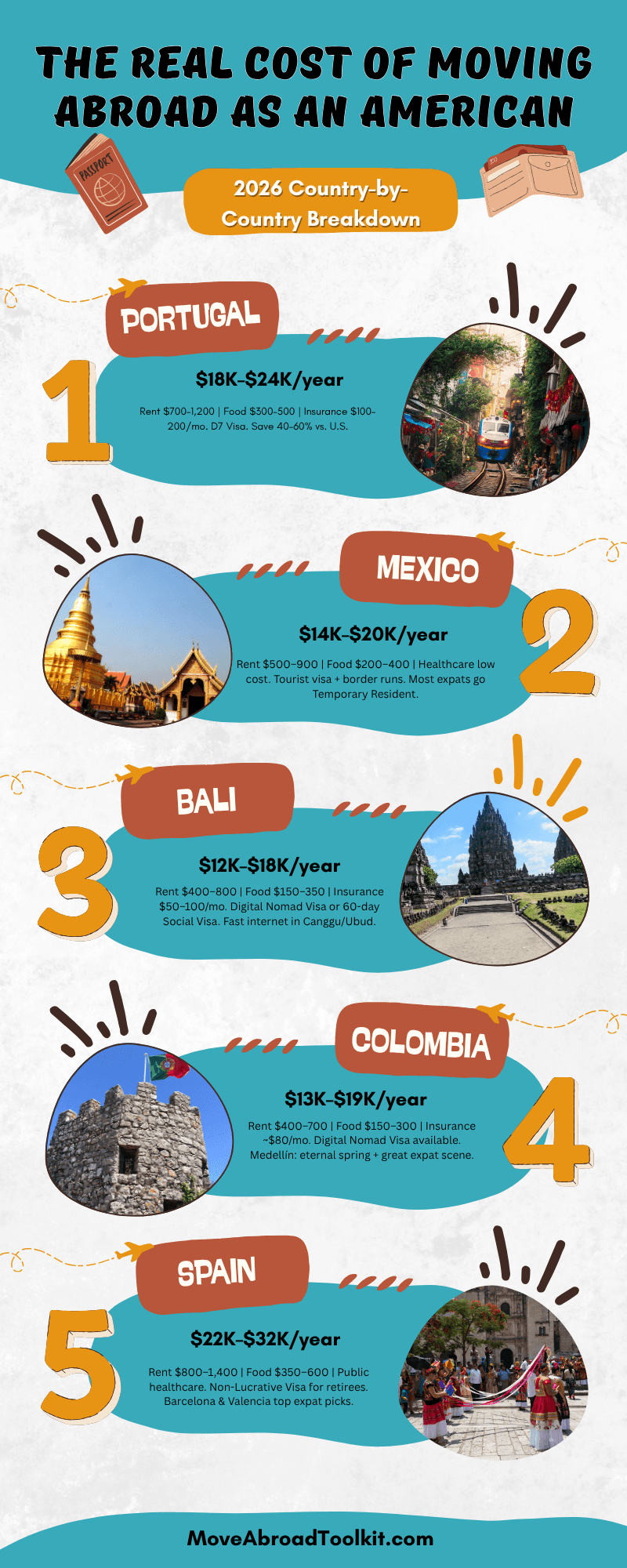
📊 The Real Cost of Moving Abroad as an American
Related: Digital Nomad Visas for Americans | How to Budget for Moving Abroad | What to Pack When Moving Abroad
Key TakeawaysAmericans need a long-term visa to stay in Spain beyond 90 days, with options including digital nomad and retirement visas Spain offers a lower cost of living and better work-life balance compared to most US cities You’ll need to prepare for healthcare enrollment, tax obligations in both countries, and cultural adjustments when settling inVisa and Residency Pathways for Americans Americans can stay in Spain for up to 90 days without a visa, but moving permanently requires obtaining long-term residency through one of several pathways. Each option has different income requirements, documentation needs, and permissions for work. Spain Digital Nomad Visa
The Digital Nomad Visa lets you live in Spain while working remotely for companies outside the country. You need to prove monthly income of at least €2,400 (about $2,600) or have an employment contract with a non-Spanish employer. This visa allows you to stay for up to five years and bring family members with you. You can also work for Spanish clients, but no more than 20% of your income can come from Spanish sources.
Non-Lucrative Visa
The Non-Lucrative Visa works best if you have savings or passive income and don’t plan to work in Spain. You must show around €28,800 per year for one person, plus additional funds for each family member. This visa strictly prohibits any work activities in Spain. Your income needs to come from pensions, dividends, rental properties, or savings. You must also purchase private health insurance and prove you have housing arranged in Spain. The initial visa lasts one year, then you can renew for two-year periods. After five years of continuous residency, you become eligible for permanent residency. You need to spend at least six months per year in Spain to maintain this status.
Work Visas and Self-Employment Routes
Getting a traditional work visa requires a Spanish employer to sponsor you, which can be difficult since companies must prove no qualified EU candidate exists for the position. The employer handles most paperwork, but the process often takes several months. Self-employment visas offer another path if you plan to start a business or work as a freelancer serving Spanish clients. You need a detailed business plan and proof of sufficient funds to support yourself and launch your venture. Spain also offers an entrepreneur visa for innovative business projects that benefit the Spanish economy. This requires approval from ENISA (a government innovation agency) and represents a more complex application process than standard work permits.
Student Visa Requirements
Student visas allow you to study at a Spanish university or language school for the duration of your program. You need an acceptance letter from an accredited institution and proof of funds to cover tuition and living expenses (roughly €1,000 per month). This visa permits part-time work up to 30 hours per week, which helps offset living costs while you study. You must also show proof of health insurance and housing arrangements in Spain. After completing your studies, you can apply for a one-year residence permit to search for work or start a business. Many Americans use the student visa as a stepping stone to longer-term residency options.
Financial Planning and Banking
You should research Spanish banks and their account requirements before leaving the US. Most banks require proof of address in Spain, which means you might need to open a Spanish bank account after you arrive rather than before. Bring enough money to cover your first few months of expenses. This includes rent deposits, which often require first month’s rent plus one or two months as security. Keep funds accessible in your US account while you set up banking in Spain.
Gathering and Translating Documents
Spain requires official translations for most important documents you bring from the US. A traductor jurado, which is a sworn translator certified by the Spanish government, must handle these translations. Regular translations won’t be accepted for legal or official purposes.
Understanding Spanish Bureaucracy
Spanish administrative processes move slower than what most Americans expect. Offices often have limited hours, long wait times, and may require multiple visits to complete simple tasks.
Housing and Utilities Costs
Rent makes up your biggest expense difference between the two countries. A one-bedroom apartment in a Spanish city center runs about $800 to $1,200 per month, while the same apartment in an American city averages $1,500 to $2,500. Smaller towns and rural areas in Spain offer even better deals, with rent sometimes dropping to $500 or less.
I funded my own move abroad by selling my house, my car (to CarMax), and my belongings on Facebook Marketplace and at garage sales. That firsthand experience shapes how I write about moving abroad, I am not just summarizing data, I am telling you what the numbers actually mean for someone making a real move.
Currency exchange fees eat into every international transfer. Use Wise instead of your bank for real exchange rates and low fees. Most expats save $50 to $100 per month on transfers alone.
For health coverage while abroad, SafetyWing Nomad Insurance starts at $45.08 per month for Americans under 40. It covers you in most countries and is built for long-term travelers and expats.
📌 Complete Guide: For the full picture on moving from the US to Spain — visa options, cost of living, healthcare, banking, first 30 days, and 15+ FAQ — see our Moving to Spain from the US: 2026 Complete Guide for Americans.
If you need a VPN for US streaming or public wifi security, NordVPN works well from abroad.
US tax filing does not stop when you move abroad. You still owe US taxes on worldwide income. Taxes for Expats specializes in expat tax returns and can save you from expensive mistakes.
If you’re planning to apply for the Digital Nomad Visa, the income documentation is one of the trickiest parts. See our dedicated Spain DNV income requirements guide for the exact 2026 figures, W2 vs 1099 proof requirements, and Social Security Certificate timeline.
If you are serious about the move, grab the Move Abroad Toolkit to plan your budget, timeline, and logistics in one place.
Thinking about moving abroad? Book a Move Abroad Planning Call for personalized guidance on your relocation.
Continue Planning Your Move
Everything you need is in one place.
Free Quiz
Find Your Best Country Match
Answer a few quick questions about your budget, language comfort, lifestyle and visa needs, and see which countries fit you best.