90 Days in Portugal: The Complete 2026 Guide for Americans
This post contains affiliate links. If you click through and make a purchase, I may earn a small commission at no extra cost to you. I only recommend products and services I personally use and trust.
90 days in Portugal has become one of the most popular extended-stay options for Americans. The D8 Digital Nomad Visa, Schengen-friendly border flexibility, Atlantic coastline, affordable cost of living, and easy logistics make a three-month Portugal stay genuinely transformative — and accessible to anyone who plans ahead.
This guide covers the full logistics: exactly how long you can stay, what it costs for three months, where to base yourself, and what surprises most Americans by the end of month two.
📋 WHAT’S IN THIS GUIDE

Key Takeaways
- Americans can stay in Portugal visa-free for 90 days within any 180-day period under the Schengen Agreement — no visa needed for a 3-month stay
- A 90-day stay in Portugal costs $4,500–$9,000 total depending on city and lifestyle
- Lisbon is the most expensive and most popular base; Porto offers similar amenities at lower cost; the Algarve for beach-focused months
- Portugal’s Digital Nomad Visa and D7 Passive Income Visa are the routes for stays beyond 90 days
- Portugal has the lowest cost of living of any Western European country — Lisbon runs roughly 30% cheaper than London or Paris
How Long Can Americans Stay in Portugal?
Americans can stay in Portugal (and all Schengen Area countries) for 90 days within any rolling 180-day period without a visa. This is the standard Schengen tourist allowance and covers your entire three-month stay with no pre-arrangement required.
The 90/180 rule is important: it’s not a calendar year reset. If you spent 30 days in France last month, those count against your 90. For a clean 90-day Portugal trip with no prior Schengen travel, you have the full 90 days available. For stays beyond 90 days, Portugal offers the Digital Nomad Visa (for remote workers), the D7 Passive Income Visa (for retirees and passive income earners), and other residency pathways.
How Much Does 90 Days in Portugal Cost?
Portugal is the most affordable Western European country for an extended stay, but it has gotten more expensive in recent years — particularly Lisbon, which has seen significant rental price increases. Here’s a realistic 90-day budget:
| Expense | Budget (Porto/Setúbal) | Mid-Range (Lisbon) | Comfortable (Lisbon) |
|---|---|---|---|
| Accommodation (3 months) | $2,100–3,000 | $3,300–5,400 | $5,400–9,000 |
| Food (3 months) | $600–900 | $900–1,500 | $1,500–2,500 |
| Transportation | $150–250 | $200–350 | $300–600 |
| Coworking (3 months) | $300–500 | $450–700 | $600–900 |
| Health Insurance | $120–180 | $120–180 | $180–350 |
| Misc and activities | $400–700 | $600–1,000 | $1,000–2,000 |
| 90-Day Total | ~$3,670–5,530 | ~$5,570–9,130 | ~$8,980–15,350 |
Most Americans doing 90 days in Lisbon spend $5,500–$8,000 total. Porto and smaller cities bring that down to $4,000–$6,000. For detailed cost breakdowns see our Cost of Living in Lisbon and Lisbon for a Month guides.
Best Bases for 90 Days in Portugal
Lisbon — Best Overall Base
Portugal’s capital and most international city. The largest expat and digital nomad community, best coworking infrastructure, best restaurant scene, and direct transatlantic flights. More expensive than other Portuguese cities, but still cheaper than London, Paris, or Amsterdam. Monthly apartments in Príncipe Real or Mouraria run €1,200–€2,000. See our full Moving to Portugal guide for neighborhood-by-neighborhood detail.
Porto — Best Value and Character
Porto offers almost everything Lisbon does at roughly 20–30% lower cost. Extraordinary food (the best francesinha in the world is here), beautiful historic center, growing digital nomad scene, and a slightly slower, more authentic pace than Lisbon. Monthly apartments run €800–€1,400.
Algarve — Best for a Beach-Focused 90 Days

The southern coast has long drawn British and Northern European retirees — and increasingly American remote workers. Lagos and Tavira are popular bases. More seasonal pricing: winter rents are significantly lower, summer is more crowded. Good for a 90-day stay if you want beach life with European infrastructure and short-hop access to Lisbon.
Cascais or Setúbal — Best for Quiet and Value Near Lisbon
Both towns are 30–45 minutes from Lisbon by train or car, with significantly lower rents than the city center. A good choice if you want easy Lisbon access for work and socializing but prefer a quieter residential base. Monthly apartments start around €800–€1,200.
Finding Housing for 3 Months in Portugal
For 90-day stays, direct rentals are significantly cheaper than Airbnb. Idealista.pt and Uniplaces.com list furnished apartments aimed at medium-term expats. Facebook groups like “Lisbon Expats” and “Porto Digital Nomads” also list direct rentals. Expect to pay the first month plus a security deposit. Landlords in Portugal are generally open to 3-month furnished rental agreements — just ask.
Working Remotely in Portugal for 90 Days
Portugal is in the WET/WEST time zone (UTC/UTC+1) — 5 hours ahead of US Eastern Time in winter, 4 hours in summer. US morning meetings become Portuguese afternoon, which most remote workers find very manageable. Portuguese internet infrastructure is excellent — fiber broadband is widely available in Lisbon and Porto, and coworking spaces are abundant. A NOS or MEO SIM with unlimited data costs around €15–25/month.
Healthcare for a 90-Day Stay in Portugal
Portugal has an excellent public healthcare system (SNS), but as a tourist on a 90-day stay you won’t have access to it routinely. Private healthcare is affordable and high-quality — a private GP visit runs €40–€80. For 90 days, SafetyWing ($40–$60/month) covers emergency medical care. For comprehensive coverage including routine care, see international health insurance options.
What Portugal Is Actually Like After 3 Months
Month one in Portugal is discovering pastéis de nata, getting lost in Alfama, and spending too much time in wine bars. Month two you’ve found your local bakery and your regular coffee order in Portuguese. Month three you’re debating whether to look into the D7 Visa. Portugal has one of the highest rates of Americans converting a 90-day trip into a permanent move — the combination of low bureaucratic friction, high quality of life, and genuine affordability by Western European standards makes it uniquely sticky.

📌 Save this guide for later! Pin it to your travel or move abroad board so you can find it when you need it.
Click the image above to save directly to Pinterest.
Frequently Asked Questions
Can Americans stay in Portugal for 90 days without a visa?
Yes. Under the Schengen Agreement, Americans can stay in Portugal (and all Schengen countries) for 90 days within any 180-day period without a visa. No pre-approval or paperwork required.
How much does 90 days in Portugal cost?
Budget stays in Porto or smaller towns: $3,500–$5,500 total. Mid-range Lisbon: $5,500–$9,000. Comfortable Lisbon with a nice apartment: $9,000–$15,000+.
What happens if I want to stay longer than 90 days?
You’ll need a Portuguese visa — most commonly the Digital Nomad Visa (for remote workers earning foreign income) or the D7 Passive Income Visa (for retirees, passive income earners, or those with sufficient savings).
Is Lisbon or Porto better for a 90-day stay?
Lisbon for the best expat community, coworking infrastructure, and direct transatlantic flights. Porto for lower costs, similar quality of life, and a slightly more authentic Portuguese experience. Many Americans split their 90 days between both.
Planning 90 days in Portugal? Start with our Start Here guide and Resources page. Read our complete Moving to Portugal as an American guide.
For official visa information, visit SEF — Serviço de Estrangeiros e Fronteiras, Portugal’s immigration authority.
I funded my own move abroad by selling my house, my car (to CarMax), and my belongings on Facebook Marketplace and at garage sales. That firsthand experience shapes how I write about moving abroad — I am not just summarizing data, I am telling you what the numbers actually mean for someone making a real move.
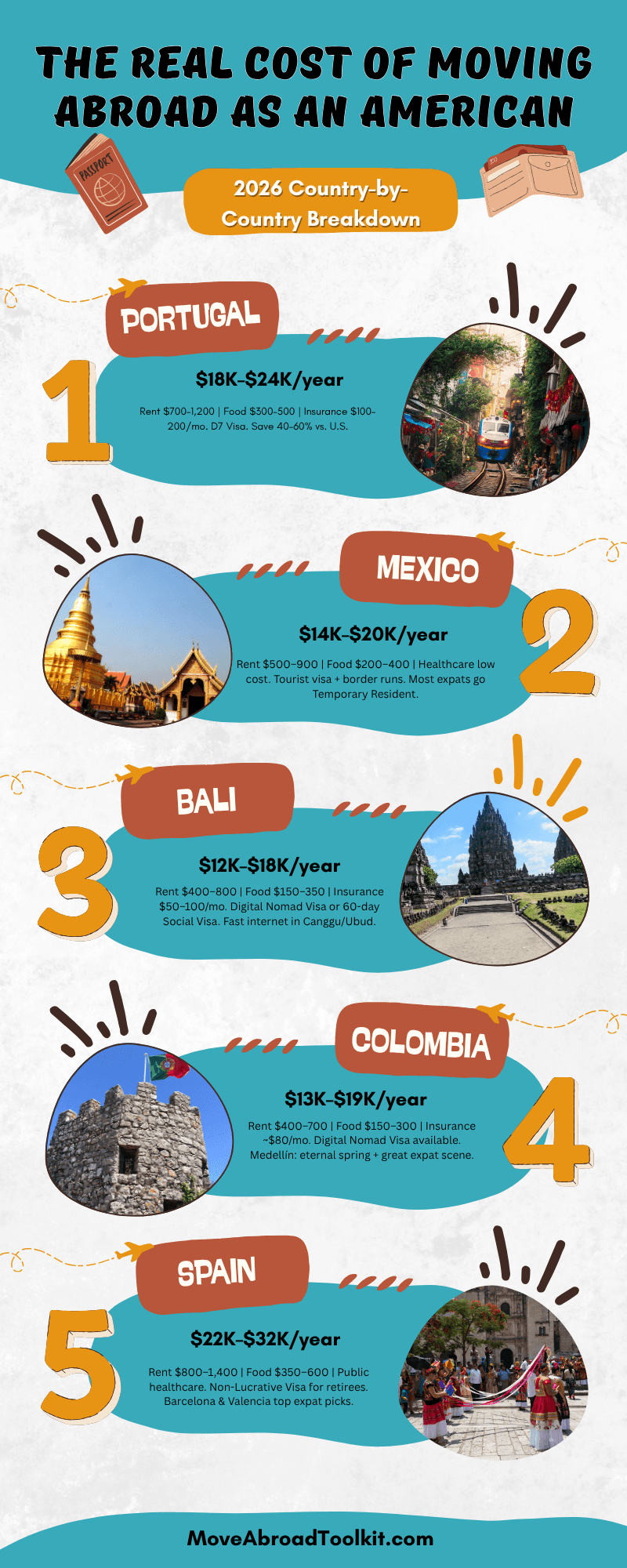
Currency exchange fees eat into every international transfer. Use Wise instead of your bank for real exchange rates and low fees. Most expats save $50 to $100 per month on transfers alone.
For health coverage while abroad, SafetyWing Nomad Insurance starts at $45.08 per month for Americans under 40. It covers you in most countries and is built for long-term travelers and expats.
If you need a VPN for US streaming or public wifi security, NordVPN works well from abroad.
US tax filing does not stop when you move abroad. You still owe US taxes on worldwide income. Taxes for Expats specializes in expat tax returns and can save you from expensive mistakes.
If you are serious about the move, grab the Move Abroad Toolkit to plan your budget, timeline, and logistics in one place.
Thinking about moving abroad? Book a Move Abroad Planning Call for personalized guidance on your relocation.
Continue Planning Your Move
Everything you need is in one place.
Free Download
Remote Income Starter Kit
30 curated remote job boards, an application tracker & freelance rate calculator. Fund your move before you leave.