Portugal D8 Digital Nomad Visa: 7 Essential Steps for Americans (2026)
Some links on this site are affiliate links, which means the site may earn a commission at no extra cost to you. Services are included because they fit the move abroad process, not because of the commission.
If you are an American doing remote work in a high cost city, this post is for you. You are quietly running the math on whether you could actually move to Portugal.
The Portugal D8 visa is the legal answer.
It lets non-EU remote workers, freelancers, and salaried employees of foreign companies live in Portugal. Either for one year on a temporary stay, or up to five years on a residence path.
The application is one of the cleaner ones in Europe. The income threshold is hittable. The timeline is predictable.
What follows is the actual application sequence. Real numbers, real documents, real costs.
I funded my own move abroad by selling my house, my car (to CarMax), and my belongings on Facebook Marketplace and at garage sales. The financial logistics of leaving the US are real. The visa is the easier part.
By the end of this post, you will know whether you qualify and what you need to gather. You will also know what it will cost and how long it will take.
Then you have no reason not to go.
📋 WHAT’S IN THIS GUIDE
- What the Portugal D8 Visa Actually Is
- Step 1: Confirm You Qualify
- Step 2: Get Your NIF
- Step 3: Open a Portuguese Bank Account
- Step 4: Gather Your Documents
- Step 5: Book and Attend the Consulate Appointment
- Step 6: Travel to Portugal and Convert at AIMA
- Step 7: Set Up Your Life on the Ground
- What the Portugal D8 Visa Actually Costs
- Frequently Asked Questions

What the Portugal D8 Visa Actually Is
The D8 is Portugal’s digital nomad visa, introduced in October 2022.
It has two tracks.
Temporary Stay Visa. Valid up to 12 months with multiple entries. Renewable for short periods up to 4 times. Does not lead to permanent residency.
Residence Visa. Valid for 4 months on entry. You then convert it to a 2-year residence permit at AIMA (the agency that replaced SEF). The permit renews for 3 more years. Total: 5 years of residence, after which permanent residency or citizenship becomes possible.
Pick the track based on what you actually want.
If you want to test Portugal for a year without committing, the temporary stay is the right one. If you want a path to EU citizenship and you are willing to plant roots, pick the residence visa.
Most Americans I talk to who are doing this seriously pick the residence track. The five-year clock to citizenship is the actual prize.
One important note. A 2025 nationality law change has been proposed.
It would extend the residency to citizenship period from 5 to 10 years. As of early 2026 this is not yet law. It is still under review by Portugal’s Constitutional Court.
Apply under the rules in effect at the time of your application.
Step 1: Confirm You Qualify for the Portugal D8 Visa
You qualify for the Portugal D8 if all of the following are true.
You are a non-EU, non-EEA, non-Swiss citizen. American citizens qualify.
You work remotely. This means one of three things.
You are employed by a non-Portuguese company. You are contracted by non-Portuguese clients as a freelancer. Or you are running a business with foreign clients.
Your income meets the threshold.
As of 2026, the requirement is four times the Portuguese minimum wage. That works out to approximately €3,680 per month, or about €44,160 per year. Income can come from salary, freelance contracts, or a combination.
You have a clean criminal record. Portugal will request a background check from your home country covering the last five years.
You have valid health insurance covering Portugal. International policies like SafetyWing or local Portuguese coverage both qualify. The policy must cover at least €30,000 in medical expenses.
You have proof of accommodation. A lease of 4 or more months for the temporary stay visa. A lease of 12 or more months for the residence visa.
If you are bringing family, the income threshold scales up.
Add 50 percent for a spouse. Add 30 percent for each dependent child. A spouse plus one child means you need to show roughly €5,520 per month combined.
Step 2: Get Your NIF (Portuguese Tax Number)
Before you can do almost anything else, you need a NIF. This is your Portuguese tax identification number.
You need a NIF to open a bank account, sign a lease, and set up utilities. You also need it to submit your visa application paperwork.
You can get it three ways.
In person at a Portuguese tax office (Finanças). Free, but you have to be in Portugal.
You usually need a fiscal representative if you are a non-EU citizen. Hard to do before you move.
Through a fiscal representative service online.
Costs €100 to €200. Done remotely from the US in about a week. This is what most Americans do.
Companies like Bordr, NIF Online, and e-Residence all handle this.
Through a Portuguese lawyer. More expensive at €250 to €500. Usually bundled with other relocation services if you are using a relocation lawyer for the full visa process.
Get the NIF first. It is the gating step for almost everything that follows.
Step 3: Open a Portuguese Bank Account
Some consulates require proof of a Portuguese bank account.
The deposit must equal at least 12 times the monthly minimum wage. Others do not. Either way, you will need one once you arrive, so doing it early saves a step.
You can open accounts remotely with banks like ActivoBank, Millennium BCP, or Novo Banco.
They will need your NIF, your passport, and a proof of address. Your US address works for the initial opening. You update it once you have a Portuguese lease.
Wise is what I use for the actual money movement.
It is not a Portuguese bank account. But it gives you a Portuguese IBAN, holds euros, and lets you transfer from US accounts at real exchange rates.
For Americans, every regular bank or US card transfer costs 3 to 4 percent in currency conversion fees. Over a year, that adds up to thousands of dollars. Wise eliminates it.
I have used Wise across France, South Africa, and other countries where I have done extended stays. It is the single banking product I recommend without reservation for this kind of move.
You will still want a real Portuguese bank account once you are settled. Most landlords prefer Portuguese SEPA transfers for rent. Many utility companies require a Portuguese IBAN.
For the initial application, a Wise euro account combined with whatever Portuguese account you can open remotely is usually enough.
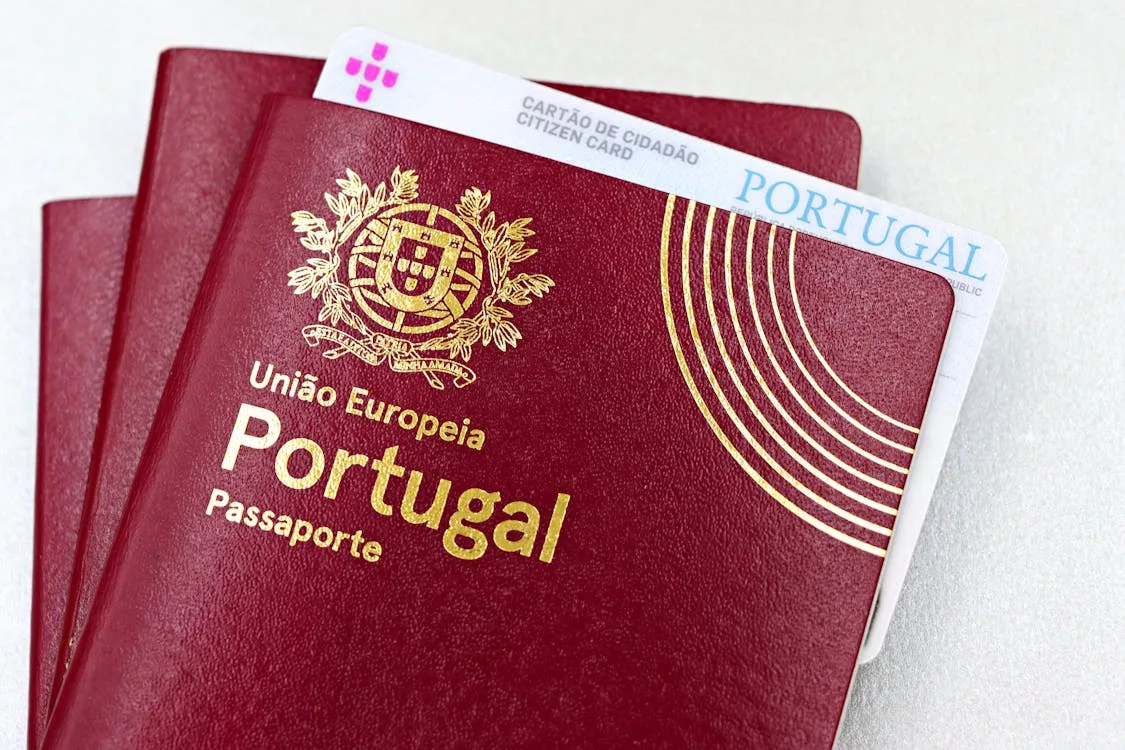
Step 4: Gather Your Documents for the Portugal D8 Visa
This is the document checklist for the D8 application.
Get every item before you book your consulate appointment. Consulates do not give you a chance to come back with missing paperwork. They reject and you start over.
Here are the required documents.
A valid US passport with at least 6 months remaining beyond your intended stay and at least 2 blank pages.
Two passport-size photos meeting Schengen specifications.
A completed national visa application form, available from your assigned Portuguese consulate.
Proof of remote work.
For employees, this is a contract from your foreign (non-Portuguese) employer plus 3 to 6 months of recent payslips. For freelancers, this is a portfolio of client contracts plus invoices and proof of payment. For business owners, this is your business registration plus revenue documentation.
Proof of income meeting the €3,680 per month threshold. Bank statements from the last 3 to 6 months are the standard. Tax returns from your last filing year strengthen the application.
Proof of savings. Some consulates require 12 months of the Portuguese minimum wage in liquid savings (around €9,840 in 2026). Confirm your specific consulate’s requirement before submitting.
A criminal background check from the FBI or your state of residence, apostilled.
The FBI background check is the cleanest option. Apostille is non-negotiable. Portugal will not accept an unapostilled background check.
Proof of accommodation in Portugal.
A signed lease of 4 or more months (temporary stay) or 12 or more months (residence visa). A property deed if you own. A formal letter of invitation from a Portuguese host with their address documentation.
Hotel bookings do not count for residence visas.
Health insurance documentation showing coverage of at least €30,000 in Portugal.
Cover letter explaining your reason for applying, your remote work situation, and your intent to comply with the visa terms.
Keep it to one page. Professional. No flowery language.
Proof of NIF.
Two copies of every document. One for the consulate, one for your own records.
Step 5: Book and Attend the Consulate Appointment
You apply at the Portuguese consulate that has jurisdiction over your US state of residence. You cannot apply from a different consulate just because they have earlier appointments.
Each consulate covers specific states. The Portuguese embassy in DC has the official list. You can also check VFS Global, which handles application processing for some US Portuguese consulates.
Book the appointment as early as you can. Wait times in 2026 range from 2 weeks (Newark) to 4 or more months (San Francisco, depending on the season). The consulate will not let you submit without an appointment.
Bring every document, both copies, and the application fee in the form they specify. Most US consulates accept a money order or cashier’s check made out to the consulate. The visa application fee is €90 to €120 depending on the consulate.
The appointment itself takes 30 to 60 minutes.
The consular officer reviews documents, takes biometrics (fingerprints), and asks basic questions about your plans in Portugal.
Be honest. Be specific. Have answers ready about where you will live, how you will support yourself, and what your timeline looks like.
After the appointment, processing takes 60 to 90 days on average. You will be notified by email when the visa is ready for collection or shipped to you.
Step 6: Travel to Portugal and Convert at AIMA
Once your Portugal D8 visa is issued, you have 120 days to enter Portugal.
If you applied for the temporary stay visa, you are done with the residency conversion process. The visa itself is your authorization to live and work in Portugal for the duration shown. Renew before it expires through the local AIMA office.
If you applied for the residence visa, the 4 month visa in your passport is the entry visa.
Within those 4 months, you must attend an AIMA appointment in Portugal. The appointment converts the visa to a 2-year residence permit.
AIMA appointments are notoriously hard to book. Many applicants book them before they leave the US.
The fee at the AIMA appointment is approximately €170. The residence permit card arrives by mail 2 to 6 weeks after the appointment.
Once the residence permit is in hand, you are a Portuguese resident.
You can register with SNS, the Portuguese national health service. You can enroll in Portuguese tax residency if you spend more than 183 days per year in Portugal. And you start the 5 year clock toward permanent residency or citizenship.

Step 7: Set Up Your Life on the Ground
Once you are in Portugal with a residence permit, the operational setup begins.
The shortlist of what to handle in your first 30 days:
Find permanent housing if you arrived on a short-term lease.
Idealista is the dominant rental marketplace in Portugal. Lisbon and Porto are the most expensive markets. Coimbra, Braga, and the Algarve outside of peak season are meaningfully cheaper.
Open a permanent Portuguese bank account if you have not already. Bring your passport, NIF, residence permit, and a recent utility bill or signed lease.
Register with SNS for public healthcare. Most cities have a Centro de Saúde where you walk in with your residence permit and NIF to enroll.
Maintain your international health insurance for the first 6 to 12 months after you are SNS-registered. SafetyWing or equivalent coverage works.
SNS has wait times. Private and international coverage gives you the option to use private clinics for routine and urgent care without long waits.
Set up Portuguese SIM and internet.
Operators are MEO, NOS, and Vodafone Portugal. Internet in Lisbon, Porto, and the Algarve is excellent. Fiber is widely available at gigabit speeds.
For your first days, Airalo or Holafly give you a working eSIM before you have a local contract sorted.
Use a VPN for any US banking, brokerage, or streaming access. Several US institutions block or restrict logins from foreign IPs. NordVPN is what I use to keep US-based accounts working from abroad without friction.
Get tax advice.
Spend 183 days in Portugal in a 12-month period and you become a Portuguese tax resident. The tax applies to your worldwide income. The US still taxes you as a citizen too.
Foreign Earned Income Exclusion (FEIE) and the US Portugal tax treaty handle most double taxation issues. You need someone who actually understands both systems. Taxes for Expats specializes in this.
What the Portugal D8 Visa Actually Costs
Here is the realistic all in cost from US application to landing in Portugal with a 2-year residence permit:
NIF service: €100 to €200
FBI background check plus apostille: $50 to $150
Document translations and notarization (if required): $100 to $300
Visa application fee at consulate: €90 to €120
Travel from US to Portugal: $400 to $1,500 depending on departure city and timing
First 4 months of accommodation in Portugal: €3,000 to €6,000 depending on city. This covers a lease deposit and first month, or a short-term rental for the gap before permanent housing.
AIMA residence permit fee: €170
First 6 months of international health insurance: €240 to €600
Lawyer or relocation service if you use one (optional): €1,500 to €5,000
Without a lawyer, you can land in Portugal on a 2-year residence permit for €4,500 to €8,500. That is on top of your travel and your housing runway.
That figure is what I mean when I say Portugal is one of the more accessible visa paths.
Compare the D8 to Spain’s NLV, the Greek digital nomad visa, or any Golden Visa investment route. The D8 is firmly in reach for a salaried American with stable remote income.
Frequently Asked Questions
How much does the Portugal D8 visa cost in fees?
The visa application fee is €90 to €120 at the consulate. The AIMA residence permit fee is approximately €170.
Total direct government fees come to €260 to €290. Beyond that, expect €100 to €200 for NIF service and $50 to $150 for FBI background check and apostille. Add $100 to $300 for translations if your consulate requires them.
What is the minimum income for the Portugal D8 visa in 2026?
€3,680 per month, equal to four times the Portuguese minimum wage. That equals approximately €44,160 per year.
If you are bringing a spouse, add 50 percent. If you are bringing dependent children, add 30 percent per child.
How long does the Portugal D8 visa take to process?
Plan on 60 to 90 days from consulate appointment to visa issuance. Add 2 to 4 months upfront to gather documents, get your NIF, and book the appointment.
Total realistic timeline from decision to landing in Portugal with a 2-year residence permit is 6 to 9 months.
Can I apply for the Portugal D8 visa from inside the United States?
Yes, and you should.
The visa must be applied for at a Portuguese consulate in your country of residence (the US). You must apply before you enter Portugal. You cannot legally apply from inside Portugal as a tourist.
What is the difference between the D7 and D8 visas?
The D7 is for Americans with passive income such as pensions, rental income, and dividends. The D8 is for Americans with active remote work income such as salary, freelance, and business revenue.
Both have similar income thresholds.
D7 from passive sources is around €870 per month. D8 from active work is €3,680 per month. Both lead to the same residence permit pathway.
Pick D7 if your income is from investments and pensions. Pick D8 if your income is from a paycheck or client work.
Will my US taxes change if I move to Portugal on the D8 visa?
Yes. The US taxes citizens on worldwide income regardless of where they live. Once you spend 183 or more days per year in Portugal, you also become a Portuguese tax resident on worldwide income.
The Foreign Earned Income Exclusion (FEIE) lets you exclude approximately $126,500 of earned income from US taxation in 2026. You must qualify under the FEIE rules. The US Portugal tax treaty handles most double taxation issues.
Talk to a CPA who specializes in expat tax before you go.
Can I bring my family on the Portugal D8 visa?
Yes. Spouse, children under 18, and dependent parents over 65 (or younger with proven financial dependence) can be included.
The income threshold scales: add 50 percent of base for spouse, 30 percent per dependent child.
Recent law changes (October 2025) added a 2-year wait for some family reunifications.
The wait is reduced to 15 months if you cohabited for 18 months before the main applicant arrived in Portugal. The wait is waived for spouses with minor children. Verify the current rule with your consulate before applying.
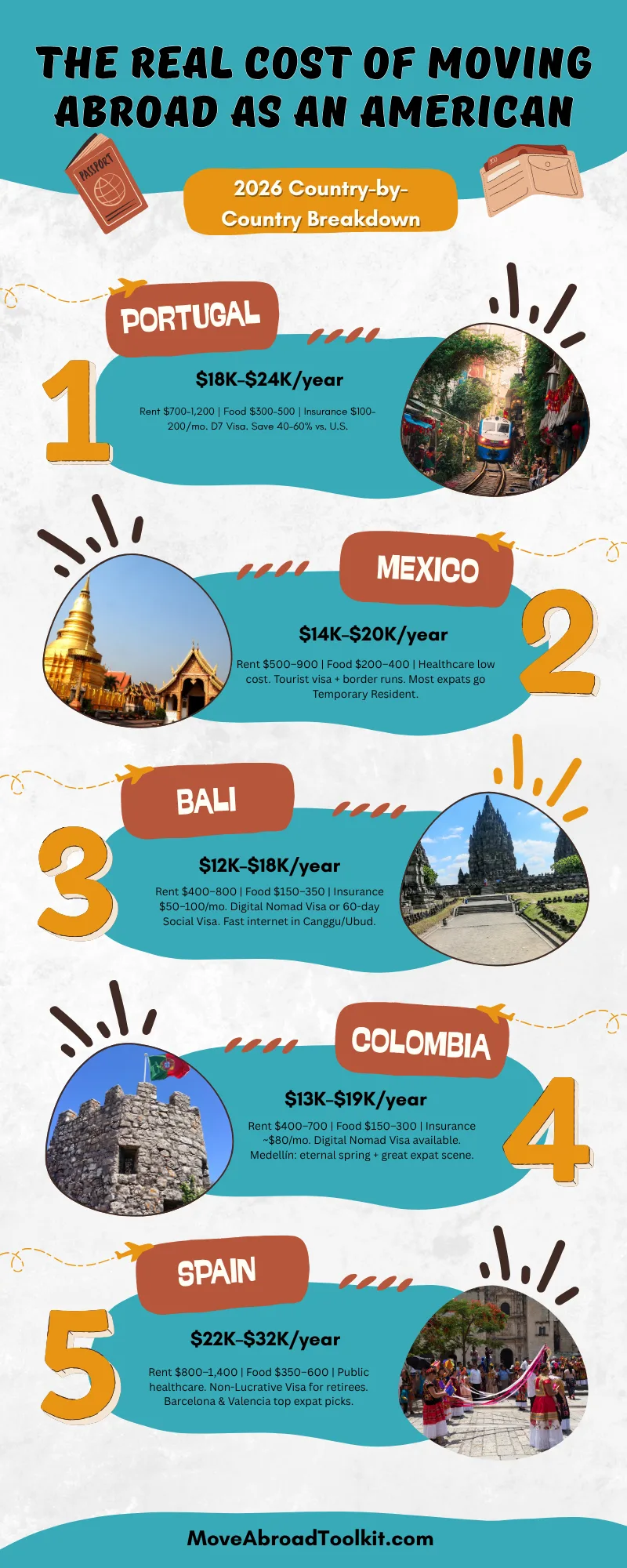

📌 Save this guide for later! Pin it to your travel or move abroad board so you can find it when you need it.
Click the image above to save directly to Pinterest.
Ready to Make the Move?
The D8 is a clean, predictable visa path for Americans with remote income who want to live in Portugal.
The income threshold is hittable. The document list is reasonable. The timeline is published.
What stops most people is not the visa. It is the rest of the move.
The financial planning. The asset liquidation.
The country selection. The operational sequencing of when to do what.
That is exactly what the Move Abroad Toolkit was built for.
The full $47 toolkit covers the M.O.V.E. Method™ in detail.
The four phases are Map Your Mindset, Own Your Financial Runway, Venture to Your Country, and Establish Your Life Abroad. You also get country comparison sheets, a 90-day departure planner, and full visa checklists for 11 countries.
If you want to see the framework first, the free M.O.V.E. Method™ Guide walks through the four phases.
If you are further along, book a planning call. You will get personalized guidance on whether Portugal is the right fit and how to sequence your move.
Not sure which country to plan around yet? Before you work through the details, take the free country match quiz to find the countries that fit your budget, visa needs and lifestyle.
Read Next
Cost of Living in Lisbon 2026. What €3,680 actually buys you in Lisbon vs Porto vs the Algarve.
Moving to Portugal as an American: Complete 2026 Guide. The full country pillar.
Start Here: The M.O.V.E. Method™. Where to begin if Portugal is your first serious country shortlist.
Comparing the D7 and D8 side-by-side? Our dedicated Portugal D7 vs Digital Nomad Visa guide.
Browse Our Full Resources List. Every tool we actually use, from Wise to SafetyWing to Idealista.
For health coverage while abroad, SafetyWing Nomad Insurance starts at $45.08 per month for Americans under 40. It covers you in most countries and is built for long-term travelers and expats.
If you are serious about the move, grab the Move Abroad Toolkit to plan your budget, timeline, and logistics in one place.
Thinking about moving abroad? Book a Move Abroad Planning Call for personalized guidance on your relocation.
Continue Planning Your Move
Everything you need is in one place.
Free Quiz
Find Your Best Country Match
Answer a few quick questions about your budget, language comfort, lifestyle and visa needs, and see which countries fit you best.