Cost of Living in Cape Town for Americans: 7 Real Numbers (2026)
This post contains affiliate links. If you click through and make a purchase, I may earn a small commission at no extra cost to you. I only recommend products and services I personally use and trust.
📋 WHAT’S IN THIS GUIDE
- The Real Cost Breakdown: Rent, Food, Transport, Utilities, Healthcare
- What Your Dollar Actually Gets You in Cape Town
- Best Neighborhoods in Cape Town for American Expats
- Hidden Costs Americans Don’t Expect
- Is Cape Town Affordable Compared to US Cities?
- The Real Long-Term Savings You Can Expect
- Frequently Asked Questions
- Ready to Make Your Move to Cape Town?
The cost of living in Cape Town for Americans runs between $1,500 and $2,800 per month for a comfortable lifestyle, depending on your neighborhood and habits. That’s roughly 40 to 60 percent less than comparable cities in the US. Kim spent time living and researching across southern Africa, and Cape Town consistently ranks as one of the most livable cities on the continent for Americans who want city infrastructure, natural beauty, and a favorable exchange rate. This guide breaks down the real numbers so you can plan your move with confidence.
How Much Does It Cost to Live in Cape Town as an American?
Most American expats in Cape Town spend between $1,500 and $2,800 per month for a comfortable lifestyle — 40 to 60 percent less than comparable US cities. A furnished one-bedroom apartment runs $650–$1,200 per month, groceries $200–$350, transport $50–$100, and private health insurance $40–$80 per month. Total monthly budget: roughly $2,000 for a single person living well.
The Real Cost Breakdown: Rent, Food, Transport, Utilities, Healthcare
Here are the actual numbers Americans are reporting in 2026.
Rent is your biggest expense. A furnished one-bedroom apartment in a mid-range neighborhood like Gardens or De Waterkant runs between $650 and $950 per month. In Sea Point, expect $800 to $1,200. Camps Bay is the premium end at $1,400 to $2,500 for a one-bedroom with ocean views. If you’re open to Woodstock or Observatory, you can find solid one-bedrooms for $500 to $700.
Food costs are low by American standards. You can eat well at local restaurants for $6 to $12 per meal. A week of groceries at a standard supermarket runs $40 to $65 depending on how much imported food you buy. Sticking to local produce and South African brands keeps your monthly food budget around $300 to $450 for one person.
Transport without a car costs $60 to $100 per month using the MyCiTi bus and ride-shares.
Owning a car adds $150 to $300 per month in fuel, insurance, and parking. The MyCiTi bus network covers central areas well, but many expats find a vehicle useful for weekend trips and accessing areas like Constantia or Hout Bay.
Utilities including electricity, water, and internet run $80 to $150 per month in a standard apartment. Note that Cape Town has load shedding, which affects electricity reliability and can push costs higher if you use backup power systems.
Healthcare at private facilities is excellent and affordable by US standards. A GP visit costs $25 to $50. Most Americans use international health insurance rather than enrolling in the local public system. Read our full guide to international health insurance for expats to compare plans. SafetyWing’s Nomad Insurance starts at $56 per month and covers you in South Africa with no local enrollment required.

What Your Dollar Actually Gets You in Cape Town
The rand exchange rate makes Cape Town exceptional value for dollar-earners.
As of 2026, one US dollar buys approximately 18 to 19 South African rand. That means a $2,000 monthly income translates to around 36,000 to 38,000 rand. In practical terms, that’s a furnished apartment in a great neighborhood, full grocery budget, restaurant meals 4 to 5 times per week, and weekend activities with money left over.
A sit-down dinner for two at a mid-range Cape Town restaurant with wine costs $25 to $40. A wine bottle from the Cape Winelands at a restaurant costs $8 to $15. A gym membership runs $25 to $40 per month. A one-way Uber across the city is typically $3 to $6.
Use Wise to transfer money from your US bank to a South African account. The mid-market exchange rate Wise offers saves you significantly compared to using your US bank’s international transfer fees. Many Americans keep their US income in dollars and convert only what they need each month.
Best Neighborhoods in Cape Town for American Expats
Cape Town’s neighborhoods are distinct in character and price. Here’s what each one actually offers.
Sea Point is the most popular area for expats and long-term visitors. It sits along the Atlantic Seaboard with a promenade, strong walkability, and a dense concentration of restaurants and cafes. Rent runs $800 to $1,200 for a one-bedroom. Safety is relatively good for Cape Town standards, with active street life through most hours.
Gardens is centrally located and walkable to the city bowl. One-bedrooms run $650 to $950. It’s favored by remote workers who want proximity to coworking spaces and coffee shops in a quieter but well-connected setting.
Camps Bay is the glamour option. It has a beachfront strip, mountain views, and a boutique atmosphere. Expect to pay $1,400 to $2,500 for a one-bedroom and $3,000 to $5,000 for a furnished villa. Most Americans who choose Camps Bay are earning well above location-independent averages or staying short-term.
Woodstock is Cape Town’s creative and up-and-coming neighborhood. It’s home to street art, design studios, and good coffee. Rent is lower at $500 to $700 for a one-bedroom. It’s close to the city but has a more mixed neighborhood dynamic that requires standard urban awareness.
For medium-term stays, Airbnb Monthly listings in Sea Point and Gardens are often better value than standard short-term nightly rates. Monthly furnished rentals through Airbnb in these areas typically run 20 to 35 percent less than nightly equivalents.
Hidden Costs Americans Don’t Expect
These are the expenses that catch new arrivals off guard.
Load shedding backup power. Cape Town has improved its electricity reliability compared to the rest of South Africa, but load shedding still occurs. If you work remotely, you’ll want an inverter or UPS system for your laptop and router. Basic setups cost $100 to $250 upfront. Some furnished apartments include these already; most do not.
Security costs. Most expat-friendly apartments include security in the building costs. But if you rent a house or a less managed property, you’ll likely add an alarm system monitoring fee of $20 to $40 per month and possibly a security gate installation costing $300 to $600 one-time.
Domestic help. Many expats in Cape Town hire a housekeeper for 2 to 3 days per week. The cost is $8 to $15 per day, which amounts to $64 to $180 per month. This is completely optional but very common among the expat community.
Car purchase. Cape Town is large and some areas are not well-served by public transit. Many expats buy an inexpensive used car. Entry-level used vehicles cost $3,500 to $6,000. Factor in insurance, parking, and fuel on top of that purchase price.

SIM card and data. Local SIM cards from Vodacom or MTN run $5 to $10 upfront with data bundles. If you need reliable coverage for remote work, budget $25 to $40 per month for a solid data plan.
Wire transfer and banking fees. South African banks are tough for foreigners to join without residency. Many expats use Wise to move money from the US to rand at strong exchange rates. Without Wise, you lose 2 to 4 percent on every transfer.
Furnished apartment deposits. Most expat-friendly furnished rentals ask for one to two months rent as a deposit. Budget $700 to $2,400 for initial deposits and setup costs. Using Airbnb Monthly for your first month is a common strategy. It gives you time to find a long-term rental on the ground.
Is Cape Town Affordable Compared to US Cities?
The honest answer is yes, significantly cheaper than most American metros.
A comparable lifestyle in Austin, Texas costs $3,500 to $5,000 per month. In Cape Town, that same lifestyle costs $1,800 to $2,800. The biggest savings come from rent (40 to 60 percent lower), dining out (50 to 70 percent lower), and domestic services. Healthcare costs are also dramatically lower if you’re paying out of pocket at private facilities.
Cape Town is not the cheapest city in the world. It’s not Chiang Mai or Medellín on a pure cost basis. But it offers things those cities don’t: English as a primary language, European-standard infrastructure in expat neighborhoods, world-class wine country 45 minutes away, and a climate that competes with California.
For Americans who want affordability without sacrificing quality of life, Cape Town is one of the strongest arguments on the continent. Visit our complete guide to moving to South Africa for visa options, logistics, and what to expect before you land.
The Real Long-Term Savings You Can Expect
The full cost of living in Cape Town for Americans is often a fraction of the US baseline. That gap widens over a multi-year window.
Over 3 years, the average remote worker in Sea Point or Gardens saves $60,000 to $95,000. The comparison is against a similar life in San Diego, Austin, or Seattle. That includes rent, groceries, Uber, private healthcare, and dining out.
Many expats use those savings to pay off student loans. Others build an emergency fund or invest in index funds back home.
Healthcare alone accounts for a huge chunk of that gap.
A US couple with basic employer coverage often spends $8,000 to $14,000 per year on premiums, copays, and deductibles. In Cape Town, a similar couple typically spends $1,800 to $3,500 per year. That covers SafetyWing or a solid international plan plus out-of-pocket private care. The net savings work out to $6,000 to $10,500 per year on healthcare alone.
Cape Town’s monthly savings are compelling on their own. To factor in your full financial runway including move-in costs, visa fees, and the buffer you need before your first paycheck clears abroad, the 5-component cost formula gives you the real number.
The cost of living in Cape Town for Americans stays relatively stable in dollar terms year over year.
South African inflation has run 5 to 7 percent in recent years. The rand has also weakened against the dollar during the same period. That FX move protects US-earning expats from most of the squeeze. Rent in dollar terms has moved less than 10 percent in the main expat neighborhoods over the last 3 years.
Stack the tax savings, the FX savings, the healthcare savings, and the rent savings together. A remote worker earning $85,000 to $130,000 per year sees a real uplift. It typically lands at $30,000 to $55,000 per year in take-home. That is genuinely life-changing money at that income band.
Frequently Asked Questions
How much money do you need to live comfortably in Cape Town as an American?
Most Americans live comfortably on $1,800 to $2,500 per month in Cape Town. This covers a good one-bedroom apartment in Sea Point or Gardens, groceries, dining out several times per week, transport, and weekend activities. Budget travelers can manage on $1,200 to $1,500 per month in more affordable neighborhoods like Woodstock or Observatory.
Is Cape Town safe for American expats?
Cape Town has areas with high crime rates, but the main expat neighborhoods (Sea Point, Gardens, Camps Bay, Constantia) have relatively low rates of violent crime compared to the city overall. Basic urban awareness applies: avoid walking alone late at night, don’t display expensive items, and use reputable transport apps. Most expats report feeling safe in their daily routines within these neighborhoods.
Can Americans work remotely from Cape Town?
Yes. South Africa does not currently have a dedicated digital nomad visa, but Americans can stay up to 90 days visa-free and extend through a tourist visa renewal. Many remote workers rotate on visitor status. If you plan to stay longer than 90 days, consult an immigration attorney about available visa options through our resources page.
What is the best time of year to visit or move to Cape Town?
Cape Town’s summer runs November through March and is warm, sunny, and dry. This is the peak tourist season with higher rental prices. Winter (June through August) is cool and rainy but much quieter and cheaper for accommodation. Most expats who live there year-round prefer the shoulder seasons of April to May and September to October for the best balance of weather and livability.
Is $1,500 a month enough to live in Cape Town?
Yes, but you need to make deliberate choices. Live in Observatory or Woodstock, cook at home most days, and limit Ubers. That budget works for a solo expat. You will have less room for travel and premium dining.
How bad is load shedding for expats in Cape Town?
Load shedding runs in stages from 1 to 8. Each stage adds 2 hours of planned outages. Most expats adapt quickly with an inverter, a UPS for the router, and a simple routine. It is annoying, not a dealbreaker. The situation has improved over the last 2 years.

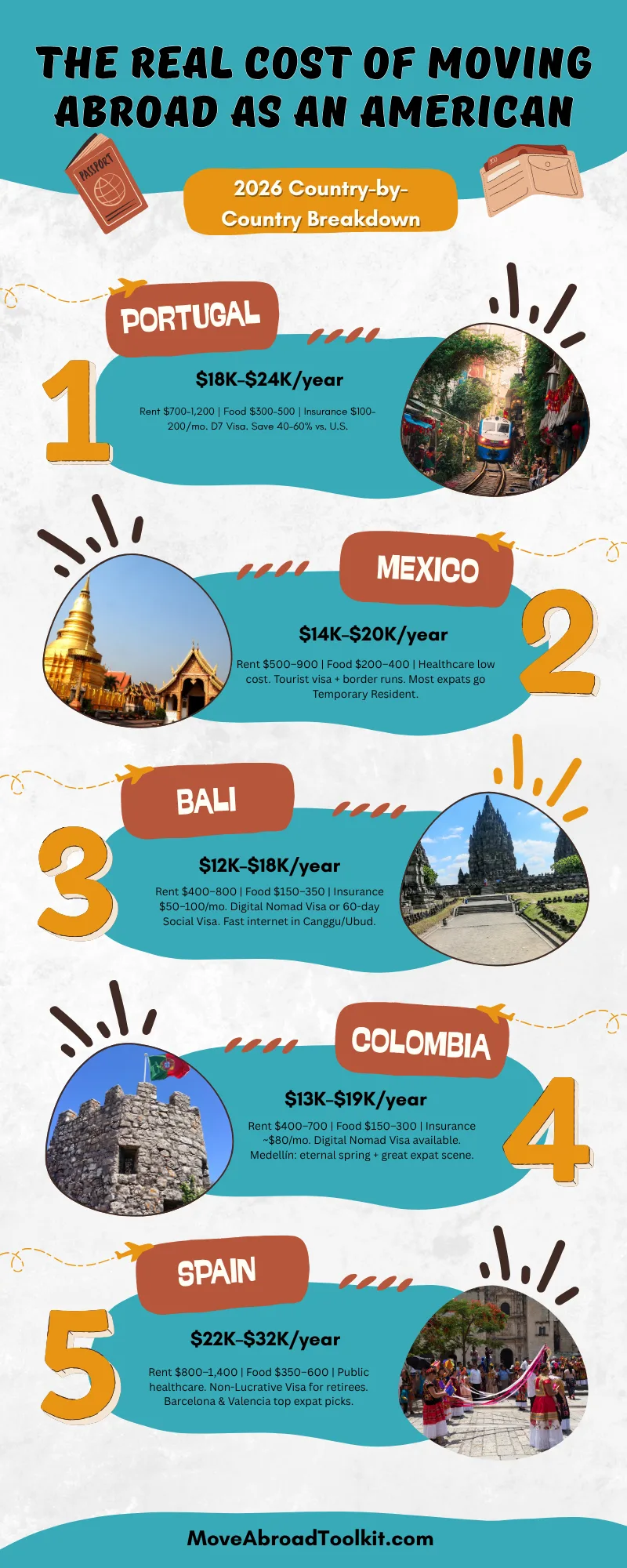
📌 Save this guide for later! Pin it to your travel or move abroad board so you can find it when you need it.
Click the image above to save directly to Pinterest.
Ready to Make Your Move to Cape Town?
Cape Town is one of the most compelling destinations for Americans who want a high-quality life at a fraction of US costs. The exchange rate, the climate, the food scene, and the English-speaking environment make it accessible in a way that many cheaper cities are not.
Start with the Start Here guide to map out your move step by step. Then bookmark the resources page for the tools and services that make relocation smoother.
The Move Abroad Toolkit gives you everything you need to plan, budget, and execute your international move with confidence. Explore the full toolkit here.
I funded my own move abroad by selling my house, my car (to CarMax), and my belongings on Facebook Marketplace and at garage sales. That firsthand experience shapes how I write about moving abroad — I am not just summarizing data, I am telling you what the numbers actually mean for someone making a real move.
For health coverage while abroad, SafetyWing Nomad Insurance starts at $45.08 per month for Americans under 40. It covers you in most countries and is built for long-term travelers and expats.
If you need a VPN for US streaming or public wifi security, NordVPN works well from abroad.
US tax filing does not stop when you move abroad. You still owe US taxes on worldwide income. Taxes for Expats specializes in expat tax returns and can save you from expensive mistakes.
If you are serious about the move, grab the Move Abroad Toolkit to plan your budget, timeline, and logistics in one place.
Thinking about moving abroad? Book a Move Abroad Planning Call for personalized guidance on your relocation.
Continue Planning Your Move
Everything you need is in one place.
Free Download
Remote Income Starter Kit
30 curated remote job boards, an application tracker & freelance rate calculator. Fund your move before you leave.