
Moving to Spain from the US: 2026 Complete Guide for Americans
Some links on this site are affiliate links, which means the site may earn a commission at no extra cost to you. Services are included because they fit the move abroad process, not because of the commission.
Why trust this guide? I’m Kim, founder of Move Abroad Toolkit. After selling my house, my car (to CarMax), and nearly everything I owned on Facebook Marketplace and at garage sales, I funded my own move abroad. Spain was one of the first destinations I seriously researched and nearly chose before landing where I did. Spain draws more American interest than almost any other destination in Europe, and the decision usually turns on three things: cost, visa route and tax residency. This guide is the complete picture I wish I’d had.
Spain is not a fantasy. It’s a fully operational choice for Americans willing to do the work upfront. More than 200,000 Americans currently live there, drawn by Mediterranean climate, world-class healthcare, genuine EU access, and a quality of life that costs significantly less than comparable US cities. Spain also offers one of the most advantageous tax regimes for new foreign residents on the planet, the Beckham Law, which locks in a 24% flat income tax rate for your first six years.
The honest caveat: moving from the US to Spain involves real bureaucratic complexity. Apostilles, sworn translations, Social Security Certificates, TIE cards, padron registrations, the administrative layer is substantial. Americans who go in expecting a straightforward process leave disappointed. Americans who plan the administrative timeline realistically arrive prepared.
If you’re also comparing Mediterranean options, the Malta Digital Nomad Visa is worth exploring, it offers an English-speaking EU island with a straightforward application process for remote workers.
This guide covers the full move from the US to Spain using the M.O.V.E. Method: Map your mindset (region selection), Own your financial runway, Venture out (the visa process), and Establish abroad (first 30 days).
What’s In This Guide
- Why Spain Is a Top Destination for US Expats
- Step 1, Map Your Mindset: Choose Your Region
- Step 2, Own Your Financial Runway
- Step 3, Venture Out: The Visa Process
- Step 4, Establish Abroad: Your First 30 Days
- Critical Pre-Move Checklist for Americans
- Hidden Costs Americans Don’t Expect
- Working Remotely from Spain as an American
- Is Spain Right for You?

Why Spain Is a Top Destination for US Expats
Spain consistently ranks among the most aspirational relocation destinations for Americans, and the data supports the aspiration. The World Health Organization ranks Spain’s healthcare system in the global top 10. The cost of living is 30-50% lower than equivalent US coastal cities. Valencia, in particular, is one of the most affordable major Spanish cities, see the full cost of living in Valencia Spain for Americans breakdown for exact 2026 numbers. The Beckham Law offers a 24% flat income tax rate for new residents for up to six years, compared to Spain’s standard top rate of 47%. And after ten years of legal residency, you become eligible for Spanish citizenship, full EU passport access.
The time zone reality deserves honest mention. Spain runs 6 hours ahead of US Eastern Time. This works well for some remote situations (European client base, async-friendly employers) and is genuinely challenging for others. This is a filter, not a dealbreaker, but stress-test it against your specific work situation before committing.
Step 1: Map Your Mindset, Choosing Your Region in Spain
Spain is not one place. Regional differences in culture, cost, climate, and expat infrastructure are significant enough that where you choose to live shapes your entire experience. Americans often fixate on Barcelona or Madrid without considering that Valencia offers comparable quality of life at 30-40% lower cost, or that Malaga’s expat community has grown dramatically in the past three years.
Madrid: Urban Capital with Full Expat Infrastructure
Madrid is Spain’s financial and cultural center. The American expat community is well-established, English is widely spoken in business contexts, and the city has everything a US transplant needs operationally. Cost of living is the highest in Spain, with a comfortable monthly budget of €2,500-4,000 for one person. Summers are brutally hot (regularly 38-40C). Madrid is best for high-earning professionals, those with US corporate employers, or anyone who needs full urban infrastructure during a transition period.
Barcelona: Cosmopolitan, Beaches, Catalan Complexity
Barcelona offers Mediterranean beach lifestyle, global cosmopolitan culture, world-class architecture, and a startup and creative ecosystem. The catch: Barcelona is the most expensive city in Spain, rental markets are tight, and the region operates in both Castilian Spanish and Catalan. Best for: creatives, digital nomads who value the specific Barcelona aesthetic and social scene, and those who’ve already visited and know exactly what they want.
Valencia: Mid-Sized, Growing American Community, More Affordable
Valencia is the choice that surprises Americans once they discover it. Spain’s third-largest city has Mediterranean beaches, spectacular food culture (paella originates here), and costs 30-40% less than Madrid or Barcelona. A comfortable monthly budget runs €1,800-3,000. The American expat community has grown significantly in the past three years. See our Cost of Living in Valencia guide for specific monthly figures.
Andalusia and Malaga: Coastal, Lower Cost, Slower Pace
Malaga, Seville, and Granada offer Spain’s most affordable cost of living alongside impressive historic cities. Malaga has seen a surge in expat and digital nomad arrivals, partly driven by a growing tech sector. Monthly budgets run €1,500-2,500. Trade-offs: less corporate expat infrastructure, more reliance on Spanish language in daily life. Best for retirees, lifestyle-first movers, and remote workers who don’t need a dense US professional network nearby.
Other Regions Briefly
Bilbao and San Sebastian in the Basque Country offer high quality of life with distinct cultural identity. Galicia (Santiago de Compostela, Vigo) is green, Atlantic-facing, and dramatically underrated at a significantly lower cost than southern coastal cities. Each has a different personality from classic Spain.

Step 2: Own Your Financial Runway
Cost of Living Reality Check
Spain is cheaper than comparable US coastal cities, but not cheap by absolute standards. Realistic monthly budgets for one person living comfortably: Valencia €1,800-3,000, Madrid or Barcelona €2,500-4,500, Malaga or Seville €1,500-2,500. These assume standard long-term rental rates, not tourist pricing. The rental market in Barcelona and Madrid has tightened, factor 3-6 months of housing search time for the best rates in those cities.
Navigating Spanish Taxes: Beckham Law and Wealth Tax
The Beckham Law (Regimen Especial de Trabajadores Desplazados) offers a 24% flat income tax rate on Spanish-source income for new Spanish residents, available for six years. Requirements: no Spanish tax residency in the prior 5 years, new Spanish residency established, income from foreign sources or a foreign employer, and the opt-in application (Modelo 149) filed within 6 months of registering for social security in Spain. For DNV holders earning from US employers or foreign freelance clients, this rate applies to primary income.
The Wealth Tax applies to high-net-worth individuals but varies significantly by region, Madrid has effectively eliminated the regional portion. US side: the Foreign Earned Income Exclusion (approximately $126,500 in 2026) and Foreign Tax Credit structure your US obligations. Consult Taxes for Expats for CPA-prepared returns that model both Spanish and US obligations. See our full Spain DNV taxes guide for the complete breakdown.
Step 3: Venture Out, The Spain Visa Process for Americans
Non-Lucrative Visa (NLV): For Retirees and Passive Income
The NLV requires approximately €28,800/year in passive income for a solo applicant (roughly €2,400/month), with additional amounts for dependents. You cannot work in Spain on an NLV, including remote work for non-Spanish employers. This is the cleaner choice for retirees or those living fully from investment income or Social Security benefits.
Digital Nomad Visa (DNV): For Active Remote Workers
The Spain digital nomad visa specifically permits remote work for foreign employers and clients. The 2026 income requirement is €2,762/month for a solo applicant (200% of Spain’s SMI). For the complete documentation breakdown, W2 vs 1099 proof, Social Security Certificate, family thresholds, see our Spain DNV income requirements guide. The DNV also unlocks Beckham Law eligibility, see our complete Spain DNV requirements guide for the full application walkthrough.
Other Visa Pathways
The Golden Visa (€500,000+ property investment) exists but has faced political debate. Work visas apply to those employed by Spanish companies. Student visas cover those enrolled in Spanish programs. Family reunification applies if you have qualifying EU or Spanish relatives. Most Americans relocating for lifestyle choose NLV or DNV.
The Apostille and Sworn Translation Process
American documents used in Spanish visa applications must be apostilled (internationally certified by the appropriate US authority) and sworn-translated (by a certified Spanish jurado translator). FBI background checks are apostilled through the US Department of State. Birth certificates are apostilled through the Secretary of State of the issuing state. Average apostille processing: 2-6 weeks. Sworn translation costs: €60-150 per document, 1-2 weeks. Budget 3-4 months for the full documentation preparation process before your visa appointment.
Step 4: Establish Abroad, Your First 30 Days in Spain
Getting Your TIE (Tarjeta de Identidad de Extranjero)
The TIE is your Spanish foreigner identity card and the foundational document for life in Spain. You need it to open a bank account, sign a rental lease, and access many services. DNV and NLV holders have 30 days from arrival to apply at the local Oficina de Extranjeria. Appointments are booked online and can be in high demand in major cities, book immediately upon arrival. Required: passport, visa authorization, completed EX-17 form, two passport photos, proof of address, and the TIE fee payment receipt (approximately €16, Tasa 790-012).
Finding Long-Term Housing
Spain’s rental market operates differently from the US. Standard contracts run 5 years with 1-year extension rights for the tenant. Landlords require a fianza (1 month security deposit) plus an additional garantia of 1-2 months. Some landlords require a garante (guarantor with Spanish property) for Americans without local credit history, a common friction point. Primary platforms: Idealista (dominant for long-term rentals), Fotocasa, and Habitaclia (Catalonia). Never wire funds before viewing a property in person or on video call.
Opening a Spanish Bank Account
With your TIE in hand, opening a Spanish bank account becomes straightforward. BBVA, Santander, and CaixaBank are the major retail banks. Requirements: passport, TIE, Spanish address, and NIE (assigned through the TIE process). In the meantime, Wise provides EUR account details and a debit card without requiring Spanish residency, your financial bridge for the first weeks. See our full best banks for living abroad guide for the complete expat banking stack.
Healthcare Setup in Spain
DNV holders typically access healthcare through private insurance initially. Private Spanish insurers, Sanitas, Adeslas, DKV, offer comprehensive plans starting around €50-100/month for healthy adults under 40. Private healthcare in Spain is high quality and dramatically less expensive than US private insurance. SafetyWing provides month-to-month global coverage during the transition period before local insurance is arranged.

Critical Pre-Move Checklist for Americans Moving to Spain
6 months out: Passport renewal if less than 12 months remaining. Begin visa research and consulate selection. Start income documentation assembly. Submit SSA Certificate of Coverage application now, it takes 12-16 weeks.
4 months out: FBI background check submission (allow 8-12 weeks for federal processing). Begin apostille applications for all required documents. Get sworn translation quotes and initiate. Research housing markets in your target Spanish city.
3 months out: Submit visa application at your assigned Spanish consulate. Begin virtual housing scouting on Idealista and Fotocasa. Open Wise account and get the debit card.
2 months out: Begin US life liquidation, sell what you don’t need (Kim’s proven approach: Facebook Marketplace, garage sales, CarMax for the car). Give employer notice. Set up US mail forwarding. Cancel non-essential US subscriptions.
1 month out: Research pet relocation if applicable (Spain accepts US-microchipped, vaccinated pets with health certificate and USDA APHIS endorsement). Finalize US expat tax planning. Set automatic US bill payments.
Move week: Confirm TIE appointment booking. Arrive with 30+ days of accommodation confirmed. Carry all visa documents, apostilles, and translations in physical and digital copies.
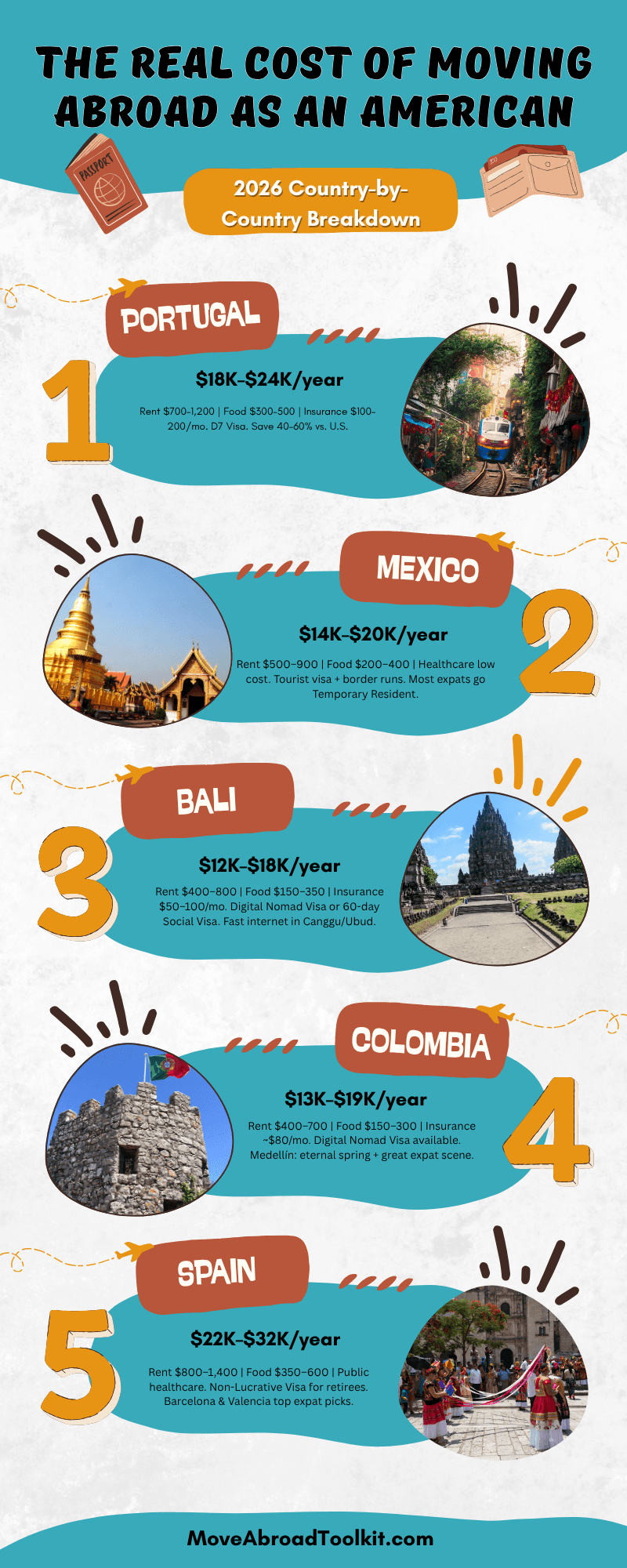
Hidden Costs Americans Don’t Expect When Moving to Spain
- Apostille fees: $20-40 per document plus shipping and expediting
- Sworn translator fees: €60-150 per document depending on length
- FBI background check: $18 FBI fee plus $15-30 for channeling agency
- Immigration lawyer or gestor fees: €200-800 for visa application support
- TIE application fee: approximately €16 (Tasa 790-012)
- Spanish bank account monthly fees: €5-15/month at some traditional banks (compare before opening)
- Padron registration (empadronamiento): free, but requires in-person visit with lease or landlord notarized letter
- First-year healthcare costs if not covered by employer
Budget €500-1,500 for the total documentation and administrative cost of the move on the Spanish side, plus $200-600 for US-side apostille costs depending on the number of required documents.
Working Remotely from Spain as an American
The Spanish Digital Nomad Visa legalizes what many Americans were doing informally, working remotely for foreign employers while living in Spain. With a valid DNV, you work legally, pay Spanish income tax at the Beckham Law rate (24%), and the US-Spain totalization agreement governs your social security obligations.
Co-working infrastructure in Spain’s major cities is excellent. Madrid and Barcelona have dense ecosystems with hundreds of co-working spaces. Valencia’s scene has grown significantly. Fiber internet is standard in urban areas across Spain.
The 183-day rule governs tax residency: spend 183+ days in Spain in a calendar year and you become a Spanish tax resident, which triggers Beckham Law eligibility (and obligation to apply within 6 months of social security registration).
For the full experience picture before you commit, see our Living in Spain for a Month guide and our Moving to Spain as an American cost and visa surprises guide.
Visa Pathway Comparison: Which Route Is Right for You?
Spain offers four primary visa pathways for Americans. The right choice depends entirely on your income structure, work situation, and lifestyle goals. Here is a direct comparison of the four routes most Americans seriously consider.

| Visa Type | Who It’s For | Income Requirement (2026) | Work Permitted? | Beckham Law Eligible? | Path to Residency? |
|---|---|---|---|---|---|
| Digital Nomad Visa (DNV) | Remote workers employed by foreign companies or self-employed freelancers | €2,762/month (~$3,000) | Yes, remote work for foreign employers only | Yes ✅ | Yes, leads to long-term residency |
| Non-Lucrative Visa (NLV) | Retirees, passive income earners, investment income recipients | €28,800/year (~$31,000+) | No ❌, zero work permitted including remote | No ❌ | Yes, leads to long-term residency |
| Golden Visa | High-net-worth investors with €500,000+ in Spanish real estate | Minimum €500,000 real estate investment | Yes | Potentially | Yes, fast track to permanent residency |
| Student Visa | Enrolled in accredited Spanish language or degree programs | Proof of enrollment + sufficient funds | Limited (up to 30 hrs/week part-time) | No ❌ | Yes, via residency extensions |
Kim’s take: For most working Americans under 60, the Digital Nomad Visa is the correct path. It’s the only route that permits your existing remote job or freelance income, unlocks the 24% Beckham Law flat tax rate, and has a straightforward income documentation process if you work for a US employer or have consistent freelance clients. If you’re retired with Social Security and investment income and you do not plan to work at all, the NLV is cleaner, but the no-work restriction is absolute.
Cost of Living by Region: What Americans Actually Spend
The numbers below reflect real monthly budgets for a single American adult living comfortably, not on a backpacker budget, but also not in a luxury apartment. These are mid-range numbers that assume a private one-bedroom apartment, dining out 3-4 times per week, occasional cultural events, and private health insurance.

| City/Region | Rent (1BR) | Groceries/Month | Dining Out | Transport | Health Insurance | Total Estimate |
|---|---|---|---|---|---|---|
| Madrid | €1,200–1,800 | €250–350 | €300–500 | €40–60 | €80–150 | €2,500–4,000 |
| Barcelona | €1,300–2,000 | €260–360 | €320–520 | €40–60 | €80–150 | €2,600–4,200 |
| Valencia | €800–1,300 | €220–300 | €250–400 | €30–50 | €70–130 | €1,800–3,000 |
| Seville | €700–1,100 | €200–280 | €200–350 | €30–50 | €70–120 | €1,500–2,500 |
| Granada | €600–900 | €190–260 | €180–300 | €25–45 | €70–120 | €1,300–2,200 |
| Malaga | €700–1,100 | €200–280 | €200–350 | €30–50 | €70–120 | €1,500–2,500 |
| Mallorca | €900–1,400 | €240–320 | €280–420 | €40–60 | €75–130 | €1,800–2,800 |
These figures do not include one-time setup costs (furniture, appliances if unfurnished, utility deposits) or annual expenses like flights home and professional tax preparation. Budget an additional €2,000–4,000 in your first year for setup costs alone.
Healthcare in Spain for American Expats
Spain’s healthcare system ranks among the best in the world, and for Americans accustomed to the US system, the contrast is striking, both in quality and cost. As a new resident on a DNV or NLV, your initial access pathway is private insurance, with a transition to the public system possible after longer-term residency.
Private Health Insurance: Your First-Year Option
Spain’s private health insurers offer comprehensive coverage at a fraction of US costs. The three dominant providers are Sanitas (owned by Bupa), Adeslas, and DKV. Monthly premiums for a healthy American under 40 typically run €50–100. For ages 40–55, expect €80–160. Coverage includes primary care, specialists, diagnostics, and most hospitalization, with a specialist visit copay of €5–15 and zero copay on most primary care.
Dental is separate from most Spanish health insurance plans. Expect to pay €30–80 for routine dental checkups and €100–200 for fillings at private clinics. Spain has no equivalent of US dental insurance; most expats pay out of pocket or add a basic dental supplement (€8–15/month) to their plan.
Accessing the Public Sistema Nacional de Salud (SNS)
Spain’s public healthcare system is free at point of service for those enrolled. As a DNV holder contributing to Spain’s Social Security system (RETA for self-employed, or standard SS contributions for employees), you can register for your tarjeta sanitaria (health card) at your local health center. Processing varies by region, Madrid and Barcelona can take 3–6 months for new residents to be fully enrolled in the public system. In the meantime, private insurance is your practical option.
For interim coverage during the transition period before local insurance is fully arranged, SafetyWing’s Nomad Insurance provides month-to-month global health coverage with no commitment, it’s what I used during my own first months abroad and what I recommend to everyone going through the setup phase.
Banking and Money Management as an American in Spain

Opening a Spanish bank account requires your TIE card, which typically takes 4–8 weeks to process after arrival. This creates a practical gap: you arrive in Spain, need to pay rent, buy groceries, and cover day-to-day expenses, but can’t open a local account yet. Here’s the banking stack that works for most American expats at each stage.
Pre-TIE: Wise Is Your Bridge
Wise provides EUR account details and a physical debit card without requiring Spanish residency. You can open it from the US before you leave, transfer money from your US accounts at mid-market exchange rates, and have a working EUR debit card on arrival. I use Wise to move money between currencies.
Spanish Banks: What to Expect After Your TIE
Once your TIE arrives, the major Spanish retail banks accept new resident accounts with your passport, TIE, and proof of address. BBVA and Santander both offer English-language digital banking and have the largest branch networks. CaixaBank is dominant in Catalonia and Valencia. Monthly fees run €5–15 for standard accounts, some accounts are fee-free if you set up direct deposit or maintain a minimum balance.
N26 (German digital bank, EU-based) is another popular option for expats who want a fully digital experience with a Spanish IBAN. They accept residents of EU countries including Spain without requiring in-branch appointments.
Education for Families: Schools in Spain
If you’re moving with school-age children, Spain has a layered education system that accommodates expat families at different budget levels. Understanding the options upfront prevents one of the most common source of stress for families in their first year.
International Schools
International schools offer English-medium instruction and typically follow the British, American, or IB curriculum. They are available in all major Spanish cities. Costs run €8,000–25,000 per year per child, with Madrid and Barcelona at the higher end. These schools are the smoothest transition path for kids who don’t speak Spanish, and for families who may relocate again within a few years. Waiting lists exist for popular schools in Madrid and Barcelona, apply 6–12 months before your planned arrival.
Spanish Public Schools
Spain’s public schools are free and legally accessible to all legal residents regardless of nationality. Instruction is in Spanish (and the regional language in Catalonia, Galicia, and the Basque Country). For children under 10, immersion in a public school produces rapid Spanish language acquisition, most kids are functionally conversational within 6 months. For older children (11+), the language gap creates a harder adjustment period. Many expat families use public school with private Spanish tutoring for the first year.
Bilingual Public Schools (Colegios Bilingues)
Spain’s public system includes designated bilingual schools that teach core subjects in both Spanish and English. These are free, highly competitive for enrollment, and available in most major cities. For families who want English continuity without international school fees, these are the prime target, but slots are limited and applications must be filed through the regional education authority well in advance.
Culture, Lifestyle, and the Reality of Daily Life

Spain operates on a rhythm that takes most Americans several months to genuinely internalize. Lunch is the main meal of the day, eaten between 2:00 and 4:00pm. Dinner doesn’t start before 9:00pm, 9:30 or 10:00pm is standard at restaurants. The siesta (a midday break, not necessarily a nap) means some small businesses close between 2:00 and 5:00pm, particularly outside major cities. This is not a charming quirk to be managed, it’s how the entire day is structured, and adapting to it is part of the relocation.
Social life in Spain is built around being outside, in plazas, at café terraces, on paseos. The bar culture is social rather than drinking-focused; going for a caña (small beer) or a café con leche at 7pm with neighbors is how communities function. Americans who adapt to this rhythm consistently report dramatically lower stress levels than their US lives, even in the face of bureaucratic frustrations.
Spanish language proficiency matters more than most expats expect. In Madrid and Barcelona, English is workable in business contexts and tourist areas. In Seville, Valencia, Granada, and smaller cities, you will need functional Spanish to rent an apartment, deal with the Oficina de Extranjeria, or navigate day-to-day commerce. I recommend reaching at least A2–B1 Spanish before moving, then continuing aggressively once there.
Common Mistakes Americans Make When Moving to Spain

The Spain relocation process has a few predictable failure points. Here are the ones that cause the most setbacks.
- Underestimating documentation timelines. The FBI background check takes 8–12 weeks. The SSA Certificate of Coverage takes 12–16 weeks. People who start these applications late miss their visa appointment windows by months.
- Choosing the wrong visa type. Americans who accept freelance work on an NLV are in violation of their visa terms. The DNV was created specifically for this situation, use it.
- Not modeling the Beckham Law correctly. The 24% rate is on Spanish-source income. Your US-source income (for those who don’t become full Spanish tax residents) has different treatment. Run the numbers with a dual-country CPA before you move, not after.
- Housing search timing. Barcelona and Madrid rental markets move fast. Coming without a housing plan and expecting to find a 12-month lease within a week routinely fails. Budget 2–4 weeks in short-term accommodation to search properly.
- Skipping the padron. The empadronamiento (municipal registration) is free and takes an hour, but it’s required for TIE renewal, school enrollment, and some local healthcare services. Americans frequently overlook it in the chaos of arrival.
- Not setting up US financial continuity before leaving. Confirm your US bank accounts can operate without in-person requirements. Set up trusted contact designations, digital access, and automatic payments before you leave, not after you’ve lost easy access to a US address.
- Underbudgeting year one. Setup costs, furniture, security deposits, administrative fees, one-time professional services, routinely add €3,000–6,000 to the first-year budget beyond monthly living expenses. Most people don’t budget this separately.
Frequently Asked Questions: Moving to Spain from the US
Can Americans move to Spain permanently?
Yes. Americans can move to Spain permanently via the Digital Nomad Visa (for remote workers), the Non-Lucrative Visa (for retirees or passive income earners), or the Golden Visa (for significant real estate investors). After five years of continuous legal residency, you become eligible for permanent residency. After ten years, Spanish citizenship and an EU passport become available.
How much money do you need to move to Spain from the US?
The NLV requires approximately €28,800/year in passive income for a single applicant. The DNV requires €2,762/month in active remote income. Beyond income requirements, budget €5,000–10,000 in liquid savings for relocation costs, first/last month rent, setup expenses, and an emergency cushion for the administrative process.
Do Americans need a visa to live in Spain?
Americans can visit Spain visa-free for up to 90 days within any 180-day period under the Schengen agreement. To live in Spain long-term, meaning more than 90 days, Americans must obtain a residency visa. The Digital Nomad Visa or Non-Lucrative Visa are the two most common pathways for American adults relocating to Spain.
What is the cheapest city in Spain for American expats?
Granada and smaller Andalusian cities like Almería or Jaén offer the lowest cost of living in mainland Spain. Monthly budgets for a comfortable lifestyle can run €1,200–1,800 in these cities. Among the major cities that most Americans target, Valencia consistently offers the best balance of cost, quality of life, infrastructure, and growing expat community, with monthly budgets running €1,800–3,000.
Is Spain a good place for American retirees?
Spain ranks among the top retirement destinations globally for Americans with passive income. The Non-Lucrative Visa was designed for exactly this profile. Social Security and pension income counts toward the income requirement. Healthcare costs are dramatically lower than the US. Climate is favorable across most of the country. The trade-off is a meaningful bureaucratic process to establish residency and a language learning curve that retirees must take seriously.
Can I work remotely from Spain as an American?
Yes, with the correct visa. The Spain Digital Nomad Visa specifically legalizes remote work for non-Spanish employers and clients. Working remotely from Spain without a DNV, on a tourist entry, for example, violates Spanish immigration law even if you’re only there 60 or 80 days. The DNV process takes 2–4 months total but provides full legal authorization and Beckham Law tax access.
Do I have to pay US taxes if I live in Spain?
Yes. The US taxes its citizens on worldwide income regardless of where they live. However, the Foreign Earned Income Exclusion (approximately $126,500 in 2026) can exclude a significant portion of foreign-earned income from US taxation. The US-Spain tax treaty and Foreign Tax Credit further reduce double-taxation. Most Americans living in Spain benefit from working with an expat CPA who handles both US and Spanish filings simultaneously.
How long does it take to get a Spain Digital Nomad Visa?
Total timeline from starting your documentation to receiving your visa is typically 4–7 months. Document preparation (FBI background check, SSA Certificate, apostilles, translations) takes 3–4 months. The consulate appointment and decision process takes an additional 4–8 weeks. Allow 6 months total from starting the process to having your visa in hand.
What is the Beckham Law and who qualifies?
The Beckham Law (officially Régimen Especial de Trabajadores Desplazados) is a Spanish tax regime that allows qualifying new residents to pay a flat 24% income tax rate on Spanish-source income for up to six years, instead of the standard progressive rate that tops out at 47%. To qualify, you must not have been a Spanish tax resident in the prior 5 years, must obtain Spanish residency in the current year, and must file the opt-in application (Modelo 149) within 6 months of registering for Spanish Social Security. DNV holders are the primary qualifying group among American expats.
Is healthcare free in Spain for expats?
Spain’s public healthcare is free at point of service for enrolled residents. As a legal resident contributing to the Spanish Social Security system, you can register for the public system and receive free primary and specialist care, hospital treatment, and prescription medication at significantly reduced cost. New residents typically start with private insurance for the first 3–6 months while the public registration processes. Private insurance is high quality and inexpensive, €50–130/month for most healthy adults under 50.
How do I get my NIE number in Spain?
Your NIE (Número de Identidad de Extranjero) is assigned as part of the TIE (Tarjeta de Identidad de Extranjero) application process. As a DNV or NLV holder, you apply for your TIE within 30 days of arrival at the local Oficina de Extranjería. Your NIE appears on your TIE card. You’ll need the TIE application (form EX-17), your passport and visa authorization, two passport photos, proof of address, and payment of the Tasa 790-012 fee (approximately €16).
What is the best neighborhood in Madrid for American expats?
Chamberí and Salamanca are the established neighborhoods for professionals and families, higher cost, excellent infrastructure, quieter residential character. Lavapiés and Malasaña attract younger expats and digital nomads. For families with school-age children, Las Rozas and Pozuelo de Alarcón (suburbs northwest of Madrid) have high concentrations of international schools and expat communities. Proximity to your international school or co-working space should drive the neighborhood decision more than aesthetics.
Can I bring my pet when moving to Spain?
Yes. Spain accepts pets from the US with a valid ISO microchip, current rabies vaccination (administered after the microchip), and an EU health certificate endorsed by the USDA APHIS (Animal and Plant Health Inspection Service). The USDA endorsement must happen within 10 days of travel. Allow 4–6 weeks to schedule the USDA appointment. Airlines have breed and size restrictions for cabin versus cargo travel, verify these well before booking.
Is Spain safe for Americans?
Spain is consistently one of the safest countries in Europe for expats and travelers. Violent crime rates are low by international standards. The primary concern in major tourist areas, particularly Barcelona’s Ramblas and Madrid’s Puerta del Sol, is pickpocketing and bag theft. Standard urban precautions (crossbody bags, awareness in crowded areas) are sufficient. Smaller cities and residential neighborhoods are notably tranquil. The US State Department currently rates Spain at Level 1: Exercise Normal Precautions.
How do I open a bank account in Spain as an American?
Open a bank account after receiving your TIE card. Bring your passport, TIE, proof of Spanish address (lease agreement or padron certificate), and your NIE number. BBVA, Santander, and CaixaBank are the three largest retail banks with English-language digital banking. Until your TIE arrives, use Wise for EUR transactions, it provides a Spanish IBAN equivalent and works from day one without requiring residency documentation.
What are the best resources for Americans moving to Spain?
The Spain Digital Nomad Visa subreddit (r/SpainDNV) and the Americans Abroad Facebook groups have active communities with recent real-world experience. For official documentation requirements, the Spanish Consulate website for your jurisdiction is the authoritative source, requirements vary by consulate (Los Angeles handles different cases than New York, for example). For tax planning, Taxes for Expats specializes in US expat returns with Spanish income. For the Move Abroad Toolkit’s Spain-specific resources, DNV income worksheet, pre-move timeline, and Spain checklist, start with the MATK Toolkit.
Still comparing countries? Take the free country match quiz to see which countries fit your budget, language comfort and lifestyle, then compare your top options side by side.
Is Moving from the US to Spain Right for You?
Spain rewards specific types of movers. You’ll thrive if you have genuine patience for administrative processes, some functional Spanish (or serious commitment to learning quickly), an appreciation for slower daily rhythms, longer meals, later schedules, siesta culture in smaller cities, and a lifestyle that doesn’t require US-speed efficiency in every interaction.
High earners benefit most from the Beckham Law. If your income exceeds $100,000/year, the 24% flat tax rate compared to high-tax US state rates (or Spain’s 47% standard rate) is transformative. If your income is below $80,000/year, cost-of-living savings in Valencia or Andalusia become the primary financial driver instead.
Spain may not be the right fit if you need US-style administrative efficiency, can’t tolerate extreme summer heat in inland cities, have income tightly locked to US Pacific Time work hours, or prioritize a large English-speaking social circle in a low-tourist environment.
The Americans who stay are the ones who came prepared, for the paperwork, the language learning curve, and the slower, richer pace of life that makes Spain worth every form you had to apostille.
Moving from the US to Spain in 2026 takes planning, not just inspiration. The M.O.V.E. Method gives you the framework: Map your region, Own your financial picture, Venture through the visa process, and Establish your life in-country with the right first priorities.
The MATK Toolkit includes a Spain-specific move checklist, DNV income worksheet, and pre-move timeline template. All free. It’s where to start.
Wise handles cross-border transfers and EUR accounts before your Spanish bank opens. SafetyWing covers you month-to-month during the transition. Airalo provides affordable eSIMs so you stay connected from day one. Taxes for Expats handles your US expat tax return, essential in your first Spain year.

📌 Save this guide for later! Pin it to your travel or move abroad board so you can find it when you need it.
Click the image above to save directly to Pinterest.
Thinking about moving abroad? Book a Move Abroad Planning Call for personalized guidance on your relocation.
Continue Planning Your Move
Everything you need is in one place.
Free Quiz
Find Your Best Country Match
Answer a few quick questions about your budget, language comfort, lifestyle and visa needs, and see which countries fit you best.