Bulgaria Digital Nomad Visa: 7 Requirements Americans Must Know (2026)
Some links on this site are affiliate links, which means the site may earn a commission at no extra cost to you. Services are included because they fit the move abroad process, not because of the commission.
QUICK ANSWER
What is the Bulgaria Digital Nomad Visa?
Bulgaria’s digital nomad visa is a Type D long-stay visa that allows non-EU remote workers to live legally in Bulgaria for up to 12 months. The income requirement is approximately €1,650/month (~$1,800), one of the lowest in Europe. Application processing typically takes 2–4 weeks after submission to the Bulgarian embassy. Americans are eligible to apply.
- Income threshold: ~€1,650/month (3× Bulgarian minimum wage)
- Processing time: 2–4 weeks at Bulgarian embassy
- Visa fee: ~€100
- Maximum stay: 12 months
- Schengen impact: None, Bulgaria is not Schengen
- Americans eligible: Yes
The Bulgaria digital nomad visa might not be on your radar yet. But for remote workers who want affordable European living without EU visa complexity, it deserves a serious look.
The Bulgaria Digital Nomad Visa is a Type D long-stay visa that lets non-EU remote workers live and work legally in Bulgaria for up to one year. The income threshold is low compared to most European alternatives. The cost of living is even lower. And the application process, while paperwork-heavy, is manageable when you know exactly what Bulgarian authorities need to see.
This guide covers the seven eligibility criteria, the full application process, what your dollar buys in Bulgaria, and what you need to know about life on the ground.
Bulgaria Digital Nomad Visa: Eligibility Requirements, Application Process, and Tax Benefits
The bulgarian digital nomad visa (digital nomad residence permit) allows remote professionals, remote workers, and remote employees of companies based outside Bulgaria – working for foreign employers to live and work from Bulgaria legally. To meet the eligibility criteria, applicants must show: an employment contract or service agreement with a foreign company, proof of accommodation in Bulgaria, a clean criminal record certificate from their home country and current country of residence, and income meeting the minimum salary requirements (at least 2x the bulgarian monthly minimum wage, approximately €1,500/month). EEA citizens benefit from simplified eligibility requirements under european union free movement rules.
For non-EU foreign nationals (including us citizens), the application process begins at the bulgarian embassy in their home country: apply for a Type D long-stay visa (90 calendar days), enter Bulgaria, then convert to the digital nomad residence permit. Legal residence as a tax resident in Bulgaria carries a flat 10% income tax on remote services income earned from a foreign company – one of the lowest rates in the european economic area. Bulgaria is in the Schengen area, so legal residence here also enables travel throughout the EU. The digital nomad residence permit is renewable annually, and many remote professionals choose to build toward permanent residency after 5 years of continuous legal residence.
📋 WHAT’S IN THIS GUIDE
What the Bulgaria Digital Nomad Visa Actually Is
Bulgaria launched its digital nomad visa option through an update to its existing long-stay visa framework.
Unlike some countries that created entirely new visa categories, Bulgaria uses its Type D long-stay visa structure. Under this framework, digital nomads and remote workers can apply for the Bulgaria digital nomad visa and get a 12-month residency permit. The visa allows you to live in Bulgaria legally while earning income from clients or employers outside of Bulgaria. You are not permitted to work for Bulgarian companies or clients under this visa category.
Bulgaria is not a Schengen area member, which is an important distinction. This means your stay in Bulgaria does not count against your 90-day Schengen allowance. You can use Bulgaria as a base and still travel to Schengen countries separately, as long as you track your Schengen days correctly.
Who Qualifies and What You Need to Prove It
The Bulgaria digital nomad visa has specific eligibility criteria that you must document before your application will move forward.
Here are the seven requirements Bulgarian authorities will check. Every item on this list requires documentation, Bulgaria does not take applicants at their word.
1. Proof of Income Above the Bulgarian Monthly Minimum Wage
You must show monthly income of at least three times the Bulgarian monthly minimum wage.
As of 2025, the Bulgarian minimum wage is approximately BGN 1,077 per month (roughly €550). Three times that amount puts your income threshold at approximately €1,650 per month, or about $1,800. This is one of the lowest income thresholds of any European digital nomad visa, making Bulgaria accessible to a wider range of remote workers. You must document this with bank statements covering the last three to six months.
Bulgaria’s threshold is one of the lowest in Europe, which makes the income bar accessible for most remote workers. To see how this stacks up against other countries, the full comparison covers 15 destinations with current figures.
2. Valid Health Insurance
You must have valid health insurance that covers you in Bulgaria for the full duration of your stay.
Standard US health insurance and Medicare do not provide coverage in Bulgaria. You’ll need an international health insurance policy with minimum coverage of €30,000. SafetyWing Nomad Insurance is a popular and affordable option among digital nomads applying for European long-stay visas, it meets the minimum requirements and covers Bulgaria specifically.
3. Proof of Accommodation in Bulgaria
You need a documented Bulgarian address at the time of your application.
A signed rental agreement is the standard form of proof of accommodation. Some applicants use hotel bookings for initial entry, but you’ll need a proper rental contract to complete your local registration. Sofia, Plovdiv, and Varna are the most popular cities for digital nomads, each offers reliable internet, a growing expat community, and affordable rents.
4. Clean Criminal Record Certificate
You must submit a criminal background check from your home country.
For Americans, this is the FBI Identity History Summary. Request it through the FBI’s website. Processing typically takes six to eight weeks. The document must be apostilled, officially certified for international use. Order it early. This is often the longest step in the documentation process and the one that causes application delays.
5. Valid Passport
Your passport must be valid for at least one year beyond your intended stay in Bulgaria.
6. Proof of Remote Work or Business Outside Bulgaria
You must prove your income comes from clients or an employer located outside of Bulgaria.
Acceptable proof includes an employment contract on company letterhead confirming remote status and salary, or freelance contracts and recent invoices from non-Bulgarian clients. The Bulgarian embassy wants to see that you are genuinely earning income independently of the Bulgarian labor market. This protects your visa eligibility and ensures you’re not competing for local employment.
7. Completed Application and Consulate Fees
You must submit your completed D-type visa application to the Bulgarian embassy in the US.
Download the application form from the Bulgarian embassy website. Complete it in full. The visa fee is typically €100, though the exact amount may vary slightly by consulate location. Bring two recent passport photos, copies of all your supporting documents, and your original documents for verification. Make an appointment in advance, the Bulgarian embassy in the US handles applications by appointment only.
How to Apply: Step-by-Step
The Bulgaria Digital Nomad Visa application follows a two-stage process similar to most European long-stay visas.
Stage 1: Apply at the Bulgarian Embassy in the US
Gather all your documents first: valid passport with at least 12 months remaining validity, proof of income for the last three to six months, valid health insurance certificate with minimum €30,000 coverage, proof of accommodation in Bulgaria, FBI background check with apostille, proof of remote work or business, completed application form, two passport photos, and the €100 visa fee. Schedule your appointment at the nearest Bulgarian embassy. You can find the full list of Bulgarian diplomatic missions on the Bulgarian Ministry of Foreign Affairs website. Processing time is typically two to four weeks after submission. You’ll receive a D-type national visa allowing entry into Bulgaria.
Stage 2: Register in Bulgaria Within 30 Days of Arrival
After you enter Bulgaria, you must register your address at the local Migration Directorate office within 30 days. Bring your signed lease agreement, passport, and the documents you submitted to the consulate. You’ll receive a certificate of residence registration. This registration is what officially establishes your legal status for the duration of your stay. Use Wise to set up an account before you arrive, it simplifies receiving foreign income, paying Bulgarian rent, and managing currencies without expensive exchange fees.
The Cost of Living Makes Your Dollar Go Further
Bulgaria consistently ranks as one of the most affordable countries in Europe, and that advantage is significant for remote workers earning in dollars.
In Sofia, a furnished one-bedroom apartment in a central area costs between €350 and €600 per month. Outside the capital, you can find quality rentals for €200 to €400. Groceries cost roughly 40% less than in Western Europe. A sit-down meal at a local restaurant averages €5 to €10. Monthly public transport passes in Sofia cost around €20. Internet is fast, affordable, and widely available, Bulgaria consistently ranks highly for internet speed in Europe.
A solo digital nomad can live comfortably in Sofia for €800 to €1,200 per month, covering rent, food, utilities, transport, and entertainment. That figure leaves significant room within the income requirement of approximately €1,650. Add NordVPN for secure remote working on public networks and to access US-based services from abroad, both practical necessities when you’re working internationally long-term.
One additional benefit for Americans: the US-Bulgaria tax treaty. Bulgaria has a flat 10% income tax rate, one of the lowest in the EU. You’ll still be required to file US taxes as a citizen, but you may qualify for the Foreign Earned Income Exclusion if you meet the 330-day physical presence test. NordVPN is useful for secure remote access; for tax planning, Taxes for Expats specializes in Americans living abroad and can help you navigate both your US obligations and potential Bulgarian tax exposure.
Frequently Asked Questions
Is Bulgaria in the Schengen Area?
Bulgaria is an EU member state but is not yet a full Schengen area member. Your time in Bulgaria does not count against your 90-day Schengen allowance. This is an advantage for digital nomads who want to travel across Europe, you can live in Bulgaria and still have your full 90-day Schengen window available for travel to countries like France, Spain, and Germany.
How long can I stay in Bulgaria on the digital nomad visa?
The Type D long-stay visa allows you to stay in Bulgaria for up to 12 months. There is currently no straightforward renewal pathway specifically for digital nomads as there is in countries like Greece or Croatia. If you want to stay longer, you would need to explore other visa categories or reapply from outside Bulgaria. Check with the Bulgarian embassy for the most current renewal options, as this area of the law continues to evolve.
Can I work for Bulgarian clients on this visa?
No. The Bulgaria digital nomad visa is specifically for remote workers who earn income from outside Bulgaria. Working for Bulgarian companies or clients would require a different type of work authorization. This is a standard condition for digital nomad visas across most European countries, you are living in the country, not entering its local labor market.
What is the income requirement for the Bulgaria Digital Nomad Visa?
You must show monthly income of at least three times the Bulgarian monthly minimum wage. As of 2025, this puts the threshold at approximately €1,650 per month, or roughly $1,800. This is one of the lowest income requirements of any European digital nomad visa, which is a significant advantage for remote workers who are earlier in their careers or who work in industries with lower average incomes.
How long does the Bulgaria digital nomad visa take to process?
After submitting your complete application at the Bulgarian embassy or consulate, processing typically takes 2 to 4 weeks. This is the processing time for the D-type national visa itself, your Stage 1 application. The step that most often causes delays is the FBI Identity History Summary (criminal background check with apostille), which can take 6 to 8 weeks to obtain. Order your FBI background check first, before you begin assembling the rest of your application. Once you arrive in Bulgaria, you have 30 days to register your address at the local Migration Directorate office, that registration step is typically completed same-day or within a few business days.
Can Americans apply for the Bulgaria digital nomad visa?
Yes. Americans are eligible to apply for the Bulgaria digital nomad visa. US citizens apply through the Bulgarian embassy or consulate in the United States. The main Bulgaria-specific document requirement for Americans is the FBI Identity History Summary as proof of a clean criminal record, this must be apostilled for international use. All other requirements (income proof, health insurance, accommodation, remote work documentation) are the same for US applicants as for other nationalities. The US-Bulgaria bilateral relationship also means Americans benefit from a favorable tax treaty, with Bulgaria’s flat 10% income tax rate potentially complementing the US Foreign Earned Income Exclusion for those who meet the 330-day physical presence test.
Not sure which country to plan around yet? Before you work through the details, take the free country match quiz to find the countries that fit your budget, visa needs and lifestyle.
Ready to Make Your Move to Bulgaria?
The Bulgaria digital nomad visa offers something rare: European residency with a genuinely low income threshold and an affordable lifestyle that lets your dollars stretch.
If you’re comparing European digital nomad options, the Greece Digital Nomad Visa is worth reading alongside this one, it offers EU/Schengen membership with a higher income requirement. The Croatia Digital Nomad Visa is another strong alternative for non-Schengen European living. For a broader comparison of where Americans are moving abroad, see the Best Countries for Americans to Move Abroad guide, and the Digital Nomad Visas for Americans overview covers all the options in one place.
When you’re ready to plan your move, the Start Here page walks you through everything step by step. The Resources page has vetted tools for every stage of the process.

📌 Save this guide for later! Pin it to your travel or move abroad board so you can find it when you need it.
Click the image above to save directly to Pinterest.
I funded my own move abroad by selling my house, my car (to CarMax), and my belongings on Facebook Marketplace and at garage sales. That firsthand experience shapes how I write about moving abroad, I am not just summarizing data, I am telling you what the numbers actually mean for someone making a real move.
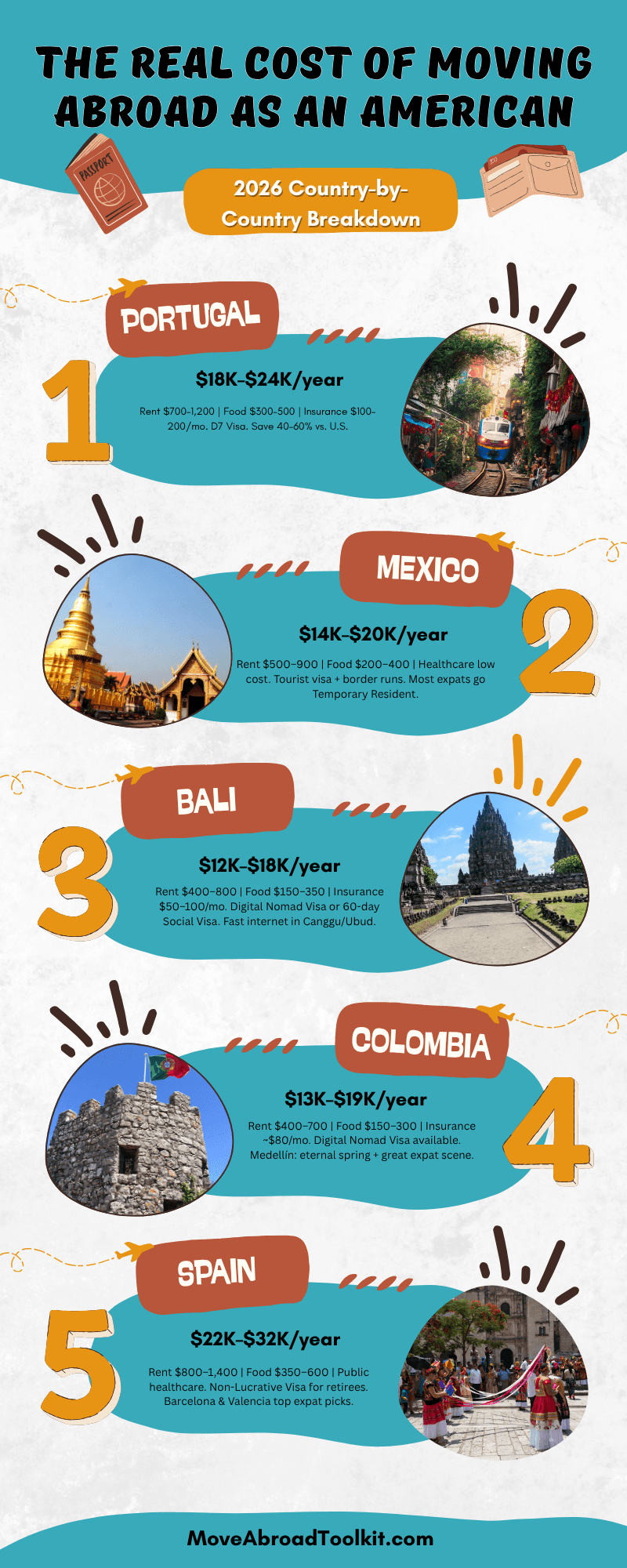
Currency exchange fees eat into every international transfer. Use Wise instead of your bank for real exchange rates and low fees. Most expats save $50 to $100 per month on transfers alone.
For health coverage while abroad, SafetyWing Nomad Insurance starts at $45.08 per month for Americans under 40. It covers you in most countries and is built for long-term travelers and expats.
If you need a VPN for US streaming or public wifi security, NordVPN works well from abroad.
US tax filing does not stop when you move abroad. You still owe US taxes on worldwide income. Taxes for Expats specializes in expat tax returns and can save you from expensive mistakes.
If you are serious about the move, grab the Move Abroad Toolkit to plan your budget, timeline, and logistics in one place.
Just starting out? See where to begin, check our recommended tools, and when you are ready to build your plan, get the Move Abroad Toolkit.
Thinking about moving abroad? Book a Move Abroad Planning Call for personalized guidance on your relocation.
Continue Planning Your Move
Everything you need is in one place.
Free Quiz
Find Your Best Country Match
Answer a few quick questions about your budget, language comfort, lifestyle and visa needs, and see which countries fit you best.