
Portugal Digital Nomad Visa Tax: What You Need to Know
Some links on this site are affiliate links, which means the site may earn a commission at no extra cost to you. Services are included because they fit the move abroad process, not because of the commission.
Thinking about working remotely from a beautiful country by the ocean? The Portugal digital nomad visa makes it easier than ever to live there while keeping your remote job. But before you pack your bags, you need to understand how Portugal digital nomad visa tax works.
I’m Kimberly. I research the details of moving abroad. Portugal’s digital nomad visa tax situation is one of the most asked-about topics in the expat community, and I’ve dug into the details so you don’t have to start from scratch. I funded my own move abroad by selling my house, selling my car to CarMax, and selling my belongings on Facebook Marketplace, so I know how much every tax decision affects the money you actually have to live on. That is why every tax figure in this guide links to an official or professional source rather than to my opinion.
Portugal’s tax rules for new residents changed recently, and a lot of older advice online is now out of date. The NHR regime that many guides still describe is closed to new applicants, and its replacement is much narrower. This guide explains how a D8 holder is actually taxed, what Americans still owe the IRS, and why a cross-border tax professional should check your plans before you move.
Once you decide to make the move, there’s lots of support to help you get settled. You’ll find vibrant communities of other digital nomads, affordable living options, and a mix of city and countryside life to choose from. Consider Portugal if you’re looking for a mix of work and adventure.
Update, September 2026: Portugal closed the NHR regime to new applicants. Its replacement, IFICI, applies a 20% flat rate for 10 years, but only to income from qualifying research, innovation, and tech roles. Most remote workers on the D8 visa will not qualify, so read the NHR sections below as background and confirm your status with a Portugal tax advisor before you move.
Key Takeaways
- NHR was revoked from 1 January 2024 and is closed to new applicants (PwC Portugal Tax Guide 2026).
- Its replacement, IFICI, taxes qualifying income at 20%, but only for specific research, innovation and professional roles. Most D8 remote workers will not qualify (PwC).
- Without a special regime, Portuguese tax residents pay progressive rates from 12.5% to 48% on worldwide income for 2026 (PwC Worldwide Tax Summaries).
- US citizens still owe US taxes while living abroad in Portugal and must keep filing a US return (IRS).
- This is general information, not tax advice. Speak with a cross-border tax professional before you move.
📋 WHAT’S IN THIS GUIDE
Portugal’s Digital Nomad Visa Overview
Portugal offers a Digital Nomad Visa (also called the Temporary Stay Visa for Remote Work) that aims to attract remote workers and freelancers. This visa allows you to stay longer in the country, enjoy its rich culture, and experience a vibrant work-life balance. For a full comparison of your options, see our guide on the Portugal D7 vs Digital Nomad Visa.
Key Benefits
The Digital Nomad Visa provides several benefits for remote workers. You can reside in Portugal while working for a company located outside the country. This visa grants temporary residency, making it easier to travel across Europe.
Portugal’s appealing lifestyle is another huge perk. Enjoy beautiful beaches, historic cities, and a mild climate. The local community is welcoming, and there are plenty of coworking spaces. Plus, you will have access to top-notch healthcare and good public services.
Eligibility Requirements
To apply for the Digital Nomad Visa, you must meet certain requirements. You need to show proof of income from a non-Portuguese source, typically at least four times the Portuguese minimum monthly wage. With the 2026 minimum wage set at €920 per month, that works out to €3,680 per month. You’ll also need health insurance, a clean criminal record, and proof of accommodation in Portugal.
Having remote work contracts or freelance agreements in place is essential. The Portuguese government wants to ensure you have stable income that doesn’t depend on local employment. For transfer of funds between currencies, Wise is popular for low-cost international transfers when you’re moving money between the US and Portugal.
How Portugal Digital Nomad Visa Tax Works
The D8 visa is an immigration status, not a tax status. Holding it does not give you a special tax rate. What decides your Portugal digital nomad visa tax bill is whether you become a Portuguese tax resident and, if you do, whether any special regime applies to you. For most remote workers, the answer is the standard Portuguese system.
Becoming a Tax Resident
You are a Portuguese tax resident if you spend more than 183 days in Portugal, consecutive or not, in any 12 month period that starts or ends in the tax year. You can also become resident with fewer days if you have a home in Portugal in conditions that suggest you intend to keep it as your habitual residence (PwC Worldwide Tax Summaries, residence).
Portuguese tax residents are taxed on their worldwide income, not only on money earned in Portugal (PwC Worldwide Tax Summaries). A D8 holder who lives in Portugal for most of the year should expect to meet the residency test.
What Happened to NHR
The Non-Habitual Resident regime, known as NHR, was Portugal’s best known tax incentive for new residents. It was repealed by Law 82/2023, the 2024 State Budget (KPMG Flash Alert 2025-044), and revoked with effect from 1 January 2024 (PwC Portugal Tax Guide 2026).
NHR now applies only to people who were already registered before 1 January 2024, people who met its registration requirements by 31 December 2023, and certain people who became tax resident by 31 December 2024 and met specific conditions. Those people keep it for the rest of their ten year period (PwC Portugal Tax Guide 2026).
If you are moving to Portugal on a D8 visa now, NHR is not available to you. Older articles that promise a 0% rate on foreign income for ten years describe a regime that no longer accepts new applicants.
IFICI, the Replacement Regime, and Who Qualifies
Portugal replaced NHR with the Tax Incentive for Scientific Research and Innovation, known as IFICI and sometimes called NHR 2.0 (KPMG Flash Alert 2025-044). It applies a special 20% rate to employment and self-employment income from eligible activities for ten consecutive years, and exempts most foreign source income, with the exception of pensions and certain income from tax havens (PwC, IFICI).
The eligible activities are narrow. PwC lists teaching in higher education and scientific research, qualified professions in companies operating in eligible business sectors, employees and members of corporate bodies in start-ups, and certain activities in the Azores and Madeira (PwC, IFICI). The implementing regulation, Portaria 352/2024, requires highly qualified professionals to hold a doctorate, or a bachelor’s degree plus three years of documented professional experience, and limits many roles to companies in listed activity codes that export at least 50% of their turnover (EY).
The Portuguese tax authority adds further conditions. You must not have been tax resident in Portugal in the previous five years, you cannot have benefited from NHR or IFICI before, and you must register by 15 January of the year after you become resident. You can still register after that date, but the ten year period then runs from the year you register rather than your first year of residence. For most categories, the role must be held under an employment contract, and a service contract does not qualify (Portal das Finanças, IFICI FAQs).
Does a D8 Remote Worker Qualify for IFICI?
Usually not. IFICI is tied to specific activities, specific employers and, for most categories, a Portuguese employment contract. A typical D8 holder works remotely for a US company or invoices foreign clients as a freelancer, and neither fits the eligible activities described by PwC, EY and the tax authority. A small number of D8 holders may have a qualifying role. If you think you do, have a Portuguese tax advisor confirm it before you rely on it, and plan your budget on the standard rates below until then.
Standard Portuguese Income Tax Rates for 2026
If no special regime applies, Portugal taxes resident individuals at progressive rates. These are the 2026 brackets for mainland Portugal.
| Taxable income, 2026 | Rate |
|---|---|
| Up to €8,342 | 12.5% |
| €8,342 to €12,587 | 15.7% |
| €12,587 to €17,838 | 21.2% |
| €17,838 to €23,089 | 24.1% |
| €23,089 to €29,397 | 31.1% |
| €29,397 to €43,090 | 34.9% |
| €43,090 to €46,566 | 43.1% |
| €46,566 to €86,634 | 44.6% |
| Over €86,634 | 48% |
Source: PwC Worldwide Tax Summaries, Portugal, taxes on personal income. Mainland Portugal, resident individuals.
Each rate applies only to the part of your taxable income that falls within that band. An additional solidarity rate of 2.5% applies to taxable income above €80,000, rising to 5% above €250,000 (PwC Worldwide Tax Summaries). Deductions and other rules change the final figure, so treat this table as a starting point, not a calculation of what you will owe.
US Tax Obligations Abroad
Moving to Portugal does not end your US tax obligations. US citizens and resident aliens living abroad are taxed on their worldwide income, and the IRS notes that benefits such as the foreign earned income exclusion are only available if you file a US return. Americans abroad also get an automatic extension to June 15 to file (IRS, US citizens and resident aliens abroad).
Foreign Earned Income Exclusion (FEIE)
For tax year 2026, the maximum Foreign Earned Income Exclusion is $132,900 per person. To claim it, you must meet either the bona fide residence test or the physical presence test (IRS, figuring the foreign earned income exclusion).
Foreign Tax Credit
You may also be able to claim a foreign tax credit for income tax you pay to Portugal (IRS). Which option works better, the exclusion or the credit, depends on your income and how much Portuguese tax you pay, so have a professional compare both before you file.
The US and Portugal Tax Treaty
The US and Portugal signed an income tax treaty in 1994. It does not stop the US taxing its own citizens: the treaty’s saving clause allows the United States to tax its citizens as if the treaty had not come into effect, with limited exceptions (IRS, US and Portugal treaty text). For Americans, relief from double taxation therefore comes mainly through the exclusion or the credit.
FBAR Reporting
If the combined value of your foreign financial accounts exceeds $10,000 at any time during the calendar year, you must file an FBAR (IRS, FBAR). This is a reporting requirement, separate from your tax return.
For US expat tax filing, Taxes for Expats specializes in Americans abroad.
For health coverage that travels with you between the US and Portugal, SafetyWing Nomad Insurance provides flexible medical coverage for remote workers living abroad. And for data connectivity across Europe, Airalo eSIM makes staying connected affordable throughout your Portugal stay.
Social Security: Which System Do You Pay Into?
The US and Portugal have a totalization agreement, effective 1 August 1989, which is designed so you do not pay social security to both countries on the same work (SSA, US and Portugal agreement).
Under the agreement, self-employed workers who live in Portugal are covered by the Portuguese system (SSA). Employees are generally covered by the country where they work, with an exception for employees sent temporarily by their employer where the assignment is not expected to exceed five years (SSA, agreement text). Whether that exception fits a D8 holder working indefinitely from Portugal for a US employer is a question for a professional.
In Portugal, the self-employed contribution rate is 21.4%, calculated on relevant income, which is 70% of income from services rendered. Reduced rates apply to people who depend heavily on a single client (PwC Worldwide Tax Summaries, other taxes).
Practical Steps for Digital Nomads
Here’s a practical approach to navigating the Portugal digital nomad visa tax situation:
- Get your visa first: Apply for the digital nomad visa through the Portuguese consulate in your home country.
- Know when you become resident: Track your days, and remember that a home in Portugal can make you resident before you reach 183 days (PwC).
- Check IFICI only if your role could qualify: The registration deadline is 15 January of the year after you become resident (Portal das Finanças).
- Keep filing in the US: File a US return every year, and an FBAR if your foreign accounts exceed $10,000 (IRS).
- Hire a cross-border tax professional: Choose someone who works with both Portuguese and US tax, ideally before you move.
For banking in Portugal, check our guide on opening a bank account in Portugal as an American. Having a local account simplifies everything from paying rent to receiving local transfers. The Move Abroad Toolkit has a complete checklist for Americans making this transition.
What Does This Mean for Your Total Tax Burden?
There is no single answer, and this guide deliberately does not give a worked example with a final number. Your total bill depends on whether you are employed or self-employed, which social security system covers you, what kinds of income you have, and how the US exclusion or credit interacts with the Portuguese tax you pay.
In broad terms, a D8 holder who is tax resident in Portugal and does not qualify for IFICI should expect Portuguese tax at the standard progressive rates on worldwide income, a US return every year, and relief from double taxation through the Foreign Tax Credit or the FEIE rather than through a special Portuguese rate.
Important: This article is general information based on published official and professional sources. It is not tax, legal or financial advice, and I am not a tax professional. Portuguese and US tax rules change often and interact in ways that depend on your personal situation. Before you move or make a financial decision, speak with a cross-border tax professional who works with both Portuguese and US tax.
Lisbon vs. Porto vs. Smaller Towns
Where you base yourself in Portugal also affects your practical expenses, though not your tax rate. Lisbon is the most expensive option, with rents in the city center averaging $1,200 to $2,000/month for a one-bedroom. Porto offers similar infrastructure at roughly 20-30% less. Smaller cities like Coimbra or Braga offer significantly lower costs while still having good internet and expat communities.
Not sure which country to plan around yet? Before you work through the details, take the free country match quiz to find the countries that fit your budget, visa needs and lifestyle.
Frequently Asked Questions
Do digital nomads pay tax in Portugal?
If you become a Portuguese tax resident, generally by spending more than 183 days there in a 12 month period or by having a home you intend to keep as your habitual residence, you are taxed in Portugal on your worldwide income (PwC). The D8 visa itself does not change this.
What is the Portugal digital nomad visa tax rate?
There is no special D8 rate. NHR is closed to new applicants (PwC). Its replacement, IFICI, applies a 20% rate only to income from eligible research, innovation and professional activities (PwC), and most D8 remote workers fall outside it. For them, the standard 2026 rates apply, from 12.5% to 48%, plus a solidarity rate on higher incomes (PwC).
Can I still apply for Portugal’s NHR program as a US citizen?
No. Portugal’s Non-Habitual Resident (NHR) program was revoked with effect from 1 January 2024. It now applies only to people who were registered before that date, people who met its registration requirements by 31 December 2023, and certain people who became tax resident by 31 December 2024 (PwC Portugal Tax Guide 2026). If you move to Portugal now, the only special regime is IFICI, which covers specific research, innovation and professional roles (PwC, IFICI), and most US remote workers will not qualify. NHR also never changed what you owe the IRS, because the US and Portugal tax treaty lets the US tax its citizens as if the treaty did not exist, with limited exceptions (IRS, treaty text).
How is US Social Security taxed if I live in Portugal?
Article 20 of the US and Portugal tax treaty says social security benefits paid by one country to a resident of the other may be taxed in the paying country (IRS, treaty text). How Portugal treats those benefits for its own residents depends on your circumstances, so confirm it with a cross-border tax professional.
How do I avoid double taxation between Portugal and the US?
The treaty does not stop the US taxing its citizens (IRS). Americans generally rely on the Foreign Earned Income Exclusion, up to $132,900 for 2026 (IRS), or a foreign tax credit for income tax paid to Portugal. A tax professional who specializes in US expat taxes (like Taxes for Expats) can help you decide which approach fits.
What’s the cost of living like for digital nomads in Portugal?
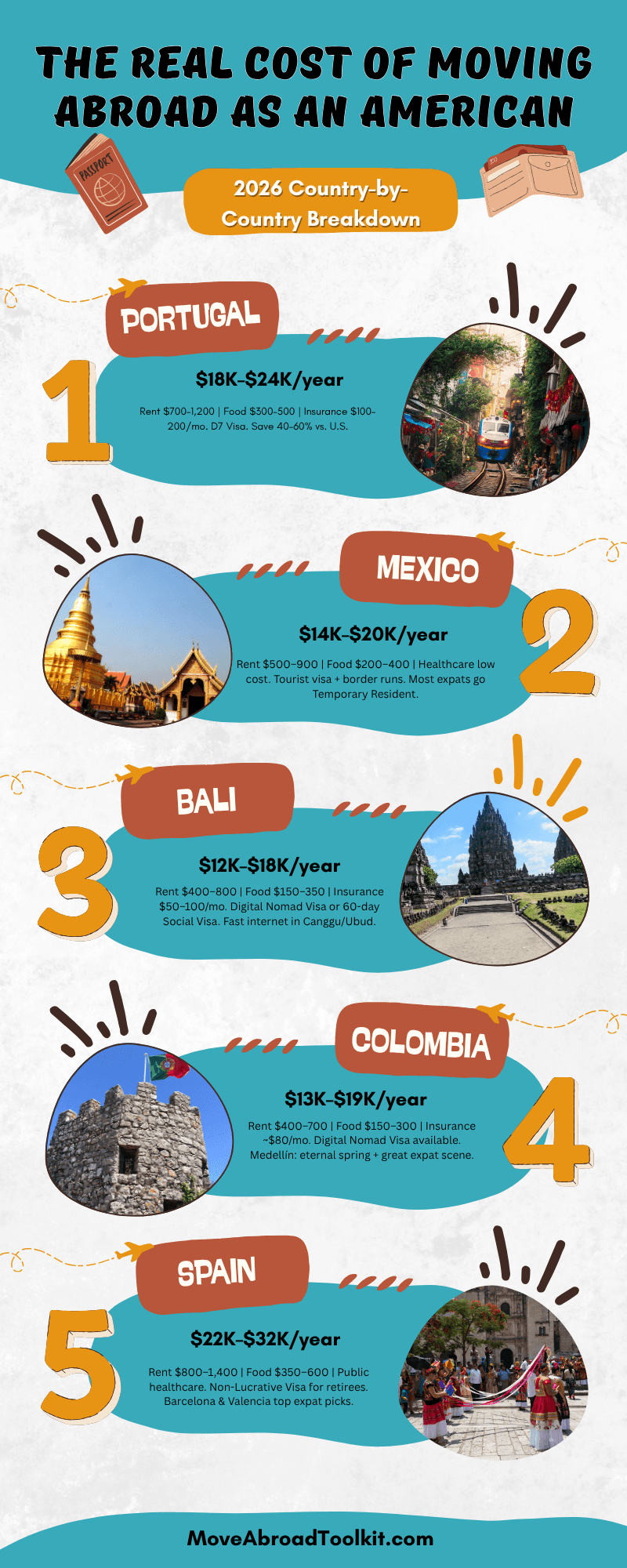
Portugal remains one of the more affordable Western European countries for remote workers. For a detailed breakdown, see our 2026 cost of living in Lisbon guide. You can also explore 90 days in Portugal for a practical month-by-month cost breakdown.

📌 Save this guide for later! Pin it to your travel or move abroad board so you can find it when you need it.
Click the image above to save directly to Pinterest.
New to planning a move? Start here, or browse our full resources list for tax, banking, and insurance tools.
Thinking about moving abroad? Book a Move Abroad Planning Call for personalized guidance on your relocation.
Continue Planning Your Move
Everything you need is in one place.
Free Quiz
Find Your Best Country Match
Answer a few quick questions about your budget, language comfort, lifestyle and visa needs, and see which countries fit you best.