Portugal D7 Visa: Complete Step-by-Step Guide for Americans
Some links on this site are affiliate links, which means the site may earn a commission at no extra cost to you. Services are included because they fit the move abroad process, not because of the commission.
At a Glance
- Visa type: D7 Passive Income / Remote Worker Visa, renewable, path to citizenship
- Minimum income: ~€920/month (minimum wage), but €1,500+/month recommended in practice
- Consulate visa fee: ~€90 ($100)
- Processing time: 60 to 90 days typically
- Path to residency: Yes, permanent residency after 5 years, citizenship eligible at 5 years
- Tax regime: NHR (Non-Habitual Resident) offers favorable rates for 10 years
- Longest lead item: FBI background check + apostille, start 12 to 16 weeks early
📋 WHAT’S IN THIS GUIDE
1. What Is the Portugal D7 Visa?
For current Portugal D7 Visa requirements, visit the official SEF (Serviço de Estrangeiros e Fronteiras) website, Portugal’s immigration authority. You can also find detailed consulate requirements via the Portugal D7 visa official portal. Americans should also review the IRS foreign income exclusion guidelines before applying.

📌 Save this guide for later! Pin it to your travel or move abroad board so you can find it when you need it.
Click the image above to save directly to Pinterest.
📌 Save this guide for later! Pin it to your travel or move abroad board so you can find it when you need it.
Hover over any image in this post to pin it directly to Pinterest.
- Who it’s for: Retirees, remote workers, investors, and anyone with regular passive income
- Duration: 1 year initially, renewable for 2-year periods
- Path to residency: After 5 years, you can apply for permanent residency or citizenship
- Minimum income: ~€920/month (the Portuguese minimum wage), though consulates often want higher amounts
- Where to apply: Portuguese consulate in the US (before traveling)
2. The 7 Essential Steps to Get Your Portugal D7 Visa
Step 1: Verify Your Income Eligibility
Portugal requires you to demonstrate sufficient income to support yourself without working locally. The official minimum is €920/month, but in practice, consulates and AIMA (the immigration authority) typically want to see:- Primary applicant: €920 to €1,500/month (higher amounts strengthen your application)
- Spouse: Add 50% of the primary minimum per spouse
- Each dependent child: Add 30% per child
Step 2: Gather Your Documents
The Portuguese consulate requires a specific document package. Prepare these well in advance, some take weeks to obtain.- Valid US passport (minimum 6 months beyond your visa expiry)
- Completed D7 Visa application form
- Passport-sized photos (2 to 4, meeting specifications)
- Criminal background check (FBI or state-level, must be apostilled)
- Proof of income: 3 to 6 months of bank statements + income source documentation
- Proof of accommodation in Portugal: rental contract or hotel booking for first stay
- Health insurance valid in Portugal (required, see Step 5)
- Declaration of means of subsistence
- Cover letter explaining your plans in Portugal (optional but highly recommended)
Step 3: Get Your Criminal Background Check Apostilled
This step trips up many applicants. Your criminal background check must be “apostilled”, meaning it needs an official government stamp verifying its authenticity for international use. In the US, this is done through your state’s Secretary of State office.An FBI background check takes 3 to 4 months to process. A state-level check is faster (1 to 2 weeks). Some applicants use both. Start this process as early as possible, it’s the longest step in the entire D7 process.Step 4: Secure Proof of Accommodation in Portugal
You need a rental contract or hotel/Airbnb booking showing you have a place to stay in Portugal. Many applicants book a short-term rental for the first 1 to 3 months, then find permanent housing after arrival.Note: You don’t need to own or have a long-term lease, just proof that you have somewhere to go.Step 5: Get Health Insurance
Portugal requires you to have health insurance that’s valid in Portugal for the duration of your initial visa period. Options include:- International expat insurance plans (Cigna Global, Pacific Cross, AXA)
- SafetyWing’s Remote Health plan (covers long-term stays)
- Some travel insurance plans if they explicitly cover long-term stays
Step 6: Apply at Your Portuguese Consulate
Schedule an appointment at your nearest Portuguese consulate. The US has consulates in Boston, New York, New Jersey, San Francisco, and Washington D.C.Bring your complete document package plus copies of everything. The consulate officer will review your application and may ask about your income sources and plans in Portugal. Processing takes 60 to 90 days typically.The D7 visa fee is approximately €90 ($100) payable at the consulate.Step 7: Register With AIMA in Portugal
After you arrive in Portugal, you have 4 months to register with AIMA (Agência para a Integração, Migrações e Asilo, the immigration authority). This is where you get your official residence permit.- Schedule an AIMA appointment (there can be a waitlist, book immediately upon arrival)
- Bring your visa, passport, NIF number, proof of address, and income documentation
- Pay the residence permit fee (€83 for a 2-year permit)
- Receive your biometric residence card within a few weeks
3. Portugal D7 Visa Cost Breakdown
| Item | Approximate Cost |
|---|---|
| Consulate visa fee | €90 (~$100) |
| FBI background check + apostille | $18 + $20 to $50 |
| Health insurance (first year) | $600 to $2,000 |
| AIMA residence permit fee | €83 (~$90) |
| Immigration attorney (optional but recommended) | $500 to $1,500 |
| Translation/notarization of documents | $100 to $400 |
| Total estimated range | $1,400 to $4,140 |
4. Cost of Living in Portugal for Americans
Portugal is still one of the most affordable Western European countries. cost of living in Lisbon has increased in recent years, but cities like Porto, Braga, Coimbra, and the Alentejo region remain very affordable.| Expense | Lisbon | Porto | Smaller Cities |
|---|---|---|---|
| Rent (1BR) | €900 to €1,400 | €700 to €1,100 | €400 to €700 |
| Groceries (1 person) | €150 to €250 | €130 to €220 | €100 to $200 |
| Eating out (mid-range) | €200 to €400 | €150 to €300 | €100 to €200 |
| Transport | €40 to €60 | €35 to €55 | €20 to €40 |
| Total monthly | €1,290 to €2,110 | €1,015 to €1,675 | €620 to €1,140 |
5. Internet and Remote Work in Portugal
Portugal has excellent internet infrastructure, fiber broadband is widely available and typically costs €30 to €50/month. Lisbon and Porto have strong coworking scenes with hundreds of spaces. Speeds of 500 Mbps+ are common in modern apartments.Portugal is 5 hours ahead of Eastern Time, which works well for Americans who need some overlap with US business hours. Using a NordVPN is useful for accessing US streaming services and maintaining secure connections when working from cafes.Portugal D7 Visa: Your 30/60/90-Day Timeline
90 Days Before You Apply
- Start your FBI background check immediately, this takes 3 to 4 months
- Gather 6 months of bank statements showing your income source
- Contact a Portuguese immigration attorney for a consultation
- Research neighborhoods in Lisbon, Porto, or your target city
- Get international health insurance that’s valid in Portugal
60 Days Before Your Target Move
- Schedule your Portuguese consulate appointment
- Book short-term accommodation in Portugal (proof of address required)
- Get your background check apostilled at your state’s Secretary of State
- Open a Wise account if you don’t have one, makes money transfers seamless
- Get your NIF (Portuguese tax ID number), can be done remotely with a fiscal representative
30 Days Before You Move
- Submit your complete visa application at the consulate
- Finalize travel arrangements and housing
- Set up a Portuguese bank account (Millennium BCP or Novo Banco work well for expats)
- Join Portuguese expat groups on Facebook for city-specific tips
- Book AIMA appointment immediately upon confirming your arrival date
Frequently Asked Questions
Who qualifies for the Portugal D7 Visa?
Any non-EU citizen who has a regular, stable income from outside Portugal qualifies. This includes retirees (pension, Social Security), remote workers (salary or freelance), investors (dividends, rental income), and anyone with passive income. You must demonstrate at least €920/month, though stronger income makes approval more likely.What is the difference between the D7 Visa and the Digital Nomad Visa (D8)?
The D7 Passive Income Visa is better established and works for anyone with regular foreign income. The D8 Digital Nomad Visa is specifically for remote workers and requires proof of a formal employment relationship with a non-Portuguese company. Many remote workers prefer the D7 for its flexibility and track record. Both eventually lead to the same residency permit in Portugal.How long can I stay in Portugal on a D7 Visa?
The initial D7 Visa is a long-stay visa valid for 4 months of entry. Once in Portugal, you register with AIMA and receive a residence permit valid for 2 years. This renews for another 3 years, and after 5 years total, you can apply for permanent residency. After 5 years, you’re also eligible for Portuguese citizenship.Do I need to speak Portuguese to get the D7 Visa?
No, the visa application process is conducted in English at most US consulates. However, having some basic Portuguese helps enormously once you’re living there. For citizenship after 5 years, you’ll need to pass a Portuguese language test (A2 level, basic conversational).Can I work in Portugal on a D7 Visa?
You can work remotely for a non-Portuguese employer or run your own foreign business. You cannot work for a Portuguese employer without a work authorization. If you want to work locally, you’ll need to convert to a different visa type or obtain a work permit separately.What is the NIF number and do I need one?
The NIF (Número de Identificação Fiscal) is the Portuguese tax identification number. You’ll need it for nearly everything in Portugal, opening a bank account, signing a lease, utilities, and healthcare. You can get your NIF remotely before you move by hiring a fiscal representative (typically €150 to €300). Most immigration attorneys handle this as part of their service.Is the Portugal Non-Habitual Residency (NHR) tax regime still available?
As of 2024, Portugal replaced the classic NHR with a new IFICI program with different benefits. Tax rules change frequently, always consult a tax professional who specializes in US expat and Portugal tax law before relying on any specific tax regime.Portugal D7 Visa Renewal: What Happens After Year 1
After your initial 1-year D7 Visa expires, you renew directly with AIMA for a 2-year residence permit. The renewal process is typically simpler than the initial application, you don’t need to go back to a consulate.- Submit renewal application to AIMA at least 30 days before your current permit expires
- Provide updated bank statements (3 to 6 months) showing continued income
- Renew your health insurance if it’s expiring
- Pay the residence permit renewal fee (~€72)
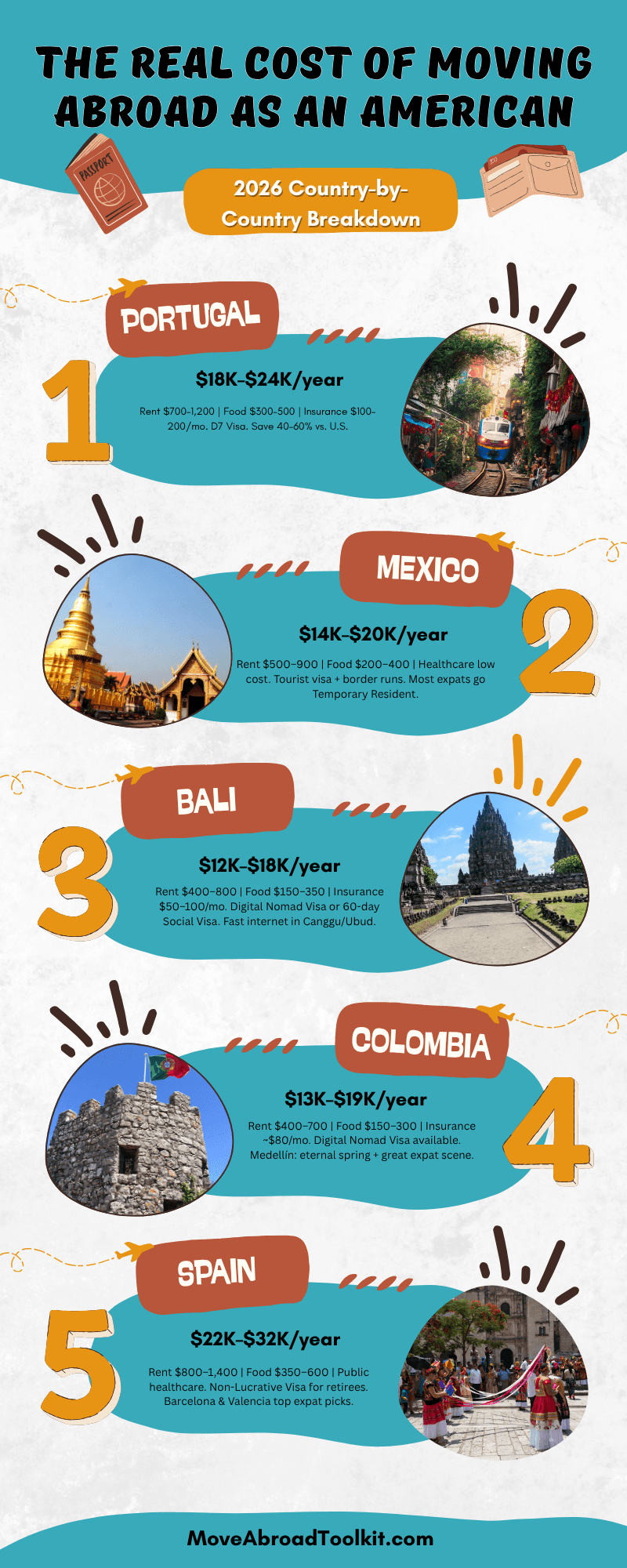
Not sure which country to plan around yet? Before you work through the details, take the free country match quiz to find the countries that fit your budget, visa needs and lifestyle.
Common Portugal D7 Visa Mistakes to Avoid
These are the most common reasons applications get delayed or rejected.- Starting too late. The FBI background check alone takes 3 to 4 months. Starting this process 6+ months before your target move date is essential.
- Insufficient income documentation. Bank statements must show consistent deposits, not just a large balance from a one-time transfer. Recurring monthly deposits are much stronger.
- Booking non-refundable flights before visa approval. Processing can take 60 to 90 days and sometimes longer. Don’t book flights until you have visa in hand.
- Missing the AIMA appointment window. You have 4 months after entering Portugal to register with AIMA. Missing this window creates serious complications. Book your AIMA appointment the day you arrive.
- Not getting an NIF before arriving. Many services in Portugal require a tax ID (NIF) before you can open accounts or sign contracts. Get it remotely before your move date.
Comparing the D7 against the Digital Nomad Visa? Our comprehensive Portugal D7 vs Digital Nomad Visa guide covers income requirements, processing times, and a clear decision framework for Americans.
I funded my own move abroad by selling my house, my car (to CarMax), and my belongings on Facebook Marketplace and at garage sales. That firsthand experience shapes how I write about moving abroad. I am not just summarizing data. I am telling you what the numbers mean for someone making a real move.
Some links below are affiliate links. We may earn a small commission if you purchase through them at no extra cost to you. All product recommendations are based on personal research and would be made regardless of compensation.
Currency exchange fees eat into every international transfer. Use Wise instead of your bank for real exchange rates and low fees. Most expats save $50 to $100 per month on transfers alone.
For health coverage while abroad, SafetyWing Nomad Insurance starts at $45.08 per month for Americans under 40. It covers you in most countries and is built for long-term travelers and expats.
If you need a VPN for US streaming or public wifi security, NordVPN works well from abroad.
US tax filing does not stop when you move abroad. You still owe US taxes on worldwide income. Taxes for Expats specializes in expat tax returns and can save you from expensive mistakes.
Thinking about moving abroad? Book a Move Abroad Planning Call for personalized guidance on your relocation.
Continue Planning Your Move
Everything you need is in one place.
Free Quiz
Find Your Best Country Match
Answer a few quick questions about your budget, language comfort, lifestyle and visa needs, and see which countries fit you best.