Moving to Costa Rica from the US: 2026 Complete Guide for Americans
Some links on this site are affiliate links, which means the site may earn a commission at no extra cost to you. Services are included because they fit the move abroad process, not because of the commission.
Moving to Costa Rica from US is one of the most practical and underrated decisions an American can make. Costa Rica offers Western-standard infrastructure, a stable democracy, excellent healthcare, and a time zone that keeps you overlapping with US business hours, all at a fraction of US costs.
I funded my own move abroad by selling my house, my car (to CarMax), and my belongings on Facebook Marketplace and at garage sales. When I evaluate Costa Rica for Americans, I’m writing from the perspective of someone who actually liquidated my US life to make a move work, not someone aggregating other people’s takes. The financial decision, the visa question, the housing research: I’ve walked through all of it.
This complete guide on moving to Costa Rica from US covers everything: visa pathways, the best regions, real cost of living numbers, healthcare, banking, taxes, and a step-by-step first 90 days. By the end, you’ll know whether Costa Rica is the right move for your situation.
📋 WHAT’S IN THIS GUIDE
- Why Costa Rica Is a Top Choice for Americans
- Visa Pathways for US Citizens
- Best Regions for American Expats
- Cost of Living Reality Check
- Housing in Costa Rica
- Healthcare for American Expats
- Banking and Money Management
- Tax Considerations
- Daily Life in Costa Rica
- Operational Logistics
- Your First 90 Days
- Is Costa Rica Right for You?
Why Costa Rica Is a Top Choice for Americans in 2026
Costa Rica has one of the highest concentrations of American expats in the world. Estimates put the American resident population at over 200,000, and the country has built an entire infrastructure around welcoming foreign residents and remote workers.
Several factors make it particularly strong for Americans. The time zone alignment is underappreciated: Costa Rica runs on CST (Central Standard Time) year-round, meaning EST workers have only a one-hour gap and CST workers have zero. That’s a practical advantage for anyone maintaining US client relationships or a US remote job.
Costa Rica’s political stability is genuine. It abolished its military in 1948 and has had uninterrupted democratic elections ever since. The country consistently ranks as one of the safest and most stable in Central America. For Americans who want the lifestyle advantages of Central America without instability concerns, Costa Rica stands apart.
Foreign-source income is not taxed for non-residents. Costa Rica only taxes income that originates within Costa Rica. For remote workers earning US income, this is a significant structural advantage for the first years of residency.

Visa Pathways for US Citizens Moving to Costa Rica
Americans can enter Costa Rica visa-free for up to 90 days per entry. For longer stays, Costa Rica offers several formal residency pathways.
Costa Rica Digital Nomad Visa
The Costa Rica Digital Nomad Visa requires proving $3,000 per month in income (or $4,000/month if you’re bringing dependents). It grants a 1-year initial stay, renewable for one additional year. Applicants must demonstrate remote employment or freelance income from outside Costa Rica. This is the fastest path for working Americans who want legal residency without committing to long-term Costa Rica income.
Pensionado (Retirement) Visa
The Pensionado Visa requires a lifetime pension income of at least $1,000 per month. Social Security benefits from the US government qualify directly. This is Costa Rica’s most accessible residency path for American retirees. Once granted, it provides permanent residency with the right to remain indefinitely. After 3 years, Pensionado residents can apply for Costa Rican citizenship.
Rentista Visa
The Rentista Visa targets those with non-employment income. Requirements: either $2,500 per month in stable non-employment income for at least 24 months, or a $60,000 deposit in a Costa Rican bank. Americans who liquidate US assets, home sale proceeds, investment accounts, can directly fund Rentista qualification. This is the MATK asset-liquidation pathway applied to Costa Rica.
Inversionista (Investor) Visa
The Inversionista Visa requires a minimum investment of $150,000 in Costa Rican real estate or a registered business. This suits Americans who want to combine residency with real estate ownership. Costa Rica’s Pacific coast real estate market has attracted steady American buyers for decades.
Best Regions for American Expats in Costa Rica
Costa Rica is diverse. Where you choose to live determines your daily experience more than almost any other decision. Here are the five regions that attract the most American expats:
The Central Valley (San José, Escazú, Heredia, Santa Ana) is where the majority of American residents live. Escazú and Santa Ana have become heavily Americanized suburbs with English-speaking services, international schools, US-brand restaurants, and full expat infrastructure. Costs are higher here but it offers the easiest transition for Americans who want familiar amenities. Monthly budget: $2,500-$4,500 for a couple.
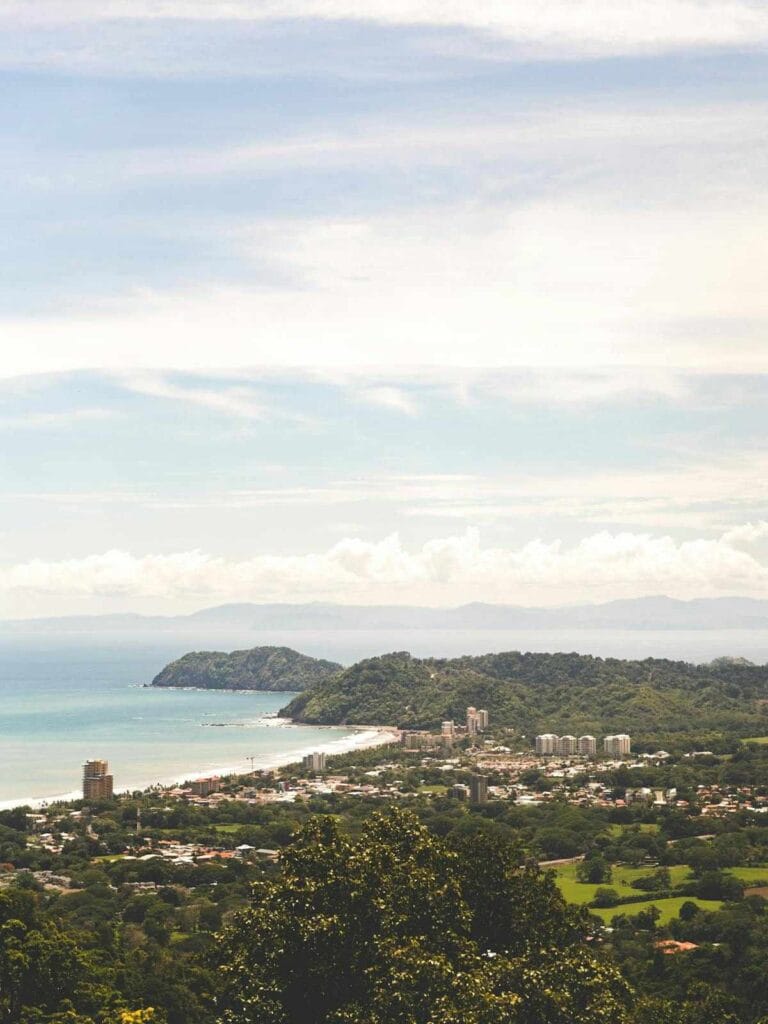
Tamarindo and Guanacaste on the Pacific coast attract the surf-and-beach crowd. The dry season (November through April) is genuinely spectacular. A strong American community has been established for decades. Monthly budget: $2,500-$4,000.
Nosara has become a hub for the wellness and yoga expat crowd. More remote, which keeps prices lower but limits convenience. Great internet and a strong English-speaking community make it viable for remote workers. Monthly budget: $2,000-$3,500.
Manuel Antonio on the central Pacific coast attracts biodiversity enthusiasts. one of the most sought-after areas in the country with a growing expat presence. Monthly budget: $2,500-$4,000.
Atenas is the retiree favorite. Known for having one of the best climates in the world (spring-like temperatures year-round), it offers a quieter pace, lower costs, and a strong American retiree community. Monthly budget: $1,800-$3,000 for a couple.

Cost of Living Reality Check: It’s Not as Cheap as Americans Expect
Costa Rica is the most expensive country in Central America. Americans who move there expecting Mexico or Nicaragua prices are consistently surprised. That said, costs are still substantially lower than major US cities.
A comfortable American lifestyle in Costa Rica typically runs $2,000-$3,500 per month for a single person or $3,000-$5,000 for a couple. This includes rent, food, transportation, healthcare, entertainment, and utilities.
Rent by region: Escazú/Santa Ana 1-bedroom runs $800-$1,400/month; Atenas or smaller towns 1-bedroom runs $500-$800/month; Tamarindo near the beach runs $800-$1,500/month. Grocery costs depend heavily on whether you shop local (affordable) or buy imported US products (expensive, 30-50% tariff premium). Electronics and appliances carry high import tariffs. High-speed fiber internet runs $50-80/month. Utilities (electricity, water) run $80-150/month.
For international money transfers, Wise consistently beats bank exchange rates. For staying connected across borders during your transition, an Airalo eSIM eliminates roaming costs before you establish local service.
Housing in Costa Rica for Americans
Renting first is strongly recommended. Even if you plan to buy, spending 6-12 months renting in your target area before purchasing is the smartest approach. Short-term furnished rentals (1-3 months via Airbnb or VRBO) let you test neighborhoods before committing. Budget 30-50% more than unfurnished long-term rates for furnished short-term options.
Americans can own Costa Rican real estate outright, no restrictions on foreign ownership. The coastal concession zone (first 150 meters from the shoreline) follows different rules: only the first 50 meters is public, and the next 100 meters requires a concession rather than full ownership. Always work with a bilingual Costa Rican attorney for real estate transactions. Utility setup (electricity, water, internet) takes 2-4 weeks after signing a lease.
Healthcare for American Expats in Costa Rica
Costa Rica’s healthcare is one of the strongest in Latin America and a primary reason Americans choose the country. The public CAJA system provides universal coverage for residents at income-based contributions ($50-200/month for most expats). Private hospitals in San José, Hospital CIMA, Clínica Bíblica, provide US-equivalent care at a fraction of US costs. Specialist consultations run $60-100; emergency visits run $200-500. Our detailed healthcare in Costa Rica for American expats guide has the full breakdown on the CAJA enrollment process and the best private facilities.
For the gap period before CAJA enrollment, SafetyWing provides flexible month-to-month coverage starting at approximately $40-60/month.
Banking and Money Management in Costa Rica
Opening a Costa Rican bank account as an American is one of the more frustrating aspects of the move. FATCA compliance has made Costa Rican banks cautious about American clients. State-owned banks (Banco Nacional, BCR) are more likely to open accounts than private banks, but the process takes 2-4 weeks and requires proof of residency.
Most American expats operate primarily from their US accounts for the first year or two. USD is accepted at many businesses in tourist and expat areas, though Colones are standard. For international transfers between US and Costa Rican accounts, Wise offers significantly better exchange rates than traditional bank wires. For secure access to US financial accounts and streaming services from Costa Rica, NordVPN is the standard expat solution.
Tax Considerations for Americans in Costa Rica
Costa Rica operates on a territorial tax system for non-residents: only income earned within Costa Rica is subject to Costa Rican income tax. US employer income, US client income, US investments, and US Social Security are not taxed by Costa Rica during your non-resident period. Tax residency is triggered by spending 183+ days in the country per calendar year.
On the US side: FATCA reporting applies to foreign accounts above $10,000. The Foreign Earned Income Exclusion (FEIE) can exclude up to $126,500 of earned income in 2026 if you meet the bona fide residence or physical presence test. Passive income (Social Security, dividends) remains US-taxable regardless of where you live. Taxes for Expats specializes in exactly this situation and is worth a consultation before your first full year of Costa Rica residency.
Daily Life in Costa Rica
Spanish is essential for daily life outside the major expat enclaves. In Escazú, Santa Ana, Tamarindo, and Nosara, English is widely spoken; beyond these areas, Spanish becomes increasingly important. Investing in Spanish lessons before and after arrival is the single best thing you can do to improve your daily quality of life.
“Pura Vida” is the national ethos, a genuine cultural preference for slower pace and life enjoyment over productivity maximization. For Americans conditioned by hustle culture, this can be frustrating or liberating. Most expats who thrive in Costa Rica make peace with Tico time fairly quickly. Costa Rica has a dry season (verano, November-April) and rainy season (invierno, May-October). The rainy season gets an unfairly bad reputation; afternoon/evening rain bursts rather than all-day monsoons, and the country is greener and less crowded.
Safety is genuinely better than most of Central America, but petty theft and opportunistic crime in tourist areas and San José are real. Basic precautions, not flashing expensive devices, using secure parking, being street-smart at night, are standard for expats.
Operational Logistics for Your Costa Rica Move
Direct flights from major US cities (Miami, Houston, Dallas, LA, New York, Atlanta, Chicago) run 3-5 hours to San José (SJO) or Liberia (LIR). Importing your vehicle is almost never worth it, import taxes run 52-79% of vehicle value. Buy or rent locally instead. Shipping personal belongings is optional for the first year if renting furnished. Pets require a vet health certificate (within 14 days of travel), proof of rabies vaccination, and parasite treatment proof, manageable with 4-6 weeks of lead time.
Your First 90 Days in Costa Rica
The first 90 days are about building foundations. This checklist mirrors the framework in our 90 Days in Costa Rica guide and living in Costa Rica for a month breakdown.
Weeks 1-2: Arrive in short-term furnished rental. Explore your pre-selected region. Confirm the neighborhood matches what you need. Walk, eat local, assess supermarkets, banks, medical facilities, and transportation.
Weeks 2-4: Sign a longer-term lease. Purchase or rent a vehicle. Set up utilities and high-speed internet. Get a Costa Rican SIM card (Kolbi or Claro).
Month 2: Start the residency application process with an immigration attorney. Compile documentation for Pensionado, Rentista, or Digital Nomad Visa. Expect 3-6 months for full DGME (Costa Rica immigration authority) approval.
Month 3: Begin bank account process. Schedule CAJA enrollment appointment. Get DIMEX (Costa Rica national ID for residents) appointment. Continue using SafetyWing health coverage until CAJA enrollment is complete.
Is Costa Rica Right for You?
You’ll thrive if: You’re a remote worker with stable US income of $3,000+/month. You’re a retiree with Social Security of $1,000+/month who wants Latin American lifestyle with stability. You love outdoor and nature experiences. You’re comfortable with Spanish or committed to learning. You’ve researched the costs honestly and aren’t expecting budget paradise.
Costa Rica will frustrate you if: You expect it to be cheaper than it is. You need US-style efficiency from services and government. You can’t tolerate rainy season humidity. You need urban density and a cosmopolitan cultural scene comparable to major US cities.
For community resources and the full expat scene breakdown, see our Moving to Costa Rica as an American guide. If you’re comparing Costa Rica to Portugal, particularly for retirees weighing the Pensionado path against the Portugal D7 passive income visa, our Portugal D7 vs Digital Nomad Visa comparison offers useful context.
Frequently Asked Questions About Moving to Costa Rica from the US
How much money do I need to move to Costa Rica from the US? For a comfortable first year, budget $30,000-$50,000 in liquid savings beyond whatever income you’ll have. This covers a furnished short-term rental while you search for long-term housing, vehicle purchase or rental, the residency application legal fees ($1,500-3,000 for an immigration attorney), and a runway while accounts and CAJA enrollment are established.
Is Costa Rica safe for Americans? The US State Department rates Costa Rica Level 2, Exercise Increased Caution, in its advisory of April 2, 2026, and notes that violent crime does affect tourists. The most common issues are petty theft, pickpocketing in tourist areas, and car break-ins. San José requires standard urban awareness. Beach towns and the Central Valley are generally relaxed environments for American residents.
Do I need to speak Spanish to live in Costa Rica? Not immediately, but you’ll want functional Spanish within 6-12 months. The major expat areas (Escazú, Santa Ana, Tamarindo, Nosara) are heavily English-accommodating. Medical appointments, government offices, and daily commerce outside expat enclaves require at least basic Spanish. Most expats who spend years in Costa Rica acquire conversational Spanish through immersion and lessons.
Can I get Social Security deposited to a Costa Rican bank account? The Social Security Administration can direct-deposit to foreign bank accounts in certain countries. Costa Rica is on the approved list. Once you have a Costa Rican bank account established, you can initiate a direct deposit transfer. For the transition period, many Americans receive Social Security in their US account and then transfer via Wise.
How long does the residency process take? Costa Rica residency approval through DGME (the immigration authority) typically takes 3-9 months after submitting a complete application. The Digital Nomad Visa is faster (2-4 months in many cases). During the application period, you can remain in Costa Rica with border runs (exiting and re-entering to reset your 90-day tourist stamp) or by maintaining your tourist status while your application is processed.
Still comparing countries? Take the free country match quiz to see which countries fit your budget, language comfort and lifestyle, then compare your top options side by side.
Start Planning Your Costa Rica Move
Moving to Costa Rica from the US is achievable for Americans across a wide range of income levels and life situations. The infrastructure is in place. The expat community is established. The healthcare is excellent. The lifestyle is real.
The key is going in with accurate expectations about costs, bureaucracy timelines, and the realities of life outside the expat bubble. Americans who thrive in Costa Rica did their research, chose the right visa, picked a region that matched their lifestyle, and gave themselves a realistic financial runway to get established.
The MATK Toolkit includes a complete Costa Rica move checklist, visa comparison chart, cost-of-living budget calculator, and the asset liquidation planning worksheet to help you determine exactly what your move will cost and what income threshold you need to qualify.
Save this guide to your Costa Rica planning board on Pinterest for easy reference as you plan your move.

📌 Save this guide for later! Pin it to your travel or move abroad board so you can find it when you need it.
Click the image above to save directly to Pinterest.
Thinking about moving abroad? Book a Move Abroad Planning Call for personalized guidance on your relocation.
Continue Planning Your Move
Everything you need is in one place.
Free Quiz
Find Your Best Country Match
Answer a few quick questions about your budget, language comfort, lifestyle and visa needs, and see which countries fit you best.