Moving to Dubai as an American: The Complete 2026 Guide
Some links on this site are affiliate links, which means the site may earn a commission at no extra cost to you. Services are included because they fit the move abroad process, not because of the commission.
📋 What’s In This Guide
Dubai is the tax-free capital of the world for high earners.
Zero income tax, world-class infrastructure, English everywhere, and a massive international expat community (over 90% of Dubai’s population is expats).
For Americans looking to live abroad without giving up modern comforts, Dubai is genuinely hard to beat.
That said, you do need to be prepared for the heat and the cultural rules.
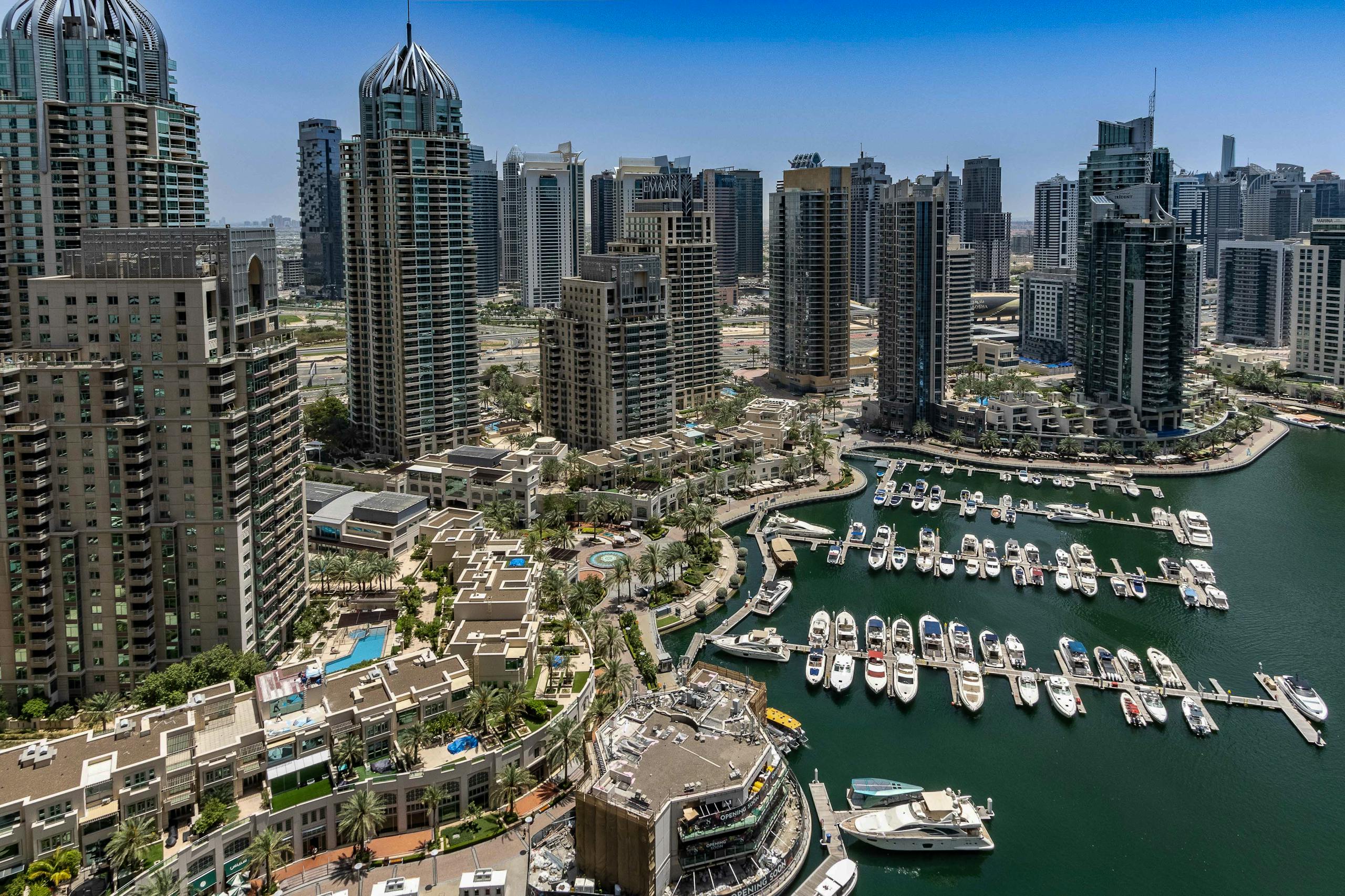

📌 Save this guide for later! Pin it to your travel or move abroad board so you can find it when you need it.
Click the image above to save directly to Pinterest.
📌 Save this guide for later! Pin it to your travel or move abroad board so you can find it when you need it.
Hover over any image in this post to pin it directly to Pinterest.
This guide covers everything you need to know about moving to Dubai as an American: visas, cost of living, best neighborhoods, what it’s really like to live there, and a step-by-step checklist to make it happen.
Why Moving to Dubai as an American Makes Sense
- Zero income tax, the UAE has no federal income tax, though Americans still owe US taxes
- High salaries, expats working in finance, tech, and consulting often earn significantly more than US equivalents
- English is everywhere, business, street signs, menus, and government offices all operate in English
- World-class infrastructure, among the best airports, roads, healthcare, and internet in the world
- Safety, Dubai consistently ranks as one of the safest cities globally
- Location hub, easy flights to Europe, Asia, and Africa from Dubai International
- Expat community, massive communities of Americans, British, Indians, and Filipinos
Visa Options for Americans Moving to Dubai
Americans get a free 30-day tourist visa on arrival in the UAE, extendable once.
For longer stays, here are your main options. See our full Digital Nomad Visas for Americans guide for the complete comparison.
UAE Remote Work Visa (Virtual Working Programme)
- Cost: ~$611 USD (AED 2,246 + fees)
- Duration: 1 year, renewable
- Requirements: Proof of remote employment (contract or employer letter), minimum monthly salary of $3,500 USD, health insurance coverage
- Work rights: Can work remotely for foreign employers; cannot work for UAE companies
- Processing time: 2-4 weeks
- Best for: Remote workers with steady foreign-employer income
UAE Golden Visa
- Cost: Varies (starting ~$2,700 USD)
- Duration: 5 or 10 years, self-renewable
- Requirements: Significant investment in UAE property ($545,000+), OR being a highly skilled professional/specialist, OR a startup founder with approved business, OR outstanding student/graduate
- Work rights: Full work rights in UAE, can sponsor family
- Best for: Long-term investors, senior executives, entrepreneurs
UAE Freelancer/Self-Employment Permit
- Cost: ~$1,500-$5,000 USD depending on free zone and business category
- Duration: 1-2 years, renewable
- Requirements: Registered with a UAE free zone (Dubai Media City, IFZA, etc.), proof of freelance income
- Work rights: Can work as freelancer/consultant for multiple clients including UAE clients
- Best for: Freelancers, consultants, creatives, coaches
Employment Visa (Sponsored by UAE Company)
- Cost: Usually paid by employer
- Duration: 2-3 years tied to employment contract
- Requirements: Job offer from UAE-registered company; company sponsors the visa and pays fees
- Work rights: Full UAE work rights for that employer
- Best for: Those with a UAE job offer in finance, tech, consulting, hospitality
Cost of Living in Dubai
Dubai is expensive, roughly similar to New York City or San Francisco, but with higher housing costs in premium areas and no income tax offsetting the spend.
Budget carefully using our How to Budget for Moving Abroad guide.
| Expense | Budget (AED/mo) | USD Approx |
|---|---|---|
| 1BR apartment (central Dubai) | AED 7,000-12,000 | $1,900-$3,270 |
| 1BR apartment (outlying areas) | AED 3,500-6,000 | $955-$1,635 |
| Groceries | AED 800-1,500 | $220-$410 |
| Eating out (mid-range) | AED 1,200-2,500 | $330-$680 |
| Transport (metro + taxi) | AED 400-900 | $110-$245 |
| Health insurance | AED 300-800 | $82-$218 |
| Utilities + internet | AED 600-1,000 | $163-$272 |
| Entertainment + lifestyle | AED 1,000-3,000 | $272-$817 |
| Total (budget) | AED 7,800 | ~$2,130/mo |
| Total (comfortable) | AED 18,000 | ~$4,900/mo |
Note: Housing is the biggest variable.
Many expats in Dubai get a housing allowance from their employer.
If you’re a remote worker, look at neighborhoods like Dubai Silicon Oasis, Jumeirah Village Circle (JVC), or Al Barsha for better value.
Best Neighborhoods in Dubai for American Expats
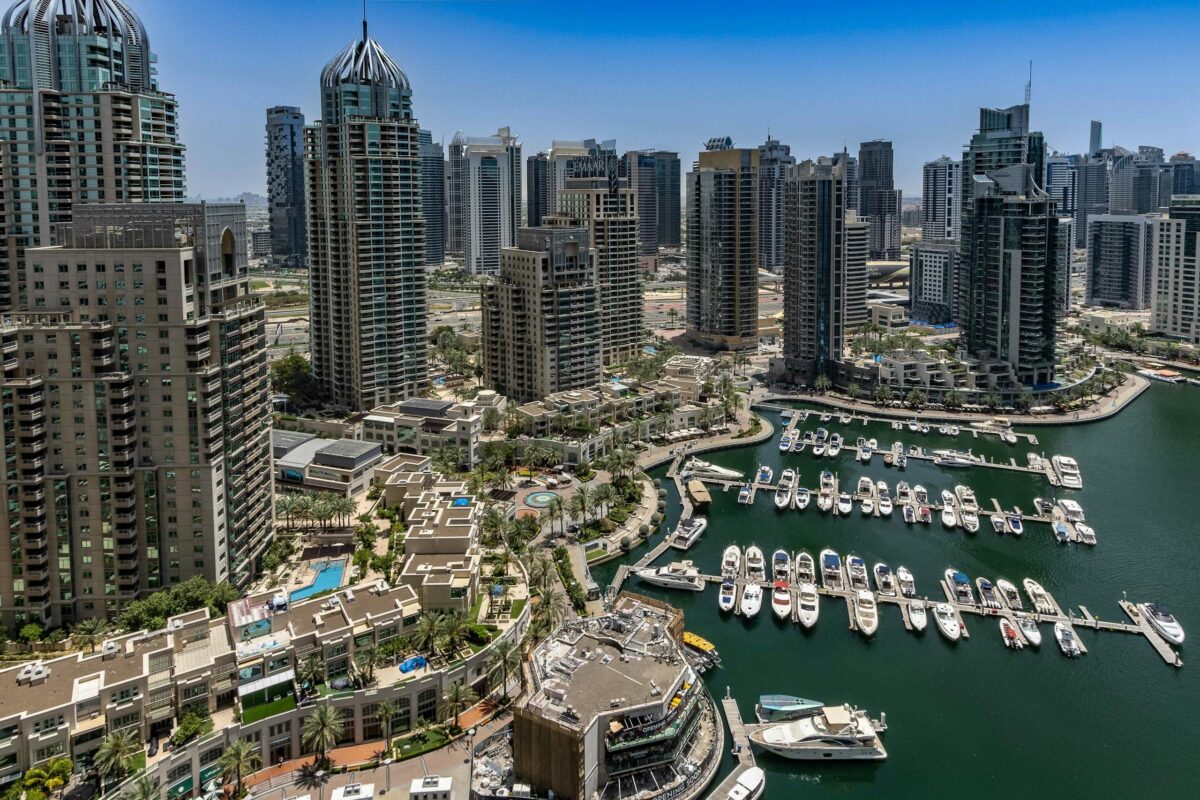
Dubai Marina
The most popular expat neighborhood.
Walkable waterfront, tons of restaurants and bars, modern high-rises. Most expensive area but the best for social life and international community feel. Metro access via the Red Line.
Jumeirah Lake Towers (JLT)
Right next to Dubai Marina but cheaper. Lots of mid-range apartments, good restaurants, metro access. Popular with younger expats and remote workers. Great value for location.
Downtown Dubai / Business Bay
Premium central location with Burj Khalifa views.
Very expensive but central to everything. Good for those working in UAE companies or who want prestige address. Business Bay has newer buildings at slightly lower prices.
Jumeirah Village Circle (JVC)
The best value for money in Dubai.
Newer buildings, quiet, family-friendly, no metro but well-connected by road. Popular with digital nomads and families who drive. Rents can be 40-50% less than Marina.
Al Barsha / Tecom
Mid-range area popular with professionals.
Close to the Mall of the Emirates and the Metro Green Line extension. Good mix of apartment quality and price. Many media and tech companies have offices here.
The Cultural Reality Check
Dubai is remarkably cosmopolitan and tolerant compared to much of the Gulf, but it’s still the UAE, with Islamic law and customs. Know these before you go:
- Alcohol: Legal in licensed venues (hotels, restaurants with liquor licenses) and regulated liquor stores. Personal alcohol purchase requires a non-Muslim liquor license (easily obtained online).
- Public behavior: Public displays of affection are frowned upon; dress modestly in malls and public areas outside beach/pool areas.
- Ramadan: Eating, drinking, or smoking in public during daylight hours during Ramadan is illegal, even for non-Muslims.
- LGBTQ+: Same-sex relationships are illegal under UAE law. American LGBTQ+ expats are present in Dubai but must exercise discretion.
- Social media: Criticizing the UAE government or ruling family online is illegal and can lead to deportation.
- Weekend: The weekend is Friday-Saturday (not Saturday-Sunday). Government offices are closed; most businesses operate shortened Friday hours.
US Taxes When Living in Dubai
The UAE has no income tax, but Americans living abroad still owe US taxes.
The good news: the Foreign Earned Income Exclusion (FEIE) lets you exclude up to ~$126,500 (2024) of foreign-earned income from US taxes.
If you pass the Physical Presence Test (330 days outside the US) or Bona Fide Residence Test, you qualify.
Moving to Dubai as an American means dealing with the UAE tax situation carefully.
The UAE has no tax treaty with the US, which means no foreign tax credits to offset US taxes on most income.
Americans should consult a US expat tax advisor, the IRS Foreign Earned Income Exclusion can help, but only covers earned income.
Moving to Dubai as an American: Your 30, 60, and 90-Day Timeline
Dubai is unlike almost any other expat destination, the infrastructure is world-class, the bureaucracy moves fast by Middle East standards, but the documentation requirements are strict and sequential.
Many steps can’t begin until the previous one is complete. Here’s the order that actually works.
90 Days Before Your Move to Dubai
Three months out is when you nail down your visa path, because in Dubai, your visa determines almost everything else.
Americans cannot just show up and sort it out; the UAE requires either employer sponsorship, a freelancer permit, the Remote Work Visa, or the Golden Visa.
Each has different income requirements, timelines, and document lists.
- Choose your visa path, the UAE Remote Work Visa requires proof of employment or business ownership and monthly income of at least $5,000. The Freelancer Permit is issued through UAE free zones (DMCC, Dubai Media City, Dubai Internet City). Golden Visa requires $545,000+ in UAE property investment or significant professional achievements. Employer-sponsored visas require a UAE job offer.
- Do a scouting trip if possible, Dubai Marina, JLT, and Downtown Dubai feel dramatically different from JVC and Al Barsha in terms of lifestyle and commute. Spend at least 10 days in your target neighborhood before signing a lease. Short-term furnished rentals via Airbnb or Booking.com are easy to find.
- Get international health insurance, Dubai requires all visa holders to have health insurance, and it’s enforced. Cigna Global, AXA International, and IMG Global Voyager are all popular with Dubai expats. Employer-sponsored visas typically include insurance; freelancers and Remote Work Visa holders must source their own.
- Open a Charles Schwab account, UAE banking works fine for daily life once you arrive, but having a USD account with no foreign transaction fees is essential for the transition period. Schwab’s investor checking reimburses all ATM fees globally.
- Start gathering documents, UAE visa applications typically require: passport (valid 6+ months), passport-size photos (white background, UAE specification), proof of income, and sometimes a background check. Requirements vary by visa type.
60 Days Before Your Move to Dubai
Two months out is when applications are submitted and housing is secured.
Dubai’s rental market moves fast, good apartments in expat neighborhoods get snapped up quickly, and most landlords require post-dated checks covering the full year (sometimes in 1-4 checks).
Having a UAE bank account helps, but isn’t always required upfront.
- Submit your visa application, timing varies by type. Remote Work Visa applications are submitted through the General Directorate of Residency and Foreigners Affairs (GDRFA) in Dubai or through authorized visa agents. Freelancer permits are applied through the relevant free zone authority. Allow 2-5 weeks for processing.
- Research housing and secure your apartment, use Property Finder or Bayut for listings. Most landlords in Dubai require rent in post-dated checks, one, two, or four checks covering the full year. Calculate your budget carefully since upfront housing costs are high. Marina and JLT run $2,000-$4,000/month for a 1BR; JVC and Al Barsha run $1,200-$2,000.
- File change of address with US institutions, IRS, Social Security, banks, and any income sources. Set up US mail forwarding (Traveling Mailbox, PostScan Mail) before you leave.
- Consult a US expat tax accountant, the UAE has no income tax, which is the major draw, but Americans still owe US taxes on worldwide income. You’ll need to file FBAR if your UAE bank accounts exceed $10,000, and understand how the Foreign Earned Income Exclusion interacts with UAE-sourced income. Do this before you move, not after.
- Join Dubai expat communities, Internations Dubai, the Facebook groups “Americans in Dubai” and “Dubai Expats” are active and practical. You’ll get current intel on visa agents, neighborhoods, and employers that no guide can give you.
30 Days Before Your Move to Dubai
Final month, your visa should be approved or in final processing, housing is locked, and you’re closing out your US commitments.
Dubai has direct flights from most major US hubs (JFK, LAX, ORD, IAD via Emirates and FlyDubai), so logistics are straightforward once the visa is in hand.
- Book your flights to Dubai (DXB), Emirates flies direct from New York (JFK), Los Angeles (LAX), Chicago (ORD), Washington (IAD), Houston (IAH), Dallas (DFW), Boston (BOS), and San Francisco (SFO). Qatar Airways and Etihad are alternatives via Doha and Abu Dhabi. Book one-way or refundable until your visa is confirmed.
- Ship essentials if needed, Dubai has world-class shopping for nearly everything, so shipping household goods rarely makes sense. Ship only irreplaceable personal items. Aramex and DHL are the most reliable for US-to-UAE shipments.
- Get an international driving permit (IDP), Americans can exchange their US driver’s license for a UAE license without a test, but you need your original US license plus an IDP initially. Apply for an IDP through AAA before leaving the US ($20).
- Unlock your US phone, Dubai’s two carriers are du and Etisalat (now rebranded as e&). Both are sold at the airport and in malls. An eSIM from Airalo covers you for the first few days.
- Digitize all documents, passport, visa approval, health insurance certificate, lease agreement (if signed in advance), and bank documents. Store in Google Drive and a password manager. Dubai’s e-government systems are efficient but require everything digitally.
Still comparing countries? Take the free country match quiz to see which countries fit your budget, language comfort and lifestyle, then compare your top options side by side.
After You Arrive: Your First 30 Days in Dubai
The first month in Dubai is the most administratively intensive of any country in this guide.
Your Emirates ID, medical test, and residence visa stamping all happen here, and most subsequent steps require your Emirates ID, so the sequence matters.
Dubai is bureaucratic but efficient; if you go in order, it moves faster than you’d expect.
- Complete your Emirates ID and medical test, within the first week, you’ll need to do a mandatory medical test (blood test and chest X-ray) at an approved MOHAP center. This is required to activate your residence visa. Results come within 1-3 days.
- Get your Emirates ID stamped and activated, your Emirates ID is issued by the ICP (Federal Authority for Identity, Citizenship, Customs and Ports Security). It’s the key document for everything in Dubai, banking, telecom contracts, healthcare, government services. Allow 5-10 days for issuance.
- Open a UAE bank account, Emirates NBD, Mashreq, and ADCB are the most expat-friendly. You’ll need your Emirates ID, passport, and residence visa stamped in your passport. Many banks also require a salary certificate or proof of income. Once open, set up your salary transfer (if employed) or link your US accounts for transfers.
- Get a UAE SIM card, buy du or Etisalat at the airport or any mall immediately. You need a UAE number for everything from banking OTPs to food delivery apps. Monthly plans start around AED 99 ($27/month) with solid data.
- Exchange your US driver’s license for a UAE license, Americans are eligible to exchange without a driving test. Visit a Roads and Transport Authority (RTA) service center with your Emirates ID, original US license, passport, and passport photos. You’ll have a UAE license within a few days.
- Set up FBAR tracking from day one, if your UAE bank account balance exceeds $10,000 at any point during the calendar year, you must file an FBAR (FinCEN Form 114) with the US Treasury by April 15. Keep records from your first deposit.
Related: Digital Nomad Visas for Americans | How to Budget for Moving Abroad | What to Pack When Moving Abroad
UAE Remote Work Visa (Virtual Working Programme)Cost: ~$611 USD (AED 2,246 + fees) Duration: 1 year, renewable Requirements: Proof of remote employment (contract or employer letter), minimum monthly salary of $3,500 USD, health insurance coverage Work rights: Can work remotely for foreign employers; cannot work for UAE companies Processing time: 2-4 weeks Best for: Remote workers with steady foreign-employer incomeUAE Golden VisaCost: Varies (starting ~$2,700 USD) Duration: 5 or 10 years, self-renewable Requirements: Significant investment in UAE property ($545,000+), OR being a highly skilled professional/specialist, OR a startup founder with approved business, OR outstanding student/graduate Work rights: Full work rights in UAE, can sponsor family Best for: Long-term investors, senior executives, entrepreneursUAE Freelancer/Self-Employment PermitCost: ~$1,500-$5,000 USD depending on free zone and business category Duration: 1-2 years, renewable Requirements: Registered with a UAE free zone (Dubai Media City, IFZA, etc.), proof of freelance income Work rights: Can work as freelancer/consultant for multiple clients including UAE clients Best for: Freelancers, consultants, creatives, coachesEmployment Visa (Sponsored by UAE Company)Cost: Usually paid by employer Duration: 2-3 years tied to employment contract Requirements: Job offer from UAE-registered company; company sponsors the visa and pays fees Work rights: Full UAE work rights for that employer Best for: Those with a UAE job offer in finance, tech, consulting, hospitalityCost of Living in Dubai Dubai is expensive, roughly similar to New York City or San Francisco, but with higher housing costs in premium areas and no income tax offsetting the spend. Budget carefully using our How to Budget for Moving Abroad guide.Expense Budget (AED/mo) USD Approx1BR apartment (central Dubai) AED 7,000-12,000 $1,900-$3,2701BR apartment (outlying areas) AED 3,500-6,000 $955-$1,635Groceries AED 800-1,500 $220-$410Eating out (mid-range) AED 1,200-2,500 $330-$680Transport (metro + taxi) AED 400-900 $110-$245Health insurance AED 300-800 $82-$218Utilities + internet AED 600-1,000 $163-$272Entertainment + lifestyle AED 1,000-3,000 $272-$817Total (budget) AED 7,800 ~$2,130/moTotal (comfortable) AED 18,000 ~$4,900/moNote: Housing is the biggest variable. Many expats in Dubai get a housing allowance from their employer. If you’re a remote worker, look at neighborhoods like Dubai Silicon Oasis, Jumeirah Village Circle (JVC), or Al Barsha for better value. Best Neighborhoods in Dubai for American Expats Dubai Marina
The most popular expat neighborhood.
Jumeirah Lake Towers (JLT)
Right next to Dubai Marina but cheaper. Lots of mid-range apartments, good restaurants, metro access. Popular with younger expats and remote workers. Great value for location.
Downtown Dubai / Business Bay
Premium central location with Burj Khalifa views.
Jumeirah Village Circle (JVC)
The best value for money in Dubai.
Al Barsha / Tecom
Mid-range area popular with professionals.
I funded my own move abroad by selling my house, my car (to CarMax), and my belongings on Facebook Marketplace and at garage sales. That firsthand experience shapes how I write about moving abroad, I am not just summarizing data, I am telling you what the numbers actually mean for someone making a real move.
Currency exchange fees eat into every international transfer. Use Wise instead of your bank for real exchange rates and low fees. Most expats save $50 to $100 per month on transfers alone.
For health coverage while abroad, SafetyWing Nomad Insurance starts at $45.08 per month for Americans under 40. It covers you in most countries and is built for long-term travelers and expats.
If you need a VPN for US streaming or public wifi security, NordVPN works well from abroad.
US tax filing does not stop when you move abroad. You still owe US taxes on worldwide income. Taxes for Expats handles US returns for Americans living abroad, and you get a $25 discount when you sign up through this link.
If you are serious about the move, grab the Move Abroad Toolkit to plan your budget, timeline, and logistics in one place.
Thinking about moving abroad? Book a Move Abroad Planning Call for personalized guidance on your relocation.
Continue Planning Your Move
Everything you need is in one place.
Free Quiz
Find Your Best Country Match
Answer a few quick questions about your budget, language comfort, lifestyle and visa needs, and see which countries fit you best.