Best Countries for Americans to Move Abroad in 2026
Some links on this site are affiliate links, which means the site may earn a commission at no extra cost to you. Services are included because they fit the move abroad process, not because of the commission.
Tax planning: Americans owe US taxes no matter where they live. Taxes for Expats specializes in US expat returns and helps you work through the Foreign Earned Income Exclusion and tax treaties for whichever country you choose, and signing up through this link gets you $25 off.
I built MoveAbroadToolkit because I’m tired of seeing Americans get bad information about something this important. I funded my own move abroad by selling my house, my car (to CarMax), and my belongings on Facebook Marketplace and at garage sales, so when I rank countries for Americans, I’m not just aggregating other people’s takes. I know what it actually costs to commit.
📋 What’s In This Guide

Best Countries for Americans to Move Abroad in 2026
Most “best countries to move abroad” lists rank places by weather and vibes. This one ranks them by what actually matters when you’re planning a real move, visa accessibility, cost of living relative to the dollar, internet reliability, safety, and whether daily life as an American is actually manageable.
I’ve spent extended time in several of these countries personally. The others I’ve researched in the kind of depth that only comes from actually planning to go there, not just writing about it.
This guide to the best countries for Americans to move abroad covers the top destinations across four categories, budget-first, Europe-focused, Africa and emerging markets, and Southeast Asia. Each one has a honest breakdown of what it costs, what visa you’d use, and what surprises people when they actually show up. If you want to see data on where Americans actually go, by country, by age group, and by motivation, that statistics roundup provides the numbers behind the patterns covered here.


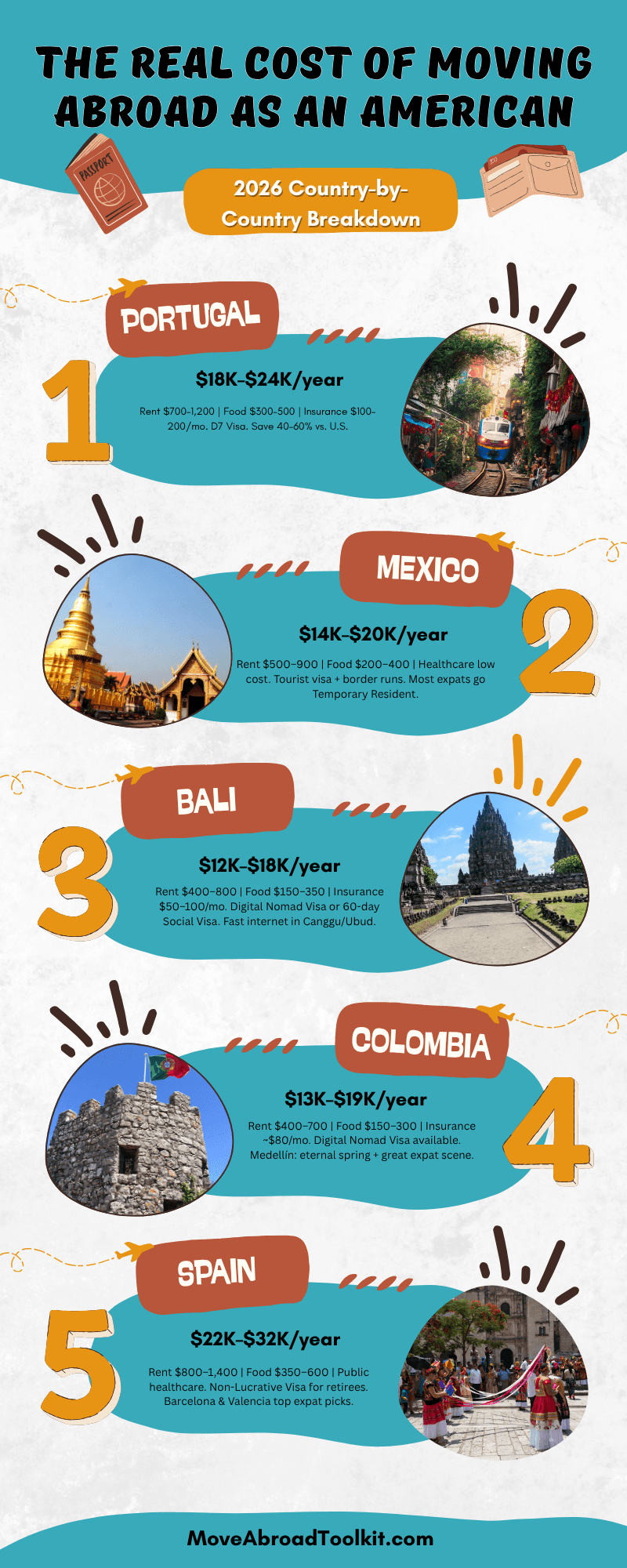
📌 Save this guide for later! Pin it to your travel or move abroad board so you can find it when you need it.
Click the image above to save directly to Pinterest.
📌 Save this guide for later! Pin it to your travel or move abroad board so you can find it when you need it.
Hover over any image in this post to pin it directly to Pinterest.
How to Pick the Best Countries for Americans to Move Abroad
Before we get into the list, let’s set the criteria, because “best” is doing a lot of work in that headline and it means something different depending on who’s asking.
Here’s what I actually weigh when evaluating a country for an American looking to relocate:
1. Dollar strength (purchasing power)
Your dollar does not behave the same in every country. In South Africa, $1 USD is worth roughly 18-19 ZAR, meaning a good sit-down dinner costs you about $8-12. In France, that same dollar is close to parity with the euro, and that same dinner is $25-40. Same income. Completely different quality of life. Purchasing power is the single most important factor most people forget to calculate.
2. Visa accessibility for Americans
Some countries make it genuinely easy for Americans to live legally, low income requirements, straightforward paperwork, fast processing. Others have technically available visas that are bureaucratic nightmares. I’ll note both the visa type and the realistic difficulty.
3. Cost of living in a non-tourist area
Tourist pricing and local pricing are not the same thing. A 1-bedroom in the tourist center of Lisbon is not representative of what an expat actually pays after their first month. I’m using local market pricing, not vacation rental pricing.
4. Internet reliability
Non-negotiable for remote workers. I’m looking at average download speeds and how consistent they are outside of the capital city. Once you land, a VPN is a smart addition, NordVPN lets you access US-based streaming services and keeps your banking apps from flagging foreign IP addresses.
5. Safety, with context
Crime statistics without context are useless. A country with a high overall crime rate may have extremely safe expat neighborhoods. I’ll give the nuanced version, not the headline version.
6. English accessibility in daily life
This isn’t about whether people speak English at tourist sites. It’s about whether you can navigate a doctor’s appointment, a lease signing, or a government office without a translator.
Best Budget Countries for Americans (Under $2,000/mo)
🇲🇽 Mexico, Best Overall for Budget + Proximity
Monthly cost estimate: $1,200-$1,800 for a comfortable lifestyle
Best cities: Mexico City, Mérida, Oaxaca, Puerto Escondido, San Miguel de Allende
Visa to use: Temporary Resident Visa (income requirement ~$1,620/mo)
Dollar strength: Strong, 1 USD = ~17-18 MXN
Mexico is the most practical choice for most Americans, and not just because of the cost.
You’re in the same time zone or close to it (depending on where you land), flights home are cheap, and the Temporary Resident Visa has one of the lowest income requirements of any long-stay visa in the world. Mexico City specifically has become one of the most established remote work hubs in the western hemisphere, with co-working spaces, strong expat communities, and a food scene that will ruin you for American food permanently.
The knock on Mexico is safety, and it deserves an honest answer rather than a dismissal. Violence in Mexico is highly concentrated geographically and is largely cartel-related, not random. Neighborhoods like Roma Norte, Condesa, and Polanco in CDMX have crime rates comparable to many US cities. Mérida consistently ranks as one of the safest cities in all of Latin America.
The mistake is treating “Mexico” as one monolithic safety situation rather than researching the specific city and neighborhood you’re considering.
What surprises people: How good the healthcare is. Mexico has both a public system and private hospitals that are excellent quality at a fraction of US costs. Many Americans pay out of pocket for private care and still spend less than their US insurance premiums.
Best for: First-time movers, people who want to stay US-adjacent, remote workers who need US time zone overlap, anyone who wants a trial run before committing to a further destination.
💡 Real cost check: (Source: Numbeo via our resources page) A furnished 1BR in Roma Norte (CDMX) runs roughly $700-$1,100/mo. Add groceries ($200-300), eating out 3-4x/week ($150-250), transport ($30-60 on Uber/Metro), and you’re at $1,100-$1,700 all-in for a comfortable life in one of the most exciting cities in the world.
🇨🇴 Colombia, Best for Culture + Value
Monthly cost estimate: $1,100-$1,700
Best cities: Medellín, Cartagena, Bogotá, Santa Marta
Visa to use: Digital Nomad Visa or Pensionado Visa (~$750/mo for pensionado)
Dollar strength: Very strong, 1 USD = ~4,000 COP
Colombia has gone through one of the most significant reputation transformations of any country in the last 20 years, and for good reason. Medellín in particular has become a genuine expat hub with incredible infrastructure, a Metro system, world-class coffee, and a cost of living that makes your dollar feel like a superpower. The Digital Nomad Visa (Nómada Digital) is relatively new and has one of the more reasonable income requirements in the region.
Bogotá is for people who want a proper capital city experience, it’s large, culturally rich, and has every amenity you’d expect. Medellín is for people who want perfect weather (it sits at 5,000ft elevation and is called the “City of Eternal Spring” for a reason, around 72°F year-round), a strong expat community, and a slightly slower pace.
What surprises people: The altitude in Bogotá (8,600ft) genuinely affects people for the first week. Budget for an acclimatization period and don’t plan intense activity in the first few days.
Best for: People who want strong value without sacrificing quality of life, coffee lovers, anyone drawn to Latin culture and nightlife, retirees with pension income (Pensionado visa is one of the easiest in the region).
🇬🇭 Ghana, Best for the African Diaspora + Emerging Market Value
Monthly cost estimate: $900-$1,500
Best cities: Accra, Cape Coast
Visa to use: Right of Abode (for those of African descent), Tourist + Right to Abode application, or standard long-stay
Dollar strength: Very strong, though the Ghanaian Cedi has faced inflation pressure
English: Official language, no language barrier
Ghana is one of the most politically stable countries in West Africa, English is the official language, and the government has actively courted the African diaspora through the “Year of Return” initiative and subsequent Beyond the Return campaign. For Black Americans especially, Ghana represents something most countries on this list don’t, a place where you may feel less like an outsider and more like someone returning.
Accra is a proper capital city with good infrastructure, growing expat communities, and a creative/entrepreneurial energy that’s attracting people from around the world. The food scene is underrated. The weather is hot and humid year-round, this is not a mild climate, and it will take adjustment.
What surprises people: Load-shedding (scheduled power outages) is real and affects daily life. Most serious expats invest in a generator or UPS system, which adds to monthly costs. Factor this into your budget.
Best for: African diaspora looking to connect with roots, people drawn to Anglophone West Africa, entrepreneurs interested in emerging markets, anyone who wants to be genuinely early to a destination before it becomes the next expat hotspot.
Best Countries in Europe for Americans
🇵🇹 Portugal, Best Overall in Europe
Monthly cost estimate: $1,800-$2,800 (Lisbon/Porto); $1,200-$1,800 (smaller cities)
Best cities: Lisbon, Porto, Braga, the Algarve, the Azores
Visa to use: D7 Passive Income Visa (~$830/mo income) or Digital Nomad Visa (~$3,480/mo)
Dollar strength: Moderate, USD close to parity with EUR
Path to EU residency: Yes, 5 years to permanent residency, 6 to citizenship
Portugal is the most popular European destination for American expats right now, and the popularity is earned. English is widely spoken (especially among younger people and in cities), the country is genuinely safe (it consistently ranks in the top 5 globally on the Global Peace Index), the food and wine are exceptional, and the bureaucracy for visa applications, while not painless, is more manageable than many EU countries.
The D7 visa is the most accessible for Americans who don’t meet the Digital Nomad income threshold. It requires demonstrating passive income, pension, rental income, or savings, not necessarily active remote work. The income requirement (~$830/mo for a single applicant) is low by any standard, making it accessible even for people early in their financial runway.
Lisbon has gotten expensive relative to what it was five years ago, this is real and worth acknowledging. A 1BR in central Lisbon now runs $1,200-$1,800/mo, which is no longer the “affordable Europe” story people heard in 2018. But Porto is still genuinely affordable ($800-$1,300), and smaller cities like Braga or Setúbal offer even better value with good infrastructure.
What surprises people: The bureaucracy. Portugal is lovely and the people are warm, but government processes move slowly and the SEF (immigration office) wait times can be long.
Apply for your NIF (tax number) and bank account before you arrive if possible. Hire a relocation lawyer, it’s worth the cost for the time it saves. For banking, Wise and Charles Schwab are the two accounts every American expat needs before they land.
Best for: People who want a European base with a path to EU citizenship, retirees, remote workers with stable income, anyone who values safety and quality of life over nightlife and excitement.
💡 Schengen note: Once you have a Portuguese residence permit, you can travel freely throughout the Schengen area without counting against your 90-day tourist limit. This is a major reason people pursue EU residency specifically.
🇪🇸 Spain, Best for City Life in Europe
Monthly cost estimate: $2,000-$3,000 (Madrid/Barcelona); $1,400-$2,000 (Valencia, Seville, Málaga)
Best cities: Valencia, Seville, Málaga, Madrid, Barcelona
Visa to use: Digital Nomad Visa (~$2,800/mo income) or Non-Lucrative Visa (passive income)
Dollar strength: Moderate, USD/EUR near parity
Spain gets everything right about daily life in Europe, the food culture, the pace, the architecture, the weather (especially in the south and Valencia), and the sheer variety of lifestyle options across different cities. Valencia is consistently ranked one of the best cities in the world for quality of life and is significantly cheaper than Madrid or Barcelona while still offering everything a major city should.
The Digital Nomad Visa launched in 2023 and has been well-received. The income requirement (~$2,800/mo) is lower than Portugal’s DNV, and processing is generally faster. The Non-Lucrative Visa is an alternative for those with passive income who don’t want to demonstrate remote work income.
What surprises people: The Spanish bureaucracy is real. Getting your NIE (foreigner identification number) can take weeks and requires an appointment that books out far in advance. Plan this well ahead of your move date.
Best for: People who want European culture with better weather than northern Europe, food and nightlife focused movers, families (Spain has excellent schools and healthcare), anyone who wants to be in the EU without the rain of the UK or northern Europe.
Romania, Europe’s Hidden Value Pick for Americans
Romania offers EU access at Eastern European prices. Bucharest runs $900-1,500/month for a comfortable expat life. Cluj and Timisoara cost less. English is widely spoken. Fast internet and a growing digital nomad community make it work well for remote workers. See the complete guide: Living in Romania as an American.
Best Countries in Africa for Americans

🇿🇦 South Africa, Best for Dollar Strength + Natural Beauty
Monthly cost estimate: $1,200-$2,000 for an excellent lifestyle
Best cities: Cape Town, Johannesburg, Stellenbosch
Visa to use: Long Stay Visa (up to 3 years) or Critical Skills Visa
Dollar strength: Very strong, 1 USD = ~18-19 ZAR
English: One of 12 official languages, widely spoken in cities
I’ve spent significant time in South Africa across multiple visits, including securing a long-stay visa, so this one I can speak to with real specificity rather than research alone.
The dollar goes further in South Africa than almost anywhere else on this list. Cape Town specifically is one of the most beautiful cities in the world, Table Mountain as a backdrop, world-class wine country (Stellenbosch and Franschhoek) 45 minutes away, incredible beaches, and a restaurant scene that would hold its own in any major global city.
A furnished apartment in a safe Cape Town neighborhood like Sea Point or Green Point runs $600-$1,000/mo. A dinner at a genuinely excellent restaurant with wine is $20-30 per person.
Johannesburg is a different experience, it’s a business city, fast-paced, entrepreneurial, and the cultural heartbeat of South Africa. The Apartheid Museum, Soweto, and Maboneng are worth weeks of exploration. Joburg requires more intentionality about which neighborhoods you’re in, it’s a city where knowing your areas matters more than it does in Cape Town.
The honest challenge with South Africa is load-shedding (Eskom power outages), which has been a significant issue in recent years and affects daily life in real ways. Most expats invest in an inverter/battery system or choose accommodation that already has backup power.
This is a real cost and inconvenience to factor in, but it hasn’t deterred serious expats because the trade-off (dollar strength, beauty, culture) is still overwhelmingly positive.
What surprises people: How genuinely excellent the food and wine is. People come expecting developing-world food culture and find world-class cuisine. Also: the diversity, South Africa is one of the most culturally complex societies on earth, and experiencing that complexity is part of what makes living there so different from anywhere else.
Best for: People who want exceptional value, outdoor lovers, wine enthusiasts, anyone interested in one of the most historically and culturally significant countries in the world, people who want African residency without the language barrier.
🇲🇺 Mauritius, Best for Remote Workers Wanting Island Life with Infrastructure
Monthly cost estimate: $1,500-$2,500
Visa to use: Premium Visa (long-stay, up to 1 year, renewable), no income requirement
Dollar strength: Strong, 1 USD = ~45 MUR
English: Official language alongside French and Mauritian Creole
Mauritius is one of the most underrated destinations on this list. It’s a small island nation off the east coast of Africa with excellent infrastructure, political stability, English as an official language, and a Premium Visa that is genuinely easy to obtain, no income minimum, just proof you can support yourself. The cost of living is higher than mainland Africa but the quality of life, beaches, safety, infrastructure, internet, justifies it for the right person.
Best for: Remote workers who want island living without sacrificing infrastructure, people interested in Africa who want a gentler entry point, anyone who values political stability above all.
Best Countries in Southeast Asia for Americans
Connectivity tip for Southeast Asia: Get an Airalo eSIM before you fly, it activates on landing and works across Thailand, Indonesia, and most of the region without needing a physical SIM swap.
🇹🇭 Thailand, Best for Infrastructure + Value in Asia
Monthly cost estimate: $1,000-$1,800 (Chiang Mai); $1,400-$2,200 (Bangkok)
Best cities: Chiang Mai, Bangkok, Koh Lanta, Pai
Visa to use: LTR Visa, Remote Worker category ($80,000/yr income) or Tourist Visa + border runs
Dollar strength: Very strong, 1 USD = ~35 THB
Thailand has been the original digital nomad hub for a reason, the infrastructure is excellent, the food is world-class and cheap, the internet is reliable, and the culture around remote work and expats is well-established. Chiang Mai specifically has one of the most developed expat/nomad communities in the world, with co-working spaces, expat Facebook groups, English-speaking doctors, and a support network that makes the transition genuinely easy.
The LTR (Long Term Resident) Visa launched in 2022 and is excellent for those who qualify, but the income threshold ($80,000/yr) is high. Many people do Thailand on tourist visas with border runs, which is technically a gray area. It works, but it’s not a stable long-term legal basis and can create issues if you’re trying to open a bank account or sign a lease.
What surprises people: Tourist Thailand and daily-life Thailand are genuinely different. The streets outside the tourist zones look, feel, and cost completely differently. This is exactly why scouting trips matter, going to Chiang Mai as a tourist and going as someone testing whether they can live there are different experiences.
Best for: Digital nomads, people who want the most established expat infrastructure in Asia, food lovers, anyone who wants to be early to Thailand’s LTR visa program.
🇮🇩 Bali, Indonesia, Best for Lifestyle + Community
Monthly cost estimate: $1,000-$1,800 (Canggu/Seminyak); $600-$1,000 (Ubud, Uluwatu)
Best areas: Canggu, Ubud, Uluwatu, Seminyak
Visa to use: Social/Cultural Visa (60 days, extendable to 180) or Second Home Visa (5-10 years)
Dollar strength: Very strong, 1 USD = ~15,800 IDR
Bali has an almost absurd density of expats, remote workers, and digital nomads, which is both its greatest strength and its most honest limitation. The infrastructure built up around that community (co-working spaces, Western cafes with fast wifi, yoga studios, health food restaurants) is unmatched anywhere in Southeast Asia. If community and lifestyle amenities matter to you, nowhere on this list delivers them as consistently as Canggu does.
The limitation: Bali is Bali. It’s a small island and you’ll start to feel that after a few months. The traffic in Canggu has gotten genuinely bad as the area has developed. And the visa situation requires some navigation, there’s no straightforward digital nomad visa, though the Second Home Visa (which requires showing $130,000 in a bank account) is a long-term option for those who qualify.
Best for: First-time Asia movers, people who want strong expat community, wellness and lifestyle focused people, surfers.
Best Countries in Latin America
🇨🇷 Costa Rica, Best for Nature + Ease of Transition
Monthly cost estimate: $1,500-$2,500
Best areas: San José, Tamarindo, Santa Teresa, La Fortuna
Visa to use: Digital Nomad Visa ($3,000/mo income) or Rentista Visa ($2,500/mo passive income)
Dollar strength: Moderate, 1 USD = ~500 CRC
Costa Rica is the easiest transition in Latin America for most Americans, the infrastructure is the best in Central America, English is widely spoken in tourist and expat areas, the US dollar is accepted almost everywhere alongside the colón, and the pura vida culture genuinely permeates daily life. Health insurance for expats is straightforward here, SafetyWing covers Costa Rica and is accepted at most private clinics in a way that makes slowing down feel natural rather than forced. The biodiversity is extraordinary, you can be at a cloud forest, a volcano, and a Pacific beach within the same day.
It’s not the cheapest place to live abroad, but it’s the most friction-free. For people who want to move abroad without a steep adjustment curve, Costa Rica is the answer.
Best for: Families, nature lovers, people who want the easiest US-to-abroad transition, anyone who wants to be close to the US without being in it.
🇵🇦 Panama, Best for Retirees and Financial Infrastructure
Monthly cost estimate: $1,500-$2,500
Best areas: Panama City, Boquete, Bocas del Toro
Visa to use: Pensionado Visa ($1,000/mo pension), one of the best retirement visas in the world
Dollar strength: Panama uses USD, no exchange rate to worry about
English: Widely spoken in Panama City
Panama is unique on this list for two reasons: it uses the US dollar, eliminating any currency exchange complexity, and the Pensionado Visa is one of the most generous retirement visas in the world, offering significant discounts on healthcare, entertainment, hotels, airlines, and restaurants for qualifying retirees. If you have $1,000/month in pension income, you qualify. The process is straightforward and the country has a well-established expat infrastructure built up over decades.
Panama City is a proper modern city with skyscrapers, world-class restaurants, and a financial sector that makes international banking unusually easy. Boquete is a mountain town with cooler weather (a relief from the tropical coast) and a large, well-established expat community of mostly Americans and Canadians.
Best for: Retirees with pension income, people who want USD stability, anyone who values financial infrastructure and easy banking.
Frequently Asked Questions
What is the easiest country for Americans to move to?
Mexico is generally the easiest country for Americans to move to, it has one of the lowest income requirements for a long-stay visa (~$1,620/month), shares time zones with the US, flights home are cheap, and English is widely spoken in expat areas. Panama is the easiest for retirees specifically, with the Pensionado Visa requiring just $1,000/month in pension income.
Which country is the most affordable for Americans to live in?
Among the best countries for Americans to move abroad on a budget, Colombia, Mexico, South Africa, Thailand, and Indonesia (Bali) consistently offer the best value for Americans, with monthly budgets of $1,000-$1,800 covering a comfortable lifestyle. South Africa in particular offers exceptional purchasing power because the US dollar is worth roughly 18-19 South African Rand, making everyday expenses significantly cheaper than they appear on paper.
Do I need a visa to move abroad as an American?
Yes, if you plan to stay longer than the tourist allowance (typically 30-90 days depending on the country), you need a long-stay visa. The type of visa depends on your income source: remote workers often use digital nomad visas, those with passive income or pension use retirement or passive income visas, and some countries have specific long-stay visas for people with sufficient savings. See our full visa guide for a breakdown by country.
What is the best country in Europe for Americans to move to?
Portugal is consistently the top choice for Americans moving to Europe, it has the most accessible long-stay visa (D7 passive income visa requires only ~$830/month), English is widely spoken, it’s one of the safest countries in the world, and it offers a path to EU citizenship after 5 years of residency. Spain (especially Valencia) is a strong second for those who want better weather and more city energy.
How much money do I need to move abroad as an American?
It depends entirely on the country. In Southeast Asia or Latin America, a comfortable life can cost $1,000-$1,800/month. In Portugal or Spain, budget $1,800-$2,800/month. In addition to monthly expenses, plan for 3 months of buffer before you go to cover setup costs, deposits, and surprises. Many Americans fund their move by liquidating assets, selling their house, car, and belongings, rather than relying solely on remote income.
How to Actually Choose Your Country
Reading a list like this can create decision paralysis rather than clarity. Here’s how to actually narrow it down.
Step 1: Start with your visa eligibility
Your income source determines which visas you qualify for. Visit our Visa Options hub to see every major visa type broken down by income requirement and country. Remote worker income opens some doors (Digital Nomad visas). Passive income, pension, or savings opens others (D7, Pensionado, Rentista). Before you fall in love with a country, make sure you can legally stay there.
Step 2: Calculate purchasing power, not sticker price
Don’t just look at the monthly cost estimate. Look at the exchange rate and what that means for your specific income. $3,000/month in Cape Town is a very comfortable life. $3,000/month in Lisbon is comfortable but not extravagant. $3,000/month in Paris is a stretch. Same number, completely different life.
Step 3: Do a scouting trip before you commit
This is non-negotiable. I did scouting trips in South Africa and France before committing to extended stays in both. The version of a country you experience as a tourist is genuinely different from the version you experience doing your laundry, grocery shopping, and navigating a bureaucratic appointment. A 2-4 week scouting trip where you live like a local, our Start Here guide walks through exactly how to structure one, not a tourist, is the best money you’ll spend in this process.
Step 4: Take the quiz
If you’re still stuck, the Country Finder Quiz on this site walks you through 7 questions and matches you with your top 3 countries based on budget, lifestyle, visa needs, and pace. It takes 2 minutes and cuts through the paralysis.
Ready to figure out where you’re going?
Take the free Country Finder Quiz and get matched to your top destinations, plus get the M.O.V.E. Method™ guide sent to your inbox.
Thinking about moving abroad? Book a Move Abroad Planning Call for personalized guidance on your relocation.
Continue Planning Your Move
Everything you need is in one place.
Free Quiz
Find Your Best Country Match
Answer a few quick questions about your budget, language comfort, lifestyle and visa needs, and see which countries fit you best.