
Advantages and Disadvantages of Living Abroad: What to Expect (2026)
Some links on this site are affiliate links, which means the site may earn a commission at no extra cost to you. Services are included because they fit the move abroad process, not because of the commission.
You’ve been thinking about it. Maybe you’re burned out, priced out, or just tired of the script. Moving abroad sounds like the answer — and honestly? For a lot of Americans, it is. But understanding the real advantages and disadvantages of living abroad is the first step.
But before you list your furniture on Facebook Marketplace, you need the full picture. The advantages and disadvantages of living abroad are real — and nobody does you any favors by overselling one side.
This is the honest breakdown of the advantages and disadvantages of living abroad — what actually gets better, what actually gets harder, and how to know whether it’s the right move for you.

📋 What’s In This Guide
- The Real Advantages of Living Abroad
- The Real Disadvantages of Living Abroad
- The Advantages and Disadvantages of Living Abroad: Side by Side
- Who Should Actually Move Abroad
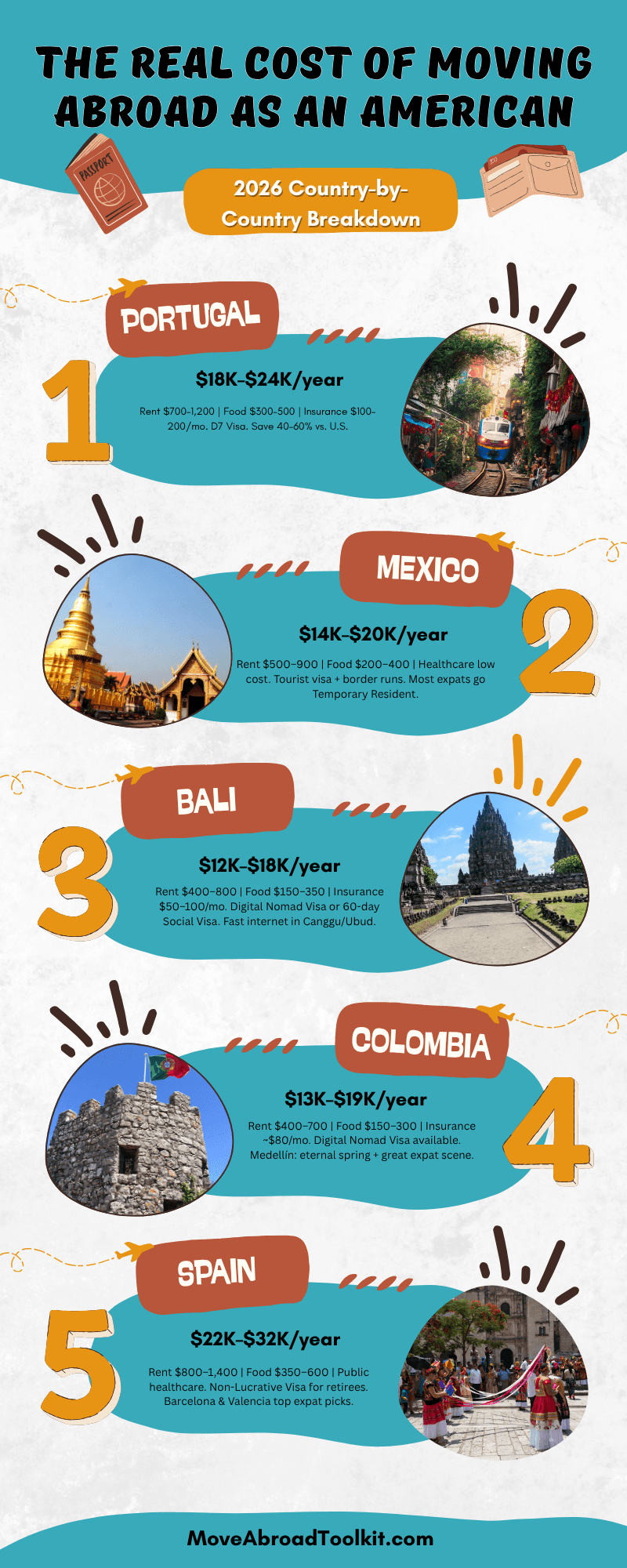
- The Best Countries for Americans Moving Abroad
-

📌 Save this guide for later! Pin it to your travel or move abroad board so you can find it when you need it.
Tap the button below, or on a computer, hover over any image to pin it.

What are the biggest advantages of living abroad as an American?
The top advantages include significantly lower cost of living in many countries, access to affordable healthcare, personal growth through cultural immersion, new career opportunities, a slower pace of life, and the chance to build genuine independence. Many Americans find their savings stretch two to three times further abroad.
What are the main disadvantages of living abroad?
Common challenges include being far from family and friends, navigating bureaucracy in a foreign language, culture shock and loneliness in the first few months, complicated US tax obligations, difficulty accessing familiar products and services, and the emotional toll of feeling like a perpetual outsider. Healthcare quality can also vary significantly by country.
Is living abroad cheaper than living in the United States?
In most popular expat destinations, yes. Countries like Mexico, Portugal, Thailand, Colombia, and many parts of Southeast Asia offer a significantly lower cost of living than the US. A comfortable lifestyle that might cost $4,000 to $5,000 per month in the US can often be achieved for $1,500 to $2,500 in these countries, including rent, food, and healthcare.
How do I deal with homesickness when living abroad?
Building a local social circle is the most effective strategy. Join expat communities, take language classes, find coworking spaces, and maintain regular video calls with family and friends back home. Many expats find that homesickness peaks around months two to four and gradually eases as routines develop. Planning visits home also helps manage the emotional distance.
Do Americans still have to pay US taxes while living abroad?
Yes. The US taxes citizens on worldwide income regardless of where they live. However, the Foreign Earned Income Exclusion allows qualifying Americans to exclude up to $132,900 (2026) from federal income tax. Self-employment tax still applies. Filing requirements become more complex abroad, so working with a US expat tax specialist is strongly recommended.
What is the best country for Americans to move to?
There is no single best country — it depends on your priorities. Portugal offers affordable living and a path to EU residency. Mexico provides proximity to the US and low costs. Thailand offers extremely low costs and great food. Spain combines culture with digital nomad visa options. The right choice depends on your income, visa eligibility, healthcare needs, and lifestyle preferences.
The Real Disadvantages of Living Abroad
The Logistics Are Genuinely Complicated
Visas, residency permits, taxes, banking — the administrative side of moving abroad is real work. Most countries don’t make it easy for foreigners to stay legally long-term. You’ll need to research visa options, track renewal dates, potentially hire a local immigration lawyer, and deal with bureaucracy that doesn’t always translate (word for word or figuratively).
US taxes are their own layer. Americans are taxed on worldwide income regardless of where they live — meaning you still file with the IRS even if you haven’t set foot in the US for three years. The Foreign Earned Income Exclusion helps, but you need to understand it and apply it correctly. This is not optional, and it’s not intuitive.
Among the advantages and disadvantages of living abroad, logistics rank as one of the most frustrating realities. None of this is insurmountable. But it’s not a detail — it’s a recurring part of expat life, and you need to budget time and sometimes money for it.
Relationships Are Hard From Far Away
Time zones make casual connection harder. You miss things: funerals, weddings, the slow accumulation of dinners and Sunday mornings that keep friendships intact. Family relationships shift when the physical proximity that maintained them disappears.
Some expats handle this well — they build strong local connections and stay meaningfully in touch with people at home. Others find the distance erodes relationships faster than expected. Honest expats will tell you this is one of the harder parts, and it doesn’t get better by pretending it’s not real.
This is one of the most significant disadvantages on any list of advantages and disadvantages of living abroad. If you have aging parents, young children who need grandparent involvement, or close friendships that depend on physical presence, this disadvantage carries real weight. Factor it in seriously.
Belonging Takes a Long Time to Build
You can get to know a city in months. Belonging to a community takes years. The expat social scene — especially in popular destinations like Lisbon or Mexico City — can feel transient. People move in, build connections, and move on. You might find yourself rebuilding your social circle every 12–18 months.
Deep friendships with locals are possible but often slower to form, especially if you don’t speak the language well. This isn’t a reason not to move — but it’s worth going in with realistic expectations about the social timeline. Most expats say year one is exciting, year two is when it gets harder, and year three is when it starts to feel like actual home.
Career Progression Can Stall
If you work remotely for a US company and your role is stable, this may not apply. But if you’re in a career where visibility, networking, and in-person presence matter — management track, client-facing roles, most industries that aren’t fully remote — living abroad can put you at a disadvantage.
You’re not in the room. You’re not at the happy hour. You don’t get the informal conversations that precede promotions. Some people mitigate this by flying home quarterly; others restructure their careers around remote-compatible roles. But the disadvantage is real and worth naming, especially if you’re earlier in your career and still building your professional reputation.
The Honeymoon Ends
When weighing the advantages and disadvantages of living abroad, the honeymoon phase deserves honest attention. The first few months abroad are usually great. Everything is new, slightly exotic, and you’re still comparing it to the life you left. Then the novelty wears off. The grocery store stops being charming and starts being inconvenient. The language barrier stops being a fun challenge and starts being exhausting. The bureaucracy stops being a story and starts being a problem.
This is normal. It doesn’t mean the move was a mistake. But the version of living abroad that looks like a permanent vacation exists on Instagram, not in reality. The people who stay long-term are the ones who got past the honeymoon phase and found something durable underneath it.
The Advantages and Disadvantages of Living Abroad: Side by Side
| Factor | Advantage | Disadvantage |
|---|---|---|
| Cost of living | Significantly lower in most expat destinations | Depends on destination and your income source |
| Healthcare | Affordable private care in most countries | Quality varies; US care is more advanced in some areas |
| Relationships | Fresh community, new perspectives | Distance strains existing friendships and family ties |
| Career | Remote work opens global options | In-person careers can stall; visibility matters |
| Daily life quality | Slower pace, better work-life balance in many places | Bureaucracy, language barriers, navigating systems |
| Personal growth | Significant — resilience, perspective, adaptability | Can be destabilizing before it becomes stabilizing |
| Taxes/legal | Possible tax advantages with proper planning | US worldwide taxation still applies; complexity is real |
Who Should Actually Move Abroad
After reviewing all the advantages and disadvantages of living abroad, the benefits outweigh the downsides for people who meet most of these criteria. If you’re weighing this decision using data rather than anecdotes, 47 data points on Americans abroad give a clearer picture of who’s moving, where they’re going, and what’s driving the trend in 2026.
- You earn remotely in USD, GBP, EUR, or another strong currency
- Your closest relationships can handle distance with effort from both sides
- You’re motivated by something specific — cost of living, healthcare, pace of life, cultural experience — not just escape
- You’re willing to do the administrative work: visas, taxes, banking, insurance
- You’re okay with rebuilding your social life from scratch, at least initially
If several of those aren’t true, the disadvantages will feel larger than the advantages. That’s not a judgment — it’s just math about what moving abroad actually requires.
The Best Countries for Americans Moving Abroad
If you’ve weighed the advantages and disadvantages and you’re ready to move, these are the destinations most Americans actually end up in — and why:
- Portugal — Strong expat infrastructure, affordable compared to Western Europe, English widely spoken, D7 and digital nomad visas available. Full Portugal guide here.
- Mexico — Closest time zone to the US, excellent healthcare, massive expat communities in Mexico City, Oaxaca, and Puerto Vallarta, no long-term visa required for many stays. Full Mexico guide here.
- Spain — Digital nomad visa launched in 2023, high quality of life, strong infrastructure, popular with Americans who want European culture with a social scene. Full Spain guide here.
- Colombia — Medellín and Bogotá are increasingly popular for cost of living, climate, and improving safety. Low cost, strong internet, easy residency pathways.
- Thailand — Chiang Mai is one of the original digital nomad hubs. Very low cost of living, excellent food, strong expat community, complex visa situation that requires planning.
- Romania — One of the most affordable EU countries for Americans. Bucharest and Cluj-Napoca offer fast internet, modern infrastructure, and a growing expat scene at a fraction of Western Europe costs. See: Living in Romania as an American.
Ready to narrow down where to go? Find your best country match with the free quiz. It asks about your budget, language comfort, lifestyle and visa needs, then points you to the countries worth a closer look.
Frequently Asked Questions
What are the biggest advantages of living abroad as an American?
When considering the advantages and disadvantages of living abroad, the three biggest positives are cost of living (your dollar goes significantly further in most expat destinations), healthcare access and affordability, and quality of life — particularly a slower pace and better work-life balance. For remote workers earning in USD, the financial advantages alone can be transformative.
What are the most common disadvantages of living abroad?
The most commonly cited are distance from family and friends, administrative complexity (visas, US taxes, banking), the social isolation of the first year, and for people in traditional careers, reduced visibility and networking opportunities. The transition period is also consistently harder than people expect.
Do Americans still pay US taxes when living abroad?
Yes. The US taxes citizens on worldwide income regardless of residency. You’re still required to file with the IRS even if you live full-time in another country. The Foreign Earned Income Exclusion (FEIE) can exclude up to $126,500 (2024) of foreign-earned income from US taxation, but you need to qualify and file correctly. Consult a tax professional with international experience before assuming you’re off the hook.
How long does it take to feel settled when living abroad?
Most expats describe a consistent pattern: the first 3–6 months are exciting, months 6–18 are often the hardest (novelty wears off, social connections are thin, bureaucracy is ongoing), and years 2–3 are when it starts to feel like actual home. Plan for the middle stretch to be difficult, and it tends to go better than if you expect the honeymoon to last.
Understanding the advantages and disadvantages of living abroad is just the first step — the real work is finding the right country, visa path, and financial setup for your situation. Explore the best countries for Americans to move abroad and our guide to digital nomad visas for Americans to start planning your move.
Ultimately, the decision to move abroad is deeply personal. Understanding the advantages and disadvantages of living abroad gives you the foundation you need — but only you can weigh what matters most in your own life. Some people discover that the freedom, cost savings, and cultural richness outweigh every challenge. Others find that proximity to family and career stability are non-negotiable.
Neither answer is wrong. The advantages and disadvantages of living abroad are real on both sides, and the more honestly you examine them, the better your outcome will be. Whether you move for a year or forever, start with solid research, build your financial runway, and take it one step at a time.
I funded my own move abroad by selling my house, my car (to CarMax), and my belongings on Facebook Marketplace and at garage sales. That firsthand experience shapes how I write about moving abroad, I am not just summarizing data, I am telling you what the numbers actually mean for someone making a real move.
Currency exchange fees eat into every international transfer. Use Wise instead of your bank for real exchange rates and low fees. Most expats save $50 to $100 per month on transfers alone.
For health coverage while abroad, SafetyWing Nomad Insurance starts at $45.08 per month for Americans under 40. It covers you in most countries and is built for long-term travelers and expats.
If you need a VPN for US streaming or public wifi security, NordVPN works well from abroad.
US tax filing does not stop when you move abroad. You still owe US taxes on worldwide income. Taxes for Expats specializes in expat tax returns and can save you from expensive mistakes.
If you are serious about the move, grab the Move Abroad Toolkit to plan your budget, timeline, and logistics in one place.
Thinking about moving abroad? Book a Move Abroad Planning Call for personalized guidance on your relocation.
Continue Planning Your Move
Everything you need is in one place.
Free Quiz
Find Your Best Country Match
Answer a few quick questions about your budget, language comfort, lifestyle and visa needs, and see which countries fit you best.